
Categories
Uncategorized

415V 3 Phase Generator

415V 3 Phase Generator

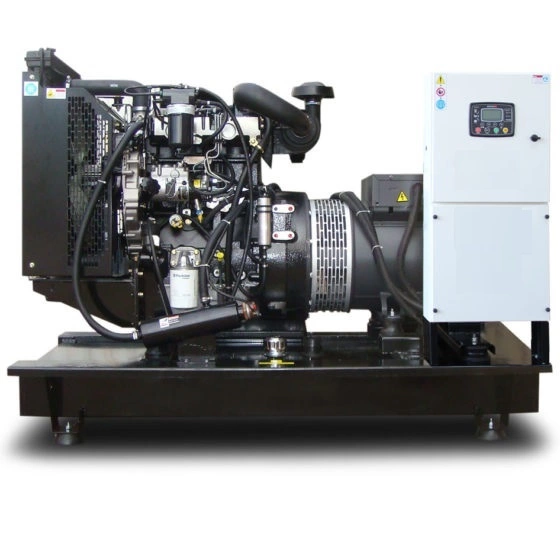
We manufacture the 415V 3 Phase Generator. Quiet generators for industrial use. High quality and low prices with Free consultation. Spare Parts warranty

Diesel Engine of the Generators

EMS Power Machines” uses diesel engines that are manufactured with the latest technology, in accordance with ISO3046 standards, and designed for generator sets. The diesel engines used; are designed for low fuel consumption, with 4-stroke type, direct injection, with all needed limiting and level sensors, with diesel electronic or mechanical type governor mounted on the fuel pump for sensitive speed adjustment or regulation.

The engines used, may have oil, air, or water-type cooling systems, depending on customer request and the diesel engine. There are also oil, fuel, and air filters that are designed for heavy operation conditions, which provide the engine with a long lifetime with high performance. All the equipment that is needed for the diesel engine for operating safely and reliably, is provided along with the generator set.

EMS Power Machines can provide a base frame fuel tank or free-standing fuel tank dependent on the model preferences of the customer. Larger sets require free-standing fuel tanks due to the need for high fuel capacity.
Fuel tanks are manufactured of plate steel or other suitable materials.
Teksan ensures that the fuel tanks are all manufactured in accordance with relevant standards. EMS Power Machines fuel tanks are equipped with:

  • Filling cap
  • Tank ventilation
  • Fuel outlet valve
  • Fuel return connections
  • Tank drainage plug
  • Sediment trapping section
  • Level gauge pipe
  • Float switches (Optional)
  • Automatic filling (Optional)

It is highly recommended to install a fuel filter and/or a water separator on the outlet line of these fuel tanks.

Engine Brands of Diesel Generators for Sale

  • Perkins Engines
  • Cummins Engines
  • Ricardo Engines
  • Baudoin Engines
  • Shanghai Dongfeng Engines
  • Volvo Engines
  • Yangdong Engines

We use any of the above-mentioned diesel engines for the production of our diesel generators according to the customers’ requests.

Perkins engines are manufactured in the UK and are very common in the generator production market.

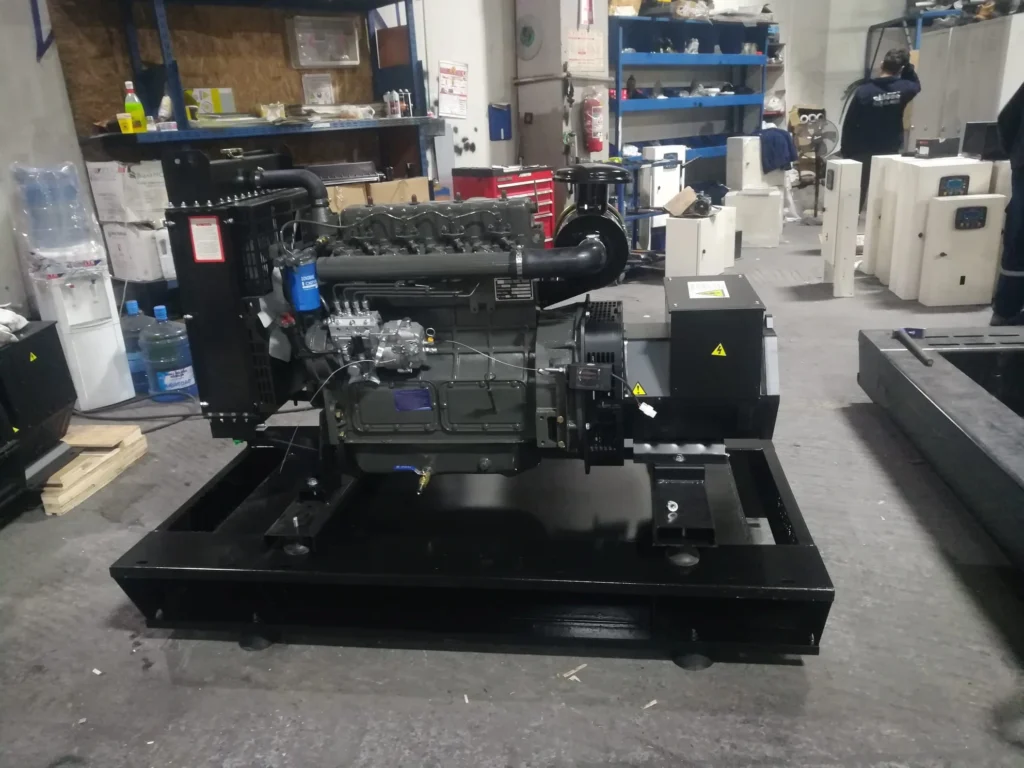
75 KVA Generator with Ricardo Engine

Ricardo engines are manufactured in China and have a very high market share in the generator manufacturing market.

Base Frame of the Generators

The base frame on which the generator set is placed has been manufactured using proper steel plates or special profiles based on the necessary dynamic, static, and vibration calculations in order for providing high resistance. EMS Power Machines produces the base frames for all ranges in accordance with international standards.
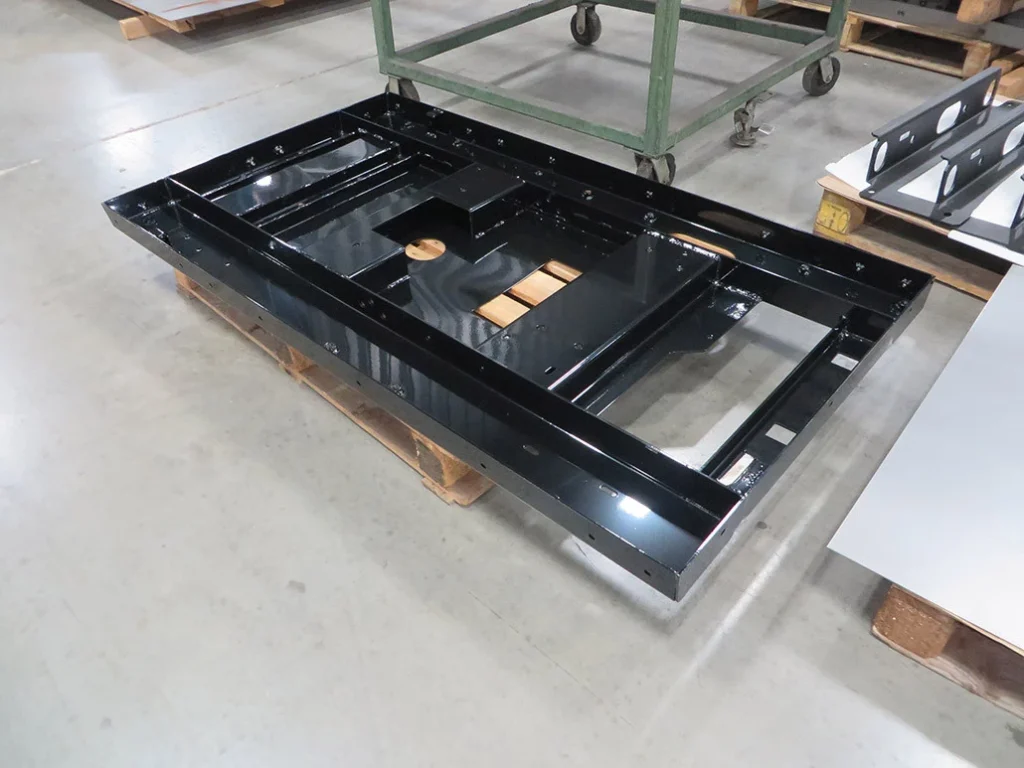
Base Frame of the Generators

The base frame of a generator, often referred to as the generator skid or chassis, is a crucial structural component that provides support, stability, and a foundation for the entire generator set. It plays a key role in ensuring the proper functioning, safety, and longevity of the generator. Here are some key aspects related to the base frame of generators:

Functions and Features

  1. Support Structure:
    • The base frame serves as the primary support structure for the generator set, providing a stable foundation to hold all the components together.
  2. Engine and Alternator Mounting:
    • The engine and alternator, the two main components of a generator set, are securely mounted on the base frame. Proper alignment and secure mounting are essential for efficient operation and to minimize vibrations.
  3. Vibration Isolation:
    • Many base frames incorporate features to isolate vibrations produced during the operation of the generator. This helps reduce noise and ensures that vibrations do not impact the performance or structural integrity of the generator.
  4. Fuel Tank Support:
    • In some generator sets, the fuel tank is integrated into or mounted on the base frame. This provides a secure and stable location for the fuel tank.
  5. Cooling System Support:
    • The cooling system components, such as radiators and cooling fans, are often mounted on or integrated into the base frame to ensure proper airflow and cooling.
  6. Lifting Points:
    • Base frames are designed with lifting points or provisions for lifting equipment. This facilitates ease of transportation, installation, and maintenance of the generator set.
  7. Weatherproofing:
    • Depending on the design, the base frame may provide some level of protection against environmental elements, such as rain and dust, to ensure the longevity of the generator set.
  8. Accessibility:
    • The base frame is designed to allow easy access to key components for maintenance and service tasks. This includes access panels and doors for routine inspections and repairs.
  9. Corrosion Resistance:
    • Base frames are often constructed from materials that offer corrosion resistance to withstand environmental conditions and ensure a longer service life.

Considerations

  1. Material Selection:
    • Base frames are commonly made of steel, but the type and quality of the steel used can vary. The choice of materials depends on factors such as environmental conditions, weight considerations, and corrosion resistance.
  2. Size and Dimensions:
    • The size and dimensions of the base frame are determined by the overall size of the generator set. It should provide adequate space for all components and ensure proper ventilation.
  3. Site Conditions:
    • The design of the base frame should consider the specific site conditions where the generator will be installed. This includes factors such as seismic requirements, soil conditions, and available space.
  4. Transportation:
    • The base frame design should facilitate ease of transportation, considering factors such as size, weight, and lifting points.
  5. Regulatory Compliance:
    • The design and construction of the base frame should comply with relevant safety and construction standards set by regulatory authorities.

The base frame is a critical element in the overall design and functionality of a generator set. Its design and construction should align with the specific requirements of the generator and the intended application. Manufacturers often provide detailed specifications for the base frame in the generator set documentation. When selecting or installing a generator set, it’s important to follow the manufacturer’s guidelines and consider any site-specific requirements.

Vibration Isolators

Vibration isolators, also known as vibration mounts or isolating mounts, are components used in diesel generators to reduce the transmission of vibrations and noise generated during the operation of the engine. These isolators play a crucial role in enhancing the overall performance, stability, and comfort of the generator set. Here are key aspects related to the vibration isolators of diesel generators:

Functions and Features

  1. Vibration Reduction:
    • The primary function of vibration isolators is to reduce the transmission of vibrations generated by the diesel engine to the surrounding structure. This helps minimize the impact of vibrations on adjacent equipment and structures.
  2. Noise Reduction:
    • In addition to reducing vibrations, isolators also contribute to noise reduction. They help isolate the generator set from its surroundings, preventing the transmission of noise to nearby areas.
  3. Component Protection:
    • Vibration isolators protect various components of the generator set, including the engine, alternator, and other critical parts, from the potentially damaging effects of excessive vibrations.
  4. Structural Integrity:
    • By reducing vibrations, isolators contribute to maintaining the structural integrity of the generator set and the surrounding infrastructure. Excessive vibrations can lead to wear and tear on components and may compromise the overall stability of the generator.
  5. Isolation from External Vibrations:
    • Isolators not only prevent the transmission of internal vibrations but also isolate the generator set from external vibrations, such as those from nearby machinery or environmental factors.
  6. Adjustability:
    • Some vibration isolators are designed to be adjustable, allowing for fine-tuning to achieve optimal vibration isolation based on the specific operating conditions and requirements.

Types of Vibration Isolators

  1. Spring Mounts:
    • Spring mounts use metal springs to isolate vibrations. They are effective in reducing both high and low-frequency vibrations.
  2. Rubber Mounts:
    • Rubber mounts, or elastomeric mounts, use rubber or other elastomeric materials to absorb and dampen vibrations. They are effective for isolating high-frequency vibrations.
  3. Air Springs:
    • Air springs use compressed air to provide isolation. They are effective in isolating low-frequency vibrations and are often used in large and heavy machinery.
  4. Viscous Dampers:
    • Viscous dampers use hydraulic fluid to absorb and dissipate vibrations. They are effective in isolating both high and low-frequency vibrations.
  5. Active Isolation Systems:
    • Active isolation systems use sensors and actuators to actively counteract vibrations in real-time. These systems can provide dynamic and adaptive vibration control.

Considerations

  1. Application Specifics:
    • The selection of vibration isolators should consider the specific application, environmental conditions, and the frequency spectrum of vibrations generated by the diesel generator.
  2. Load Capacity:
    • The isolators should be selected based on the load capacity of the generator set to ensure proper support and isolation.
  3. Installation and Maintenance:
    • Proper installation and regular maintenance of the vibration isolators are crucial to ensure their effectiveness over time.
  4. Regulatory Compliance:
    • Compliance with relevant safety and regulatory standards should be considered when selecting vibration isolators.
  5. Manufacturer Recommendations:
    • Follow the manufacturer’s recommendations for the type and specification of vibration isolators suitable for a particular generator model.

Vibration isolators are integral components that contribute to the smooth and reliable operation of diesel generators while minimizing the impact on surrounding structures and environments. When selecting or maintaining vibration isolators, it’s essential to consider the specific requirements of the generator set and follow the guidelines provided by the generator manufacturer.

Vibration insulators are used in order to decrease the negative effects of vibrations caused by the rotational movement of the engine and alternator. These insulators which also prevent the vibration to be transferred from
the base frame to the ground, are placed between the engine/alternator and the base frame. Specially chosen vibration isolators are mounted between the engine, alternator, and base frame. Alternatively, in bigger generator sets, vibration isolators are mounted between the base frame and floor.

Exhaust System and Silencer

An exhaust system should be designed to decrease the noise coming from the exhaust manifold and dispel the exhaust gases into the atmosphere. The exhaust system consists of a flexible compensator that absorbs vibration and expansion, steel pipes, bend, silencer, and mounting equipment. Further details on exhaust systems can be found in the “Installation” section of this manual.
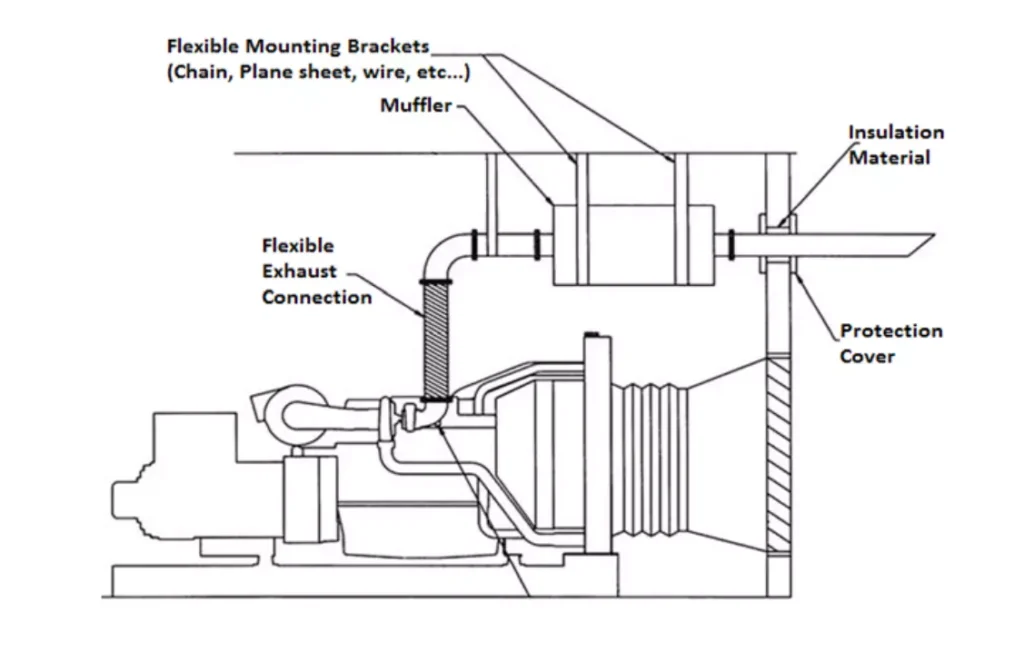
Exhaust System and Silencer of Generators

The exhaust system and silencer of a diesel generator play a crucial role in managing and reducing the noise and emissions produced during the operation of the generator. Here are key aspects related to the exhaust system and silencer of diesel generators:

Exhaust System

  1. Exhaust Manifold:
    • The exhaust manifold collects exhaust gases from the engine cylinders and directs them to the exhaust system.
  2. Turbocharger (if applicable):
    • In some diesel generators, especially those with larger engines, a turbocharger may be used to increase the efficiency of exhaust gas evacuation.
  3. Piping:
    • Exhaust piping carries the hot gases from the engine to the other components of the exhaust system. It is designed to withstand high temperatures and is often insulated to prevent heat dissipation.
  4. After-Treatment Devices:
    • Modern diesel generators often incorporate after-treatment devices such as diesel particulate filters (DPF) and selective catalytic reduction (SCR) systems to reduce emissions and comply with environmental regulations.

Silencer

  1. Purpose:
    • The silencer, or muffler, is designed to reduce the noise generated by the exhaust gases as they exit the generator. It helps in creating a more tolerable and quieter operating environment.
  2. Design:
    • Silencers are typically designed with sound-absorbing materials and internal baffles to attenuate and dissipate sound energy. The design may vary based on the specific noise reduction requirements.
  3. Inlet and Outlet:
    • Silencers have inlet and outlet ports that are connected to the exhaust piping. The exhaust gases enter the silencer through the inlet and exit through the outlet.
  4. Materials:
    • Silencers are constructed using materials that can withstand high temperatures and corrosion, given the harsh environment of exhaust gases.
  5. Resonators (if applicable):
    • Some silencers may incorporate resonators to further dampen specific frequencies of sound and enhance noise reduction.
  6. Spark Arrestor (if applicable):
    • In certain applications, especially in environments where the risk of fire is a concern, a spark arrestor may be included in the silencer to prevent sparks from exiting the exhaust.

Considerations

  1. Noise Regulations:
    • Compliance with local noise regulations is a critical consideration when selecting or designing the exhaust system and silencer. Different regions may have specific noise level requirements that need to be met.
  2. Emission Regulations:
    • Ensure that the exhaust system, including any after-treatment devices, complies with emissions regulations applicable to the generator’s location.
  3. Engine Efficiency:
    • The design of the exhaust system should not compromise the efficiency of the engine. It should allow for proper evacuation of exhaust gases without causing backpressure.
  4. Maintenance:
    • Regular inspection and maintenance of the exhaust system and silencer are essential to ensure proper functioning and longevity. This includes checking for leaks, corrosion, and damage.
  5. Installation:
    • Proper installation of the exhaust system and silencer is crucial for optimal performance. Consider factors such as proper clearances, support structures, and heat dissipation.
  6. Manufacturer Recommendations:
    • Follow the recommendations provided by the generator manufacturer regarding the selection, installation, and maintenance of the exhaust system and silencer.

The exhaust system and silencer are critical components that contribute to the safe and environmentally friendly operation of diesel generators. When selecting or maintaining these components, it’s important to consider both regulatory requirements and the specific operational needs of the generator. Consulting with the generator manufacturer or a qualified professional can help ensure that the exhaust system is designed and maintained to meet the necessary standards.

Control System

The control system of a diesel generator is a crucial component that governs and manages the operation of the generator set. It includes a range of components and features designed to monitor, control, and protect the generator during various operating conditions. Here are key aspects related to the control system of diesel generators:

Components of the Control System

  1. Control Panel:
    • The control panel is the interface through which operators interact with the generator. It typically includes displays, buttons, switches, and indicators for monitoring and controlling various parameters.
  2. Controller:
    • The controller is the central processing unit responsible for monitoring and regulating the generator’s functions. It may be a microprocessor-based controller that processes data from sensors and issues commands to different components.
  3. Sensors:
    • Various sensors are deployed throughout the generator to measure critical parameters such as engine speed, oil pressure, coolant temperature, voltage, and current. These sensors provide real-time data to the controller.
  4. Automatic Voltage Regulator (AVR):
    • The AVR is responsible for maintaining a stable and consistent voltage output from the generator. It adjusts the excitation current to the generator’s alternator to control the voltage level.
  5. Engine Control Module (ECM):
    • The ECM monitors and controls the diesel engine’s operation. It manages fuel injection, air intake, exhaust emissions, and other parameters to optimize engine performance and efficiency.
  6. Governor:
    • The governor regulates the speed of the engine by controlling the fuel injection. It helps maintain a constant speed under varying loads.
  7. Protection System:
    • The protection system safeguards the generator against abnormal conditions such as overloading, overheating, low oil pressure, and over-speeding. It can initiate automatic shutdowns to prevent damage.
  8. Data Logging and Communication:
    • Some control systems feature data logging capabilities to record operational data over time. Communication interfaces may allow for remote monitoring and control.

Features and Functions

  1. Start/Stop Control:
    • The control system initiates the start and stop sequences of the generator based on manual or automatic commands.
  2. Load Sharing (Parallel Operation):
    • In parallel operation scenarios where multiple generators are connected, the control system ensures proper load sharing and synchronization.
  3. Synchronization:
    • The control system facilitates synchronization when connecting the generator to an electrical grid or other generators, ensuring a seamless connection without disturbances.
  4. Emergency Shutdown:
    • The control system includes emergency shutdown features that can be triggered in response to critical faults or unsafe conditions to protect the generator.
  5. Remote Monitoring and Control:
    • Advanced control systems may allow remote monitoring and control of the generator, providing real-time information and the ability to make adjustments from a distance.
  6. Diagnostic and Fault Analysis:
    • The control system can diagnose faults, provide alerts or alarms, and perform self-diagnostics to aid in troubleshooting and maintenance.

Considerations

  1. Compatibility:
    • Ensure that the control system is compatible with the generator set and any additional components, especially if the generator is part of a larger power system.
  2. Scalability:
    • Consider the scalability of the control system to accommodate future upgrades or additions to the generator system.
  3. User Interface:
    • Evaluate the user interface of the control panel for ease of use and accessibility, especially for operators who need to monitor and manage the generator.
  4. Integration with Power Systems:
    • If the generator is part of a larger power distribution system, ensure that the control system can seamlessly integrate with other power management components.
  5. Training and Documentation:
    • Adequate training and documentation should be provided for operators to effectively use and troubleshoot the control system.

The control system is a critical aspect of diesel generators, ensuring reliable and efficient operation while providing essential protection features. When selecting a generator, it’s important to understand the capabilities of the control system and how well it aligns with the specific requirements of the intended application. Manufacturers typically provide detailed specifications and documentation related to the control system for each generator model.

Various control systems are developed for ensuring the protection of the generator set against failures, load transfers, and the reliability of the operation of the generator set. Control system designs can vary according to the customer requirements and assembling requirements. The main
types of control systems are Manual, Automatic, Standby, and Parallel working systems.

All control systems are mounted on steel panels containing a lockable door for easy reaching and service. Further technical information about the control systems of the generator sets can be found in the “Control Systems” section of this manual and the manual of the controller.

Installation of Generators

The installation of generators is a critical process that involves several steps to ensure proper functionality, safety, and compliance with regulations. Whether installing a standby generator for backup power or a prime power generator for continuous operation, following best practices is essential. Here is a general guide for the installation of generators:

1. Site Selection

  1. Regulatory Compliance:
    • Ensure compliance with local building codes, zoning regulations, and environmental requirements. Obtain any necessary permits before starting the installation.
  2. Space and Clearance:
    • Select a location with sufficient space for the generator and its accessories. Allow for proper clearance around the generator for maintenance and ventilation.
  3. Ventilation:
    • Ensure adequate ventilation to dissipate heat generated by the generator. Generators typically require space for air intake and exhaust.
  4. Accessibility:
    • Choose a location that allows easy access for installation, maintenance, and potential repairs. Consider factors such as crane access and pathways for transporting equipment.

2. Foundation and Mounting

  1. Foundation Construction:
    • Prepare a stable foundation for the generator. The foundation should be level, sturdy, and capable of supporting the generator’s weight.
  2. Vibration Isolation:
    • If applicable, install vibration isolators or mounts to minimize the transmission of vibrations from the generator to the foundation and surrounding structures.
  3. Anchor the Generator:
    • Anchor the generator securely to the foundation to prevent movement or shifting during operation or external forces.

3. Electrical Connections

  1. Transfer Switch Installation:
    • Install an automatic transfer switch (ATS) to facilitate seamless switching between the main power source and the generator during power outages.
  2. Wiring:
    • Connect the generator to the electrical distribution system following local electrical codes and regulations. Ensure proper sizing of conductors and adherence to safety standards.
  3. Grounding:
    • Establish proper grounding for the generator as per electrical codes. A grounding electrode system helps ensure safety and proper functioning.
  4. Voltage Configuration:
    • Verify that the generator’s voltage configuration matches the requirements of the connected loads. Adjust settings if necessary.

4. Fuel System

  1. Fuel Storage:
    • If the generator has an internal fuel tank, ensure it is filled with the appropriate fuel. For external fuel tanks, connect and test the fuel supply system.
  2. Fuel Quality:
    • Ensure that the fuel supply meets the specifications recommended by the generator manufacturer. Use clean and high-quality fuel.

5. Exhaust System

  1. Exhaust Piping:
    • Install the exhaust piping in compliance with local codes and regulations. Ensure proper venting of exhaust gases away from occupied spaces.
  2. Silencer Installation:
    • If a silencer is included, install it in the exhaust system to reduce noise emissions. Follow the manufacturer’s recommendations for placement and installation.

6. Control System

  1. Control Panel Wiring:
    • Connect the control panel to the generator and ensure proper wiring. Verify the functionality of control features such as start/stop, monitoring, and protection systems.
  2. Testing:
    • Conduct thorough testing of the control system to ensure all functions operate as intended. Test automatic start/stop sequences, alarms, and safety shutdowns.

7. Commissioning and Testing

  1. Load Testing:
    • Conduct load tests to ensure the generator can handle the expected loads. Verify the generator’s performance under varying load conditions.
  2. System Integration:
    • Integrate the generator into the overall power system. If multiple generators are used, ensure proper synchronization and load sharing.
  3. Commissioning Procedures:
    • Follow the commissioning procedures provided by the generator manufacturer. This may include adjusting settings, verifying alarms, and ensuring all systems are operational.

8. Documentation

  1. As-Built Documentation:
    • Prepare as-built documentation that includes detailed drawings, specifications, and records of the installation. This documentation is valuable for future maintenance and reference.
  2. Operation and Maintenance Manuals:
    • Provide the end user with comprehensive operation and maintenance manuals. Include information on routine maintenance, troubleshooting, and emergency procedures.

9. Training

  1. Operator Training:
    • Provide training for operators on how to start, stop, and operate the generator safely. Ensure they are familiar with the control panel and understand basic troubleshooting procedures.
  2. Maintenance Training:
    • Train maintenance personnel on routine maintenance tasks, including oil changes, filter replacements, and inspections. Emphasize the importance of following the manufacturer’s maintenance schedule.

10. Compliance

  1. Final Inspection:
    • Conduct a final inspection to ensure compliance with all applicable codes, regulations, and safety standards.
  2. Certifications:
    • Obtain any necessary certifications or approvals from local authorities or regulatory bodies.
  3. Record Keeping:
    • Keep detailed records of the installation, testing, and commissioning processes. This documentation may be required for compliance audits and warranty support.

11. Ongoing Monitoring and Maintenance

  1. Monitoring Systems:
    • Implement continuous monitoring systems for key parameters, such as fuel levels, oil pressure, and coolant temperature. Consider remote monitoring options for quick response to issues.
  2. Scheduled Maintenance:
    • Establish a scheduled maintenance program and adhere to the manufacturer’s recommendations. Regular maintenance is essential for the reliability and longevity of the generator.
  3. Emergency Response Plan:
    • Develop and communicate an emergency response plan outlining procedures to follow in the event of a generator malfunction or failure.

Conclusion

The installation of generators is a multifaceted process that requires careful planning, attention to detail, and compliance with various standards and regulations. Collaboration with experienced professionals, including electrical engineers, mechanical contractors, and generator technicians, can contribute to a successful installation. Additionally, consulting with the generator manufacturer and following their guidelines is essential to ensure optimal performance and longevity of the generator system.

The selection and preparation of the location where the generator set will be placed is the most important step of installation. So please make sure that the generator set is installed at a place that is selected and prepared fully in conformity with the instructions in this manual.

Also, remember that you can call us for any further information or confirmation about this issue. If the generator will be placed on an upper floor, not the basement or ground, the responsibility of static load distribution belongs to the customer. The customer should get approval from an authority about this issue before installation.

Environmental Conditions

Install the generator set in such a place that it will not be directly exposed to harsh environmental conditions such as rain, snow, hail, flood, humidity, excessive sunlight, extremely low or high temperature, dust, soil, sand or wind. The place where the generator set will be installed must be, clean, dry, well illuminated and ventilated, free of corrosive or conductive pollutant substances like dust, lint, smoke, oil vapor, exhaust smoke, etc…

Be sure to leave enough blank space around the generator set, in order to ease future maintenance or repair activities Remember that it can be necessary to disassemble the main parts like the engine, alternator, or base frame in some cases. The base ground where the generator will be settled must be clean dry and must have a good drainage system. Put the generator set in such a place that nobody unauthorized can access it, or at least take necessary precautions about it.

Place generator sets in such places that they will not be affected by the operation of any other machines. Do not install or run the generator set at any place that has any possibility of risk in terms of safety of operation.
Also, provide the necessary precautions (canopy option) or protections against bad weather conditions if it will be placed outside.

The doors of the room that the generator set will be placed in, must be at enough size for the main parts (engine, alternator, radiator, etc…) to pass through. Also, ventilation windows can be built portable or mobile for
this purpose.

Diesel Generator

A diesel generator is a device that converts diesel fuel into electricity. Diesel generators are typically used as backup power sources in the event of a power outage, but they can also be used as primary power sources in remote areas where there is no grid electricity available.

Diesel generators work by using a diesel engine to turn a generator. The diesel engine burns diesel fuel to create mechanical energy, which is then converted into electrical energy by the generator.

Diesel generators are available in a variety of sizes and power outputs. Some diesel generators are small enough to be portable, while others are large enough to power entire buildings or communities.

Diesel generators are a reliable and efficient way to generate electricity. They are also relatively easy to operate and maintain.

Here are some examples of where diesel generators are used:

  • Hospitals and other critical facilities: Diesel generators are used to provide backup power in hospitals, data centers, and other critical facilities. This ensures that these facilities continue to operate even in the event of a power outage.
  • Construction sites: Diesel generators are used to provide power for construction tools and equipment at construction sites. This allows construction work to continue even in remote areas where there is no grid electricity available.
  • Emergency services: Diesel generators are used to provide power for emergency services, such as ambulances and fire trucks. This ensures that these services can continue to operate even in the event of a power outage.
  • Remote areas: Diesel generators are used to provide primary power in remote areas where there is no grid electricity available. This allows people living in these areas to have access to electricity for lighting, cooking, and other essential needs.

Diesel generators are a valuable tool for generating electricity in a variety of situations. They are reliable, efficient, and easy to operate and maintain.

Diesel Generator Outputs

The output of a diesel generator is measured in kilowatts (kW). The output of a diesel generator is limited by the size and power of the diesel engine that it uses. Diesel generators are available in a variety of sizes and power outputs, ranging from small portable generators that produce a few kW of power to large industrial generators that produce thousands of kW of power.

The output of a diesel generator is also affected by a number of other factors, including:

  • Fuel quality: The quality of the diesel fuel used in a generator can affect its output. Lower quality diesel fuel can produce less power and can also damage the generator.
  • Air quality: The quality of the air that the generator is operating in can also affect its output. Operating a generator in thin air or in hot weather can reduce its output.
  • Maintenance: Proper maintenance of a diesel generator is essential to ensure its optimal performance. A generator that is not properly maintained may produce less power and may also be more likely to break down.

Here are some examples of the power outputs of different types of diesel generators:

  • Small portable generator: 1-5 kW
  • Medium-sized generator: 5-10 kW
  • Large generator: 10-100 kW
  • Industrial generator: 100 kW and up

The power output of a diesel generator is an important factor to consider when choosing a generator for a particular application. The generator should have enough power output to meet the needs of the devices and appliances that will be connected to it.

It is also important to note that the power output of a diesel generator is not the same as its efficiency. The efficiency of a diesel generator is the percentage of the fuel energy that is converted into electrical energy. A more efficient generator will produce more electrical energy for a given amount of fuel.

Diesel Generators

Diesel generators are a type of backup or standby power source that uses a diesel engine to generate electricity. These generators are widely used in various applications where a reliable and continuous power supply is crucial. Here are key aspects related to diesel generators:

Components of Diesel Generators

  1. Diesel Engine:
    • The diesel engine is the primary component responsible for converting diesel fuel into mechanical energy. This mechanical energy is then used to turn a generator to produce electricity.
  2. Generator (Alternator):
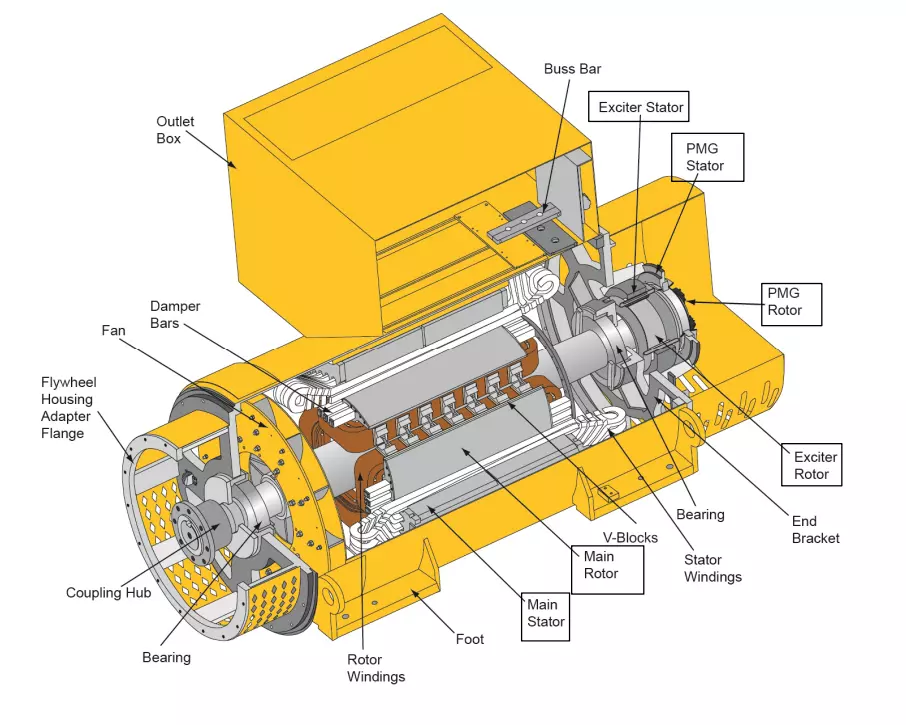
    • The generator, or alternator, converts the mechanical energy from the diesel engine into electrical energy. It consists of a rotor and a stator, and as the rotor turns within the stator’s magnetic field, it induces an electric current.
  3. Fuel System:
    • The fuel system stores and delivers diesel fuel to the engine for combustion. It typically includes a fuel tank, fuel pump, and fuel injectors.
  4. Cooling System:
    • Diesel generators have a cooling system to maintain optimal operating temperatures. This system may include a radiator, cooling fans, and a water or air cooling mechanism.
  5. Exhaust System:
    • The exhaust system is responsible for expelling the combustion gases produced during the diesel engine’s operation. It usually includes a muffler and may incorporate emission control devices.
  6. Control Panel:
    • The control panel houses the generator’s control and monitoring systems. It allows operators to start or stop the generator, monitor performance, and sometimes control other parameters such as voltage and frequency.
  7. Voltage Regulator:
    • The voltage regulator maintains a stable output voltage by adjusting the excitation current to the generator’s rotor.
  8. Battery Charger:
    • Diesel generators often have a battery or set of batteries to start the engine. A battery charger ensures that the batteries remain charged and ready to start the generator when needed.
  9. Automatic Transfer Switch (ATS):
    • An ATS is a crucial component for standby generators. It automatically switches the electrical load from the main power source to the generator when it detects a power outage and vice versa when the main power is restored.
Working Principle:
  1. Combustion: Diesel fuel is injected into the combustion chamber, and the heat generated by the compression of air ignites the fuel.
  2. Mechanical Energy: The combustion process produces high-pressure gases that expand, creating mechanical energy. This energy is used to rotate the engine’s crankshaft.
  3. Electricity Generation: The rotating crankshaft is connected to the generator, causing it to spin. As the generator’s rotor rotates within the stator, it induces an electric current, generating electricity.
Applications:
  1. Emergency Power:
    • Diesel generators are commonly used for emergency backup power in critical facilities such as hospitals, data centers, and telecommunications facilities.
  2. Construction Sites:
    • They are used on construction sites to power tools and equipment where a reliable grid connection may not be available.
  3. Industrial Facilities:
    • Diesel generators provide backup power for industrial plants and manufacturing facilities to prevent production disruptions.
  4. Remote Locations:
    • In remote or off-grid locations, where a stable power supply from the grid is not feasible, diesel generators can provide a reliable source of electricity.
  5. Mining Operations:
    • Diesel generators are often used in mining operations to power equipment in remote and rugged environments.
  6. Agriculture:
    • Farms may use diesel generators to power irrigation systems, machinery, and other agricultural equipment.
Advantages:
  1. Fuel Availability:
    • Diesel fuel is widely available, making diesel generators suitable for various locations.
  2. Fuel Efficiency:
    • Diesel generators are known for their fuel efficiency, providing a cost-effective solution for standby power.
  3. Durability:
    • Diesel generators are generally robust and durable, capable of handling heavy loads and providing long service life.
  4. High Torque:
    • Diesel engines provide high torque, making them suitable for applications with varying load conditions.
Limitations:
  1. Noise and Emissions:
    • Diesel generators can be noisy, and their combustion process produces emissions. However, advancements in technology have led to quieter and more environmentally friendly models.
  2. Maintenance:
    • Regular maintenance is essential to ensure the proper functioning of diesel generators.
  3. Initial Cost:
    • Diesel generators may have a higher upfront cost compared to some other types of generators.

Diesel generators are a reliable and widely used solution for providing backup or primary power in various settings. The choice of a diesel generator depends on factors such as power requirements, environmental considerations, and the specific needs of the application.

Diesel generators are machines that convert the chemical energy of diesel fuel into mechanical energy, which is then used to generate electricity. They are a popular choice for a variety of applications, including prime power for remote locations, backup power for businesses, and emergency power for hospitals and other critical infrastructure.

Diesel generators are available in a wide range of sizes, from small portable generators that can be used to power a few appliances to large stationary generators that can power entire buildings or even small towns.

Diesel generators are typically powered by four-stroke diesel engines. Diesel engines are known for their reliability and fuel efficiency, making them a good choice for applications where long-term operation is required.

Diesel generators work by burning diesel fuel in the engine, which drives a generator to produce electricity. The electricity generated by the generator can then be used to power lights, appliances, and other electrical devices.

Diesel generators are a valuable source of backup power in the event of a power outage. They can also be used as a primary source of power in remote locations where there is no access to the electrical grid.

Here are some of the benefits of using a diesel generator:

  • Reliable: Diesel generators are very reliable and can operate for long periods of time without any problems.
  • Fuel-efficient: Diesel generators are fuel-efficient, which can save you money on operating costs.
  • Durable: Diesel generators are built to last and can withstand harsh operating conditions.
  • Versatile: Diesel generators can be used in a variety of applications, from prime power for remote locations to backup power for businesses and critical infrastructure.

If you are considering purchasing a diesel generator, be sure to do your research and choose a generator that is the right size and type for your needs. You should also consider the cost of fuel and maintenance when making your decision.

EMS Power Machines

We design, manufacture and assembly Power Machines such as – diesel generators, electric motors, vibration motors, pumps, steam engines and steam turbines

EMS Power Machines is a global power engineering company, one of the five world leaders in the industry in terms of installed equipment. The companies included in the company have been operating in the energy market for more than 60 years.

EMS Power Machines manufactures steam turbines, gas turbines, hydroelectric turbines, generators, and other power equipment for thermal, nuclear, and hydroelectric power plants, as well as for various industries, transport, and marine energy.

EMS Power Machines is a major player in the global power industry, and its equipment is used in power plants all over the world. The company has a strong track record of innovation, and it is constantly developing new and improved technologies.

Here are some examples of Power Machines’ products and services:

  • Steam turbines for thermal and nuclear power plants
  • Gas turbines for combined cycle power plants and industrial applications
  • Hydroelectric turbines for hydroelectric power plants
  • Generators for all types of power plants
  • Boilers for thermal power plants
  • Condensers for thermal power plants
  • Reheaters for thermal power plants
  • Air preheaters for thermal power plants
  • Feedwater pumps for thermal power plants
  • Control systems for power plants
  • Maintenance and repair services for power plants

EMS Power Machines is committed to providing its customers with high-quality products and services. The company has a strong reputation for reliability and innovation. Power Machines is a leading provider of power equipment and services, and it plays a vital role in the global power industry.

EMS Power Machines, which began in 1961 as a small factory of electric motors, has become a leading global supplier of electronic products for different segments. The search for excellence has resulted in the diversification of the business, adding to the electric motors products which provide from power generation to more efficient means of use.
Categories
Uncategorized

Used 3 Phase Generator for Sale UK

Used 3 Phase Generator for Sale UK

We offer the Used 3 Phase Generator for Sale UK. Quiet generators for home use. High quality and low prices with Free consultation.

Synchronous generators are large-size generators mainly used in power plants. These may be rotating field type or rotating armature type. In the rotating armature type, the armature is at the rotor and the field is at the stator. Rotor armature current is taken through slip rings and brushes. These are limited due to high wind losses. These are used for low-power output applications.

The rotating field type of alternator is widely used because of its high power generation capability and absence of slip rings and brushes. It can be either 3 phase or two-phase generators. A two-phase alternator produces two completely separate voltages.

Used 3 Phase Generator for Sale UK

Each voltage may be considered as a single-phase voltage. Each is generated voltage completely independent of the other. The three-phase alternator has three single-phase windings spaced such that the voltage induced in any one phase is displaced by 120º from the other two. These can be connected to either delta or wye connections. In Delta Connection each coil end is connected together to form a closed loop.

A Delta Connection appears like the Greek Letter Delta (Δ). In Wye Connection one end of each coil is connected together and the other end of each coil is left open for external connections. A Wye Connection appears as the letter Y. These generators are packaged with an engine or turbine to be used as a motor-generator set and used in applications like naval, oil and gas extraction, mining machinery, wind power plants, etc

Advantages of AC Generator:

  • These Generators are generally maintenance-free, because of the absence of brushes.
  • Easily step up and step down through transformers.
  • Transmission link size might be thinner because of step-up feature
  • Size of the generator is relatively smaller than the DC machine
  • Losses are relatively less than DC machine
  • These Generator breakers are relatively smaller than DC breakers

DC Generators

DC generator is typically found in off-grid applications. These generators give a seamless power supply directly to electric storage devices and DC power grids without novel equipment. The stored power is carried to loads through dc-ac converters. The DC generators could be controlled back to an unmoving speed as batteries tend to be stimulating to recover considerably more fuel.

Classification of DC Generators
D.C Generators are classified according to the way their magnetic field is developed in the stator of the machine.

  • Permanent-magnet DC generators
  • Separately excite DC generators and
  • Self-excited DC generators

Permanent magnet DC generators do not require external field excitation because it has permanent magnets to produce the flux. These are used for low-power applications like dynamos. Separately-excite DC generators require external field excitation to produce the magnetic flux.

We can also vary the excitation to get variable output power. These are used in electro-plating and electro-refining applications. Due to residual magnetism present in the poles of the stator self-excited DC generators can able to produce their own magnetic field once it is started.

The self-excited DC Generators are further classified as Shunt wound DC generators; Series wound DC generators and Compound wound DC generators. The Compound Wound DC generators are further divided as long shunt wound DC generators, and short shunt wound

DC generators. The field pole of the DC generator is stationary, and the armature conductor rotates. The voltage generated in the armature conductor is of an alternating nature, and this voltage is converted into the direct voltage at the brushes with the help of the commutator. These are simple in design and no need to have the external circuit to vary the field excitation. Again these self-excited DC generators are classified into the shunt, series, and compound generators.

These are used in applications like battery charging, welding, ordinary lightning applications, etc.

Advantages of DC Generator:

  • Mainly DC machines have a wide variety of operating characteristics which can be obtained by selecting of the method of excitation of the field windings.
  • The output voltage can be smoothed by regularly arranging the coils around the armature. This leads to fewer fluctuations which is desirable for some steady-state applications.
  • No shielding need for radiation, so cable cost will be less as compared to AC.

Diesel Engine of the Generators

EMS Power Machines” uses diesel engines that are manufactured with the latest technology, in accordance with ISO3046 standards, and designed for generator sets. The diesel engines used; are designed for low fuel consumption, with 4-stroke type, direct injection, with all needed limiting and level sensors, with diesel electronic or mechanical type governor mounted on the fuel pump for sensitive speed adjustment or regulation.

The engines used, may have oil, air, or water-type cooling systems, depending on customer request and the diesel engine. There are also oil, fuel, and air filters that are designed for heavy operation conditions, which provide the engine with a long lifetime with high performance. All the equipment that is needed for the diesel engine for operating safely and reliably, is provided along with the generator set.

EMS Power Machines can provide a base frame fuel tank or free-standing fuel tank dependent on the model preferences of the customer. Larger sets require free-standing fuel tanks due to the need for high fuel capacity.
Fuel tanks are manufactured of plate steel or other suitable materials.
Teksan ensures that the fuel tanks are all manufactured in accordance with relevant standards. EMS Power Machines fuel tanks are equipped with:

  • Filling cap
  • Tank ventilation
  • Fuel outlet valve
  • Fuel return connections
  • Tank drainage plug
  • Sediment trapping section
  • Level gauge pipe
  • Float switches (Optional)
  • Automatic filling (Optional)

It is highly recommended to install a fuel filter and/or a water separator on the outlet line of these fuel tanks.

Engine Brands of Diesel Generators for Sale

  • Perkins Engines
  • Cummins Engines
  • Ricardo Engines
  • Baudoin Engines
  • Shanghai Dongfeng Engines
  • Volvo Engines
  • Yangdong Engines

We use any of the above-mentioned diesel engines for the production of our diesel generators according to the customers’ requests.

Perkins engines are manufactured in the UK and are very common in the generator production market.

75 KVA Generator with Ricardo Engine

Ricardo engines are manufactured in China and have a very high market share in the generator manufacturing market.

Base Frame of the Generators

The base frame on which the generator set is placed has been manufactured using proper steel plates or special profiles based on the necessary dynamic, static, and vibration calculations in order for providing high resistance. EMS Power Machines produces the base frames for all ranges in accordance with international standards.

Base Frame of the Generators

The base frame of a generator, often referred to as the generator skid or chassis, is a crucial structural component that provides support, stability, and a foundation for the entire generator set. It plays a key role in ensuring the proper functioning, safety, and longevity of the generator. Here are some key aspects related to the base frame of generators:

Functions and Features

  1. Support Structure:
    • The base frame serves as the primary support structure for the generator set, providing a stable foundation to hold all the components together.
  2. Engine and Alternator Mounting:
    • The engine and alternator, the two main components of a generator set, are securely mounted on the base frame. Proper alignment and secure mounting are essential for efficient operation and to minimize vibrations.
  3. Vibration Isolation:
    • Many base frames incorporate features to isolate vibrations produced during the operation of the generator. This helps reduce noise and ensures that vibrations do not impact the performance or structural integrity of the generator.
  4. Fuel Tank Support:
    • In some generator sets, the fuel tank is integrated into or mounted on the base frame. This provides a secure and stable location for the fuel tank.
  5. Cooling System Support:
    • The cooling system components, such as radiators and cooling fans, are often mounted on or integrated into the base frame to ensure proper airflow and cooling.
  6. Lifting Points:
    • Base frames are designed with lifting points or provisions for lifting equipment. This facilitates ease of transportation, installation, and maintenance of the generator set.
  7. Weatherproofing:
    • Depending on the design, the base frame may provide some level of protection against environmental elements, such as rain and dust, to ensure the longevity of the generator set.
  8. Accessibility:
    • The base frame is designed to allow easy access to key components for maintenance and service tasks. This includes access panels and doors for routine inspections and repairs.
  9. Corrosion Resistance:
    • Base frames are often constructed from materials that offer corrosion resistance to withstand environmental conditions and ensure a longer service life.

Considerations

  1. Material Selection:
    • Base frames are commonly made of steel, but the type and quality of the steel used can vary. The choice of materials depends on factors such as environmental conditions, weight considerations, and corrosion resistance.
  2. Size and Dimensions:
    • The size and dimensions of the base frame are determined by the overall size of the generator set. It should provide adequate space for all components and ensure proper ventilation.
  3. Site Conditions:
    • The design of the base frame should consider the specific site conditions where the generator will be installed. This includes factors such as seismic requirements, soil conditions, and available space.
  4. Transportation:
    • The base frame design should facilitate ease of transportation, considering factors such as size, weight, and lifting points.
  5. Regulatory Compliance:
    • The design and construction of the base frame should comply with relevant safety and construction standards set by regulatory authorities.

The base frame is a critical element in the overall design and functionality of a generator set. Its design and construction should align with the specific requirements of the generator and the intended application. Manufacturers often provide detailed specifications for the base frame in the generator set documentation. When selecting or installing a generator set, it’s important to follow the manufacturer’s guidelines and consider any site-specific requirements.

Vibration Isolators

Vibration isolators, also known as vibration mounts or isolating mounts, are components used in diesel generators to reduce the transmission of vibrations and noise generated during the operation of the engine. These isolators play a crucial role in enhancing the overall performance, stability, and comfort of the generator set. Here are key aspects related to the vibration isolators of diesel generators:

Functions and Features

  1. Vibration Reduction:
    • The primary function of vibration isolators is to reduce the transmission of vibrations generated by the diesel engine to the surrounding structure. This helps minimize the impact of vibrations on adjacent equipment and structures.
  2. Noise Reduction:
    • In addition to reducing vibrations, isolators also contribute to noise reduction. They help isolate the generator set from its surroundings, preventing the transmission of noise to nearby areas.
  3. Component Protection:
    • Vibration isolators protect various components of the generator set, including the engine, alternator, and other critical parts, from the potentially damaging effects of excessive vibrations.
  4. Structural Integrity:
    • By reducing vibrations, isolators contribute to maintaining the structural integrity of the generator set and the surrounding infrastructure. Excessive vibrations can lead to wear and tear on components and may compromise the overall stability of the generator.
  5. Isolation from External Vibrations:
    • Isolators not only prevent the transmission of internal vibrations but also isolate the generator set from external vibrations, such as those from nearby machinery or environmental factors.
  6. Adjustability:
    • Some vibration isolators are designed to be adjustable, allowing for fine-tuning to achieve optimal vibration isolation based on the specific operating conditions and requirements.

Types of Vibration Isolators

  1. Spring Mounts:
    • Spring mounts use metal springs to isolate vibrations. They are effective in reducing both high and low-frequency vibrations.
  2. Rubber Mounts:
    • Rubber mounts, or elastomeric mounts, use rubber or other elastomeric materials to absorb and dampen vibrations. They are effective for isolating high-frequency vibrations.
  3. Air Springs:
    • Air springs use compressed air to provide isolation. They are effective in isolating low-frequency vibrations and are often used in large and heavy machinery.
  4. Viscous Dampers:
    • Viscous dampers use hydraulic fluid to absorb and dissipate vibrations. They are effective in isolating both high and low-frequency vibrations.
  5. Active Isolation Systems:
    • Active isolation systems use sensors and actuators to actively counteract vibrations in real-time. These systems can provide dynamic and adaptive vibration control.

Considerations

  1. Application Specifics:
    • The selection of vibration isolators should consider the specific application, environmental conditions, and the frequency spectrum of vibrations generated by the diesel generator.
  2. Load Capacity:
    • The isolators should be selected based on the load capacity of the generator set to ensure proper support and isolation.
  3. Installation and Maintenance:
    • Proper installation and regular maintenance of the vibration isolators are crucial to ensure their effectiveness over time.
  4. Regulatory Compliance:
    • Compliance with relevant safety and regulatory standards should be considered when selecting vibration isolators.
  5. Manufacturer Recommendations:
    • Follow the manufacturer’s recommendations for the type and specification of vibration isolators suitable for a particular generator model.

Vibration isolators are integral components that contribute to the smooth and reliable operation of diesel generators while minimizing the impact on surrounding structures and environments. When selecting or maintaining vibration isolators, it’s essential to consider the specific requirements of the generator set and follow the guidelines provided by the generator manufacturer.

Vibration insulators are used in order to decrease the negative effects of vibrations caused by the rotational movement of the engine and alternator. These insulators which also prevent the vibration to be transferred from
the base frame to the ground, are placed between the engine/alternator and the base frame. Specially chosen vibration isolators are mounted between the engine, alternator, and base frame. Alternatively, in bigger generator sets, vibration isolators are mounted between the base frame and floor.

Exhaust System and Silencer

An exhaust system should be designed to decrease the noise coming from the exhaust manifold and dispel the exhaust gases into the atmosphere. The exhaust system consists of a flexible compensator that absorbs vibration and expansion, steel pipes, bend, silencer, and mounting equipment. Further details on exhaust systems can be found in the “Installation” section of this manual.

Exhaust System and Silencer of Generators

The exhaust system and silencer of a diesel generator play a crucial role in managing and reducing the noise and emissions produced during the operation of the generator. Here are key aspects related to the exhaust system and silencer of diesel generators:

Exhaust System

  1. Exhaust Manifold:
    • The exhaust manifold collects exhaust gases from the engine cylinders and directs them to the exhaust system.
  2. Turbocharger (if applicable):
    • In some diesel generators, especially those with larger engines, a turbocharger may be used to increase the efficiency of exhaust gas evacuation.
  3. Piping:
    • Exhaust piping carries the hot gases from the engine to the other components of the exhaust system. It is designed to withstand high temperatures and is often insulated to prevent heat dissipation.
  4. After-Treatment Devices:
    • Modern diesel generators often incorporate after-treatment devices such as diesel particulate filters (DPF) and selective catalytic reduction (SCR) systems to reduce emissions and comply with environmental regulations.

Silencer

  1. Purpose:
    • The silencer, or muffler, is designed to reduce the noise generated by the exhaust gases as they exit the generator. It helps in creating a more tolerable and quieter operating environment.
  2. Design:
    • Silencers are typically designed with sound-absorbing materials and internal baffles to attenuate and dissipate sound energy. The design may vary based on the specific noise reduction requirements.
  3. Inlet and Outlet:
    • Silencers have inlet and outlet ports that are connected to the exhaust piping. The exhaust gases enter the silencer through the inlet and exit through the outlet.
  4. Materials:
    • Silencers are constructed using materials that can withstand high temperatures and corrosion, given the harsh environment of exhaust gases.
  5. Resonators (if applicable):
    • Some silencers may incorporate resonators to further dampen specific frequencies of sound and enhance noise reduction.
  6. Spark Arrestor (if applicable):
    • In certain applications, especially in environments where the risk of fire is a concern, a spark arrestor may be included in the silencer to prevent sparks from exiting the exhaust.

Considerations

  1. Noise Regulations:
    • Compliance with local noise regulations is a critical consideration when selecting or designing the exhaust system and silencer. Different regions may have specific noise level requirements that need to be met.
  2. Emission Regulations:
    • Ensure that the exhaust system, including any after-treatment devices, complies with emissions regulations applicable to the generator’s location.
  3. Engine Efficiency:
    • The design of the exhaust system should not compromise the efficiency of the engine. It should allow for proper evacuation of exhaust gases without causing backpressure.
  4. Maintenance:
    • Regular inspection and maintenance of the exhaust system and silencer are essential to ensure proper functioning and longevity. This includes checking for leaks, corrosion, and damage.
  5. Installation:
    • Proper installation of the exhaust system and silencer is crucial for optimal performance. Consider factors such as proper clearances, support structures, and heat dissipation.
  6. Manufacturer Recommendations:
    • Follow the recommendations provided by the generator manufacturer regarding the selection, installation, and maintenance of the exhaust system and silencer.

The exhaust system and silencer are critical components that contribute to the safe and environmentally friendly operation of diesel generators. When selecting or maintaining these components, it’s important to consider both regulatory requirements and the specific operational needs of the generator. Consulting with the generator manufacturer or a qualified professional can help ensure that the exhaust system is designed and maintained to meet the necessary standards.

Control System

The control system of a diesel generator is a crucial component that governs and manages the operation of the generator set. It includes a range of components and features designed to monitor, control, and protect the generator during various operating conditions. Here are key aspects related to the control system of diesel generators:

Components of the Control System

  1. Control Panel:
    • The control panel is the interface through which operators interact with the generator. It typically includes displays, buttons, switches, and indicators for monitoring and controlling various parameters.
  2. Controller:
    • The controller is the central processing unit responsible for monitoring and regulating the generator’s functions. It may be a microprocessor-based controller that processes data from sensors and issues commands to different components.
  3. Sensors:
    • Various sensors are deployed throughout the generator to measure critical parameters such as engine speed, oil pressure, coolant temperature, voltage, and current. These sensors provide real-time data to the controller.
  4. Automatic Voltage Regulator (AVR):
    • The AVR is responsible for maintaining a stable and consistent voltage output from the generator. It adjusts the excitation current to the generator’s alternator to control the voltage level.
  5. Engine Control Module (ECM):
    • The ECM monitors and controls the diesel engine’s operation. It manages fuel injection, air intake, exhaust emissions, and other parameters to optimize engine performance and efficiency.
  6. Governor:
    • The governor regulates the speed of the engine by controlling the fuel injection. It helps maintain a constant speed under varying loads.
  7. Protection System:
    • The protection system safeguards the generator against abnormal conditions such as overloading, overheating, low oil pressure, and over-speeding. It can initiate automatic shutdowns to prevent damage.
  8. Data Logging and Communication:
    • Some control systems feature data logging capabilities to record operational data over time. Communication interfaces may allow for remote monitoring and control.

Features and Functions

  1. Start/Stop Control:
    • The control system initiates the start and stop sequences of the generator based on manual or automatic commands.
  2. Load Sharing (Parallel Operation):
    • In parallel operation scenarios where multiple generators are connected, the control system ensures proper load sharing and synchronization.
  3. Synchronization:
    • The control system facilitates synchronization when connecting the generator to an electrical grid or other generators, ensuring a seamless connection without disturbances.
  4. Emergency Shutdown:
    • The control system includes emergency shutdown features that can be triggered in response to critical faults or unsafe conditions to protect the generator.
  5. Remote Monitoring and Control:
    • Advanced control systems may allow remote monitoring and control of the generator, providing real-time information and the ability to make adjustments from a distance.
  6. Diagnostic and Fault Analysis:
    • The control system can diagnose faults, provide alerts or alarms, and perform self-diagnostics to aid in troubleshooting and maintenance.

Considerations

  1. Compatibility:
    • Ensure that the control system is compatible with the generator set and any additional components, especially if the generator is part of a larger power system.
  2. Scalability:
    • Consider the scalability of the control system to accommodate future upgrades or additions to the generator system.
  3. User Interface:
    • Evaluate the user interface of the control panel for ease of use and accessibility, especially for operators who need to monitor and manage the generator.
  4. Integration with Power Systems:
    • If the generator is part of a larger power distribution system, ensure that the control system can seamlessly integrate with other power management components.
  5. Training and Documentation:
    • Adequate training and documentation should be provided for operators to effectively use and troubleshoot the control system.

The control system is a critical aspect of diesel generators, ensuring reliable and efficient operation while providing essential protection features. When selecting a generator, it’s important to understand the capabilities of the control system and how well it aligns with the specific requirements of the intended application. Manufacturers typically provide detailed specifications and documentation related to the control system for each generator model.

Various control systems are developed for ensuring the protection of the generator set against failures, load transfers, and the reliability of the operation of the generator set. Control system designs can vary according to the customer requirements and assembling requirements. The main
types of control systems are Manual, Automatic, Standby, and Parallel working systems.

All control systems are mounted on steel panels containing a lockable door for easy reaching and service. Further technical information about the control systems of the generator sets can be found in the “Control Systems” section of this manual and the manual of the controller.

Installation of Generators

The installation of generators is a critical process that involves several steps to ensure proper functionality, safety, and compliance with regulations. Whether installing a standby generator for backup power or a prime power generator for continuous operation, following best practices is essential. Here is a general guide for the installation of generators:

1. Site Selection

  1. Regulatory Compliance:
    • Ensure compliance with local building codes, zoning regulations, and environmental requirements. Obtain any necessary permits before starting the installation.
  2. Space and Clearance:
    • Select a location with sufficient space for the generator and its accessories. Allow for proper clearance around the generator for maintenance and ventilation.
  3. Ventilation:
    • Ensure adequate ventilation to dissipate heat generated by the generator. Generators typically require space for air intake and exhaust.
  4. Accessibility:
    • Choose a location that allows easy access for installation, maintenance, and potential repairs. Consider factors such as crane access and pathways for transporting equipment.

2. Foundation and Mounting

  1. Foundation Construction:
    • Prepare a stable foundation for the generator. The foundation should be level, sturdy, and capable of supporting the generator’s weight.
  2. Vibration Isolation:
    • If applicable, install vibration isolators or mounts to minimize the transmission of vibrations from the generator to the foundation and surrounding structures.
  3. Anchor the Generator:
    • Anchor the generator securely to the foundation to prevent movement or shifting during operation or external forces.

3. Electrical Connections

  1. Transfer Switch Installation:
    • Install an automatic transfer switch (ATS) to facilitate seamless switching between the main power source and the generator during power outages.
  2. Wiring:
    • Connect the generator to the electrical distribution system following local electrical codes and regulations. Ensure proper sizing of conductors and adherence to safety standards.
  3. Grounding:
    • Establish proper grounding for the generator as per electrical codes. A grounding electrode system helps ensure safety and proper functioning.
  4. Voltage Configuration:
    • Verify that the generator’s voltage configuration matches the requirements of the connected loads. Adjust settings if necessary.

4. Fuel System

  1. Fuel Storage:
    • If the generator has an internal fuel tank, ensure it is filled with the appropriate fuel. For external fuel tanks, connect and test the fuel supply system.
  2. Fuel Quality:
    • Ensure that the fuel supply meets the specifications recommended by the generator manufacturer. Use clean and high-quality fuel.

5. Exhaust System

  1. Exhaust Piping:
    • Install the exhaust piping in compliance with local codes and regulations. Ensure proper venting of exhaust gases away from occupied spaces.
  2. Silencer Installation:
    • If a silencer is included, install it in the exhaust system to reduce noise emissions. Follow the manufacturer’s recommendations for placement and installation.

6. Control System

  1. Control Panel Wiring:
    • Connect the control panel to the generator and ensure proper wiring. Verify the functionality of control features such as start/stop, monitoring, and protection systems.
  2. Testing:
    • Conduct thorough testing of the control system to ensure all functions operate as intended. Test automatic start/stop sequences, alarms, and safety shutdowns.

7. Commissioning and Testing

  1. Load Testing:
    • Conduct load tests to ensure the generator can handle the expected loads. Verify the generator’s performance under varying load conditions.
  2. System Integration:
    • Integrate the generator into the overall power system. If multiple generators are used, ensure proper synchronization and load sharing.
  3. Commissioning Procedures:
    • Follow the commissioning procedures provided by the generator manufacturer. This may include adjusting settings, verifying alarms, and ensuring all systems are operational.

8. Documentation

  1. As-Built Documentation:
    • Prepare as-built documentation that includes detailed drawings, specifications, and records of the installation. This documentation is valuable for future maintenance and reference.
  2. Operation and Maintenance Manuals:
    • Provide the end user with comprehensive operation and maintenance manuals. Include information on routine maintenance, troubleshooting, and emergency procedures.

9. Training

  1. Operator Training:
    • Provide training for operators on how to start, stop, and operate the generator safely. Ensure they are familiar with the control panel and understand basic troubleshooting procedures.
  2. Maintenance Training:
    • Train maintenance personnel on routine maintenance tasks, including oil changes, filter replacements, and inspections. Emphasize the importance of following the manufacturer’s maintenance schedule.

10. Compliance

  1. Final Inspection:
    • Conduct a final inspection to ensure compliance with all applicable codes, regulations, and safety standards.
  2. Certifications:
    • Obtain any necessary certifications or approvals from local authorities or regulatory bodies.
  3. Record Keeping:
    • Keep detailed records of the installation, testing, and commissioning processes. This documentation may be required for compliance audits and warranty support.

11. Ongoing Monitoring and Maintenance

  1. Monitoring Systems:
    • Implement continuous monitoring systems for key parameters, such as fuel levels, oil pressure, and coolant temperature. Consider remote monitoring options for quick response to issues.
  2. Scheduled Maintenance:
    • Establish a scheduled maintenance program and adhere to the manufacturer’s recommendations. Regular maintenance is essential for the reliability and longevity of the generator.
  3. Emergency Response Plan:
    • Develop and communicate an emergency response plan outlining procedures to follow in the event of a generator malfunction or failure.

Conclusion

The installation of generators is a multifaceted process that requires careful planning, attention to detail, and compliance with various standards and regulations. Collaboration with experienced professionals, including electrical engineers, mechanical contractors, and generator technicians, can contribute to a successful installation. Additionally, consulting with the generator manufacturer and following their guidelines is essential to ensure optimal performance and longevity of the generator system.

The selection and preparation of the location where the generator set will be placed is the most important step of installation. So please make sure that the generator set is installed at a place that is selected and prepared fully in conformity with the instructions in this manual.

Also, remember that you can call us for any further information or confirmation about this issue. If the generator will be placed on an upper floor, not the basement or ground, the responsibility of static load distribution belongs to the customer. The customer should get approval from an authority about this issue before installation.

Environmental Conditions

Install the generator set in such a place that it will not be directly exposed to harsh environmental conditions such as rain, snow, hail, flood, humidity, excessive sunlight, extremely low or high temperature, dust, soil, sand or wind. The place where the generator set will be installed must be, clean, dry, well illuminated and ventilated, free of corrosive or conductive pollutant substances like dust, lint, smoke, oil vapor, exhaust smoke, etc…

Be sure to leave enough blank space around the generator set, in order to ease future maintenance or repair activities Remember that it can be necessary to disassemble the main parts like the engine, alternator, or base frame in some cases. The base ground where the generator will be settled must be clean dry and must have a good drainage system. Put the generator set in such a place that nobody unauthorized can access it, or at least take necessary precautions about it.

Place generator sets in such places that they will not be affected by the operation of any other machines. Do not install or run the generator set at any place that has any possibility of risk in terms of safety of operation.
Also, provide the necessary precautions (canopy option) or protections against bad weather conditions if it will be placed outside.

The doors of the room that the generator set will be placed in, must be at enough size for the main parts (engine, alternator, radiator, etc…) to pass through. Also, ventilation windows can be built portable or mobile for
this purpose.

Diesel Generator

A diesel generator is a device that converts diesel fuel into electricity. Diesel generators are typically used as backup power sources in the event of a power outage, but they can also be used as primary power sources in remote areas where there is no grid electricity available.

Diesel generators work by using a diesel engine to turn a generator. The diesel engine burns diesel fuel to create mechanical energy, which is then converted into electrical energy by the generator.

Diesel generators are available in a variety of sizes and power outputs. Some diesel generators are small enough to be portable, while others are large enough to power entire buildings or communities.

Diesel generators are a reliable and efficient way to generate electricity. They are also relatively easy to operate and maintain.

Here are some examples of where diesel generators are used:

  • Hospitals and other critical facilities: Diesel generators are used to provide backup power in hospitals, data centers, and other critical facilities. This ensures that these facilities continue to operate even in the event of a power outage.
  • Construction sites: Diesel generators are used to provide power for construction tools and equipment at construction sites. This allows construction work to continue even in remote areas where there is no grid electricity available.
  • Emergency services: Diesel generators are used to provide power for emergency services, such as ambulances and fire trucks. This ensures that these services can continue to operate even in the event of a power outage.
  • Remote areas: Diesel generators are used to provide primary power in remote areas where there is no grid electricity available. This allows people living in these areas to have access to electricity for lighting, cooking, and other essential needs.

Diesel generators are a valuable tool for generating electricity in a variety of situations. They are reliable, efficient, and easy to operate and maintain.

Diesel Generator Outputs

The output of a diesel generator is measured in kilowatts (kW). The output of a diesel generator is limited by the size and power of the diesel engine that it uses. Diesel generators are available in a variety of sizes and power outputs, ranging from small portable generators that produce a few kW of power to large industrial generators that produce thousands of kW of power.

The output of a diesel generator is also affected by a number of other factors, including:

  • Fuel quality: The quality of the diesel fuel used in a generator can affect its output. Lower quality diesel fuel can produce less power and can also damage the generator.
  • Air quality: The quality of the air that the generator is operating in can also affect its output. Operating a generator in thin air or in hot weather can reduce its output.
  • Maintenance: Proper maintenance of a diesel generator is essential to ensure its optimal performance. A generator that is not properly maintained may produce less power and may also be more likely to break down.

Here are some examples of the power outputs of different types of diesel generators:

  • Small portable generator: 1-5 kW
  • Medium-sized generator: 5-10 kW
  • Large generator: 10-100 kW
  • Industrial generator: 100 kW and up

The power output of a diesel generator is an important factor to consider when choosing a generator for a particular application. The generator should have enough power output to meet the needs of the devices and appliances that will be connected to it.

It is also important to note that the power output of a diesel generator is not the same as its efficiency. The efficiency of a diesel generator is the percentage of the fuel energy that is converted into electrical energy. A more efficient generator will produce more electrical energy for a given amount of fuel.

Diesel Generators

Diesel generators are a type of backup or standby power source that uses a diesel engine to generate electricity. These generators are widely used in various applications where a reliable and continuous power supply is crucial. Here are key aspects related to diesel generators:

Components of Diesel Generators

  1. Diesel Engine:
    • The diesel engine is the primary component responsible for converting diesel fuel into mechanical energy. This mechanical energy is then used to turn a generator to produce electricity.
  2. Generator (Alternator):
    • The generator, or alternator, converts the mechanical energy from the diesel engine into electrical energy. It consists of a rotor and a stator, and as the rotor turns within the stator’s magnetic field, it induces an electric current.
  3. Fuel System:
    • The fuel system stores and delivers diesel fuel to the engine for combustion. It typically includes a fuel tank, fuel pump, and fuel injectors.
  4. Cooling System:
    • Diesel generators have a cooling system to maintain optimal operating temperatures. This system may include a radiator, cooling fans, and a water or air cooling mechanism.
  5. Exhaust System:
    • The exhaust system is responsible for expelling the combustion gases produced during the diesel engine’s operation. It usually includes a muffler and may incorporate emission control devices.
  6. Control Panel:
    • The control panel houses the generator’s control and monitoring systems. It allows operators to start or stop the generator, monitor performance, and sometimes control other parameters such as voltage and frequency.
  7. Voltage Regulator:
    • The voltage regulator maintains a stable output voltage by adjusting the excitation current to the generator’s rotor.
  8. Battery Charger:
    • Diesel generators often have a battery or set of batteries to start the engine. A battery charger ensures that the batteries remain charged and ready to start the generator when needed.
  9. Automatic Transfer Switch (ATS):
    • An ATS is a crucial component for standby generators. It automatically switches the electrical load from the main power source to the generator when it detects a power outage and vice versa when the main power is restored.
Working Principle:
  1. Combustion: Diesel fuel is injected into the combustion chamber, and the heat generated by the compression of air ignites the fuel.
  2. Mechanical Energy: The combustion process produces high-pressure gases that expand, creating mechanical energy. This energy is used to rotate the engine’s crankshaft.
  3. Electricity Generation: The rotating crankshaft is connected to the generator, causing it to spin. As the generator’s rotor rotates within the stator, it induces an electric current, generating electricity.
Applications:
  1. Emergency Power:
    • Diesel generators are commonly used for emergency backup power in critical facilities such as hospitals, data centers, and telecommunications facilities.
  2. Construction Sites:
    • They are used on construction sites to power tools and equipment where a reliable grid connection may not be available.
  3. Industrial Facilities:
    • Diesel generators provide backup power for industrial plants and manufacturing facilities to prevent production disruptions.
  4. Remote Locations:
    • In remote or off-grid locations, where a stable power supply from the grid is not feasible, diesel generators can provide a reliable source of electricity.
  5. Mining Operations:
    • Diesel generators are often used in mining operations to power equipment in remote and rugged environments.
  6. Agriculture:
    • Farms may use diesel generators to power irrigation systems, machinery, and other agricultural equipment.
Advantages:
  1. Fuel Availability:
    • Diesel fuel is widely available, making diesel generators suitable for various locations.
  2. Fuel Efficiency:
    • Diesel generators are known for their fuel efficiency, providing a cost-effective solution for standby power.
  3. Durability:
    • Diesel generators are generally robust and durable, capable of handling heavy loads and providing long service life.
  4. High Torque:
    • Diesel engines provide high torque, making them suitable for applications with varying load conditions.
Limitations:
  1. Noise and Emissions:
    • Diesel generators can be noisy, and their combustion process produces emissions. However, advancements in technology have led to quieter and more environmentally friendly models.
  2. Maintenance:
    • Regular maintenance is essential to ensure the proper functioning of diesel generators.
  3. Initial Cost:
    • Diesel generators may have a higher upfront cost compared to some other types of generators.

Diesel generators are a reliable and widely used solution for providing backup or primary power in various settings. The choice of a diesel generator depends on factors such as power requirements, environmental considerations, and the specific needs of the application.

Diesel generators are machines that convert the chemical energy of diesel fuel into mechanical energy, which is then used to generate electricity. They are a popular choice for a variety of applications, including prime power for remote locations, backup power for businesses, and emergency power for hospitals and other critical infrastructure.

Diesel generators are available in a wide range of sizes, from small portable generators that can be used to power a few appliances to large stationary generators that can power entire buildings or even small towns.

Diesel generators are typically powered by four-stroke diesel engines. Diesel engines are known for their reliability and fuel efficiency, making them a good choice for applications where long-term operation is required.

Diesel generators work by burning diesel fuel in the engine, which drives a generator to produce electricity. The electricity generated by the generator can then be used to power lights, appliances, and other electrical devices.

Diesel generators are a valuable source of backup power in the event of a power outage. They can also be used as a primary source of power in remote locations where there is no access to the electrical grid.

Here are some of the benefits of using a diesel generator:

  • Reliable: Diesel generators are very reliable and can operate for long periods of time without any problems.
  • Fuel-efficient: Diesel generators are fuel-efficient, which can save you money on operating costs.
  • Durable: Diesel generators are built to last and can withstand harsh operating conditions.
  • Versatile: Diesel generators can be used in a variety of applications, from prime power for remote locations to backup power for businesses and critical infrastructure.

If you are considering purchasing a diesel generator, be sure to do your research and choose a generator that is the right size and type for your needs. You should also consider the cost of fuel and maintenance when making your decision.

EMS Power Machines

We design, manufacture and assembly Power Machines such as – diesel generators, electric motors, vibration motors, pumps, steam engines and steam turbines

EMS Power Machines is a global power engineering company, one of the five world leaders in the industry in terms of installed equipment. The companies included in the company have been operating in the energy market for more than 60 years.

EMS Power Machines manufactures steam turbines, gas turbines, hydroelectric turbines, generators, and other power equipment for thermal, nuclear, and hydroelectric power plants, as well as for various industries, transport, and marine energy.

EMS Power Machines is a major player in the global power industry, and its equipment is used in power plants all over the world. The company has a strong track record of innovation, and it is constantly developing new and improved technologies.

Here are some examples of Power Machines’ products and services:

  • Steam turbines for thermal and nuclear power plants
  • Gas turbines for combined cycle power plants and industrial applications
  • Hydroelectric turbines for hydroelectric power plants
  • Generators for all types of power plants
  • Boilers for thermal power plants
  • Condensers for thermal power plants
  • Reheaters for thermal power plants
  • Air preheaters for thermal power plants
  • Feedwater pumps for thermal power plants
  • Control systems for power plants
  • Maintenance and repair services for power plants

EMS Power Machines is committed to providing its customers with high-quality products and services. The company has a strong reputation for reliability and innovation. Power Machines is a leading provider of power equipment and services, and it plays a vital role in the global power industry.

EMS Power Machines, which began in 1961 as a small factory of electric motors, has become a leading global supplier of electronic products for different segments. The search for excellence has resulted in the diversification of the business, adding to the electric motors products which provide from power generation to more efficient means of use.
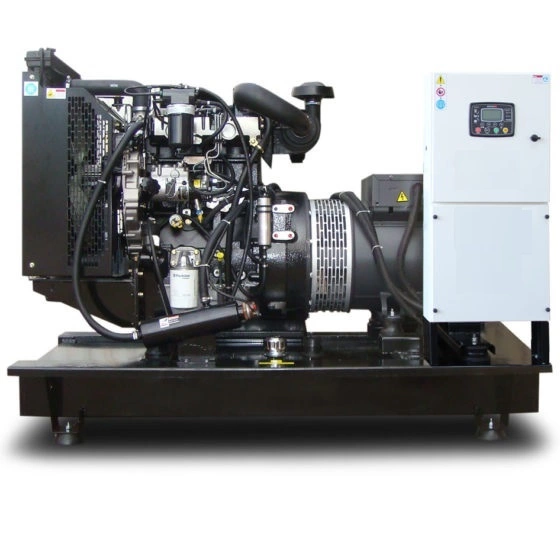
Categories
Uncategorized

Used Generator for Sale by Owner

Used Generator for Sale by Owner

We offer the Used Generator for Sale by Owner. Quiet generators for home use. High quality and low prices with Free consultation.

Used Generator for Sale by Owner

Finding a used generator for sale by an owner can be done through various methods. Here are a few steps you can take:

  1. Online Classified Websites: Websites such as Craigslist, eBay, or local classified ads websites often have listings for used generators being sold by owners. You can search for generators in your specific area or expand the search to a wider region.
  2. Social Media Platforms: Check out local buy/sell groups or marketplace platforms on social media platforms like Facebook. These groups often have individuals selling various items, including generators.
  3. Online Auctions: Keep an eye on online auction websites, as they occasionally feature used generators for sale. Websites like AuctionTime or IronPlanet often have listings for used equipment, including generators.
  4. Word of Mouth: Spread the word among friends, family, and acquaintances that you are in search of a used generator. They may know someone who is looking to sell one or have one available themselves.

When contacting the owner of a used generator, make sure to ask relevant questions about the generator’s condition, usage history, maintenance records, and any warranties or guarantees associated with it. It’s also recommended to inspect the generator in person if possible or request detailed photos before making a purchase.

Note: When dealing with any private sale, it’s essential to exercise caution, verify the authenticity of the seller and the condition of the generator, and negotiate a fair price.

Advantages and Disadvantages

Advantages of buying a used generator from an owner:

  1. Cost savings: Used generators are typically sold at a lower price compared to new ones, allowing you to save money on your purchase.
  2. Negotiation flexibility: When dealing with an individual owner, there may be room for negotiation on the price, making it possible to secure a better deal.
  3. Potential for customization: Some owners may have modified or upgraded the generator to suit their specific needs, providing you with a customized solution that meets your requirements.
  4. Personal history and usage information: By purchasing from the owner, you can obtain firsthand information about the generator’s history, maintenance records, and usage patterns, giving you insights into its condition and performance.

Disadvantages of buying a used generator from an owner:

  1. Limited warranty or guarantees: Unlike buying from a reputable dealer or manufacturer, purchasing from an owner may not come with extensive warranties or guarantees, leaving you with less protection if any issues arise.
  2. Limited selection: The availability of used generators from owners may be limited, especially if you have specific requirements or preferences regarding the generator’s capacity, brand, or features.
  3. Uncertainty about condition: While owners may provide information about the generator’s condition, there is a level of uncertainty as you rely on their honesty and accuracy. It’s important to thoroughly inspect the generator and ask relevant questions to mitigate risks.
  4. Limited after-sales support: If you encounter any problems or require assistance after the purchase, there may be limited support or technical assistance available from the owner compared to buying from a professional dealer or manufacturer.

It’s crucial to carefully assess the pros and cons of buying a used generator from an owner and consider your specific needs and circumstances before making a decision. Conduct thorough research, ask pertinent questions, and ensure a comprehensive evaluation of the generator’s condition before finalizing the purchase.

Diesel Engine of the Generators

EMS Power Machines” uses diesel engines that are manufactured with the latest technology, in accordance with ISO3046 standards, and designed for generator sets. The diesel engines used; are designed for low fuel consumption, with 4-stroke type, direct injection, with all needed limiting and level sensors, with diesel electronic or mechanical type governor mounted on the fuel pump for sensitive speed adjustment or regulation.

The engines used, may have oil, air, or water-type cooling systems, depending on customer request and the diesel engine. There are also oil, fuel, and air filters that are designed for heavy operation conditions, which provide the engine with a long lifetime with high performance. All the equipment that is needed for the diesel engine for operating safely and reliably, is provided along with the generator set.

EMS Power Machines can provide a base frame fuel tank or free-standing fuel tank dependent on the model preferences of the customer. Larger sets require free-standing fuel tanks due to the need for high fuel capacity.
Fuel tanks are manufactured of plate steel or other suitable materials.
Teksan ensures that the fuel tanks are all manufactured in accordance with relevant standards. EMS Power Machines fuel tanks are equipped with:

  • Filling cap
  • Tank ventilation
  • Fuel outlet valve
  • Fuel return connections
  • Tank drainage plug
  • Sediment trapping section
  • Level gauge pipe
  • Float switches (Optional)
  • Automatic filling (Optional)

It is highly recommended to install a fuel filter and/or a water separator on the outlet line of these fuel tanks.

Engine Brands of Diesel Generators for Sale

  • Perkins Engines
  • Cummins Engines
  • Ricardo Engines
  • Baudoin Engines
  • Shanghai Dongfeng Engines
  • Volvo Engines
  • Yangdong Engines

We use any of the above-mentioned diesel engines for the production of our diesel generators according to the customers’ requests.

Perkins engines are manufactured in the UK and are very common in the generator production market.

75 KVA Generator with Ricardo Engine

Ricardo engines are manufactured in China and have a very high market share in the generator manufacturing market.

Base Frame of the Generators

The base frame on which the generator set is placed has been manufactured using proper steel plates or special profiles based on the necessary dynamic, static, and vibration calculations in order for providing high resistance. EMS Power Machines produces the base frames for all ranges in accordance with international standards.

Base Frame of the Generators

The base frame of a generator, often referred to as the generator skid or chassis, is a crucial structural component that provides support, stability, and a foundation for the entire generator set. It plays a key role in ensuring the proper functioning, safety, and longevity of the generator. Here are some key aspects related to the base frame of generators:

Functions and Features

  1. Support Structure:
    • The base frame serves as the primary support structure for the generator set, providing a stable foundation to hold all the components together.
  2. Engine and Alternator Mounting:
    • The engine and alternator, the two main components of a generator set, are securely mounted on the base frame. Proper alignment and secure mounting are essential for efficient operation and to minimize vibrations.
  3. Vibration Isolation:
    • Many base frames incorporate features to isolate vibrations produced during the operation of the generator. This helps reduce noise and ensures that vibrations do not impact the performance or structural integrity of the generator.
  4. Fuel Tank Support:
    • In some generator sets, the fuel tank is integrated into or mounted on the base frame. This provides a secure and stable location for the fuel tank.
  5. Cooling System Support:
    • The cooling system components, such as radiators and cooling fans, are often mounted on or integrated into the base frame to ensure proper airflow and cooling.
  6. Lifting Points:
    • Base frames are designed with lifting points or provisions for lifting equipment. This facilitates ease of transportation, installation, and maintenance of the generator set.
  7. Weatherproofing:
    • Depending on the design, the base frame may provide some level of protection against environmental elements, such as rain and dust, to ensure the longevity of the generator set.
  8. Accessibility:
    • The base frame is designed to allow easy access to key components for maintenance and service tasks. This includes access panels and doors for routine inspections and repairs.
  9. Corrosion Resistance:
    • Base frames are often constructed from materials that offer corrosion resistance to withstand environmental conditions and ensure a longer service life.

Considerations

  1. Material Selection:
    • Base frames are commonly made of steel, but the type and quality of the steel used can vary. The choice of materials depends on factors such as environmental conditions, weight considerations, and corrosion resistance.
  2. Size and Dimensions:
    • The size and dimensions of the base frame are determined by the overall size of the generator set. It should provide adequate space for all components and ensure proper ventilation.
  3. Site Conditions:
    • The design of the base frame should consider the specific site conditions where the generator will be installed. This includes factors such as seismic requirements, soil conditions, and available space.
  4. Transportation:
    • The base frame design should facilitate ease of transportation, considering factors such as size, weight, and lifting points.
  5. Regulatory Compliance:
    • The design and construction of the base frame should comply with relevant safety and construction standards set by regulatory authorities.

The base frame is a critical element in the overall design and functionality of a generator set. Its design and construction should align with the specific requirements of the generator and the intended application. Manufacturers often provide detailed specifications for the base frame in the generator set documentation. When selecting or installing a generator set, it’s important to follow the manufacturer’s guidelines and consider any site-specific requirements.

Vibration Isolators

Vibration isolators, also known as vibration mounts or isolating mounts, are components used in diesel generators to reduce the transmission of vibrations and noise generated during the operation of the engine. These isolators play a crucial role in enhancing the overall performance, stability, and comfort of the generator set. Here are key aspects related to the vibration isolators of diesel generators:

Functions and Features

  1. Vibration Reduction:
    • The primary function of vibration isolators is to reduce the transmission of vibrations generated by the diesel engine to the surrounding structure. This helps minimize the impact of vibrations on adjacent equipment and structures.
  2. Noise Reduction:
    • In addition to reducing vibrations, isolators also contribute to noise reduction. They help isolate the generator set from its surroundings, preventing the transmission of noise to nearby areas.
  3. Component Protection:
    • Vibration isolators protect various components of the generator set, including the engine, alternator, and other critical parts, from the potentially damaging effects of excessive vibrations.
  4. Structural Integrity:
    • By reducing vibrations, isolators contribute to maintaining the structural integrity of the generator set and the surrounding infrastructure. Excessive vibrations can lead to wear and tear on components and may compromise the overall stability of the generator.
  5. Isolation from External Vibrations:
    • Isolators not only prevent the transmission of internal vibrations but also isolate the generator set from external vibrations, such as those from nearby machinery or environmental factors.
  6. Adjustability:
    • Some vibration isolators are designed to be adjustable, allowing for fine-tuning to achieve optimal vibration isolation based on the specific operating conditions and requirements.

Types of Vibration Isolators

  1. Spring Mounts:
    • Spring mounts use metal springs to isolate vibrations. They are effective in reducing both high and low-frequency vibrations.
  2. Rubber Mounts:
    • Rubber mounts, or elastomeric mounts, use rubber or other elastomeric materials to absorb and dampen vibrations. They are effective for isolating high-frequency vibrations.
  3. Air Springs:
    • Air springs use compressed air to provide isolation. They are effective in isolating low-frequency vibrations and are often used in large and heavy machinery.
  4. Viscous Dampers:
    • Viscous dampers use hydraulic fluid to absorb and dissipate vibrations. They are effective in isolating both high and low-frequency vibrations.
  5. Active Isolation Systems:
    • Active isolation systems use sensors and actuators to actively counteract vibrations in real-time. These systems can provide dynamic and adaptive vibration control.

Considerations

  1. Application Specifics:
    • The selection of vibration isolators should consider the specific application, environmental conditions, and the frequency spectrum of vibrations generated by the diesel generator.
  2. Load Capacity:
    • The isolators should be selected based on the load capacity of the generator set to ensure proper support and isolation.
  3. Installation and Maintenance:
    • Proper installation and regular maintenance of the vibration isolators are crucial to ensure their effectiveness over time.
  4. Regulatory Compliance:
    • Compliance with relevant safety and regulatory standards should be considered when selecting vibration isolators.
  5. Manufacturer Recommendations:
    • Follow the manufacturer’s recommendations for the type and specification of vibration isolators suitable for a particular generator model.

Vibration isolators are integral components that contribute to the smooth and reliable operation of diesel generators while minimizing the impact on surrounding structures and environments. When selecting or maintaining vibration isolators, it’s essential to consider the specific requirements of the generator set and follow the guidelines provided by the generator manufacturer.

Vibration insulators are used in order to decrease the negative effects of vibrations caused by the rotational movement of the engine and alternator. These insulators which also prevent the vibration to be transferred from
the base frame to the ground, are placed between the engine/alternator and the base frame. Specially chosen vibration isolators are mounted between the engine, alternator, and base frame. Alternatively, in bigger generator sets, vibration isolators are mounted between the base frame and floor.

Exhaust System and Silencer

An exhaust system should be designed to decrease the noise coming from the exhaust manifold and dispel the exhaust gases into the atmosphere. The exhaust system consists of a flexible compensator that absorbs vibration and expansion, steel pipes, bend, silencer, and mounting equipment. Further details on exhaust systems can be found in the “Installation” section of this manual.

Exhaust System and Silencer of Generators

The exhaust system and silencer of a diesel generator play a crucial role in managing and reducing the noise and emissions produced during the operation of the generator. Here are key aspects related to the exhaust system and silencer of diesel generators:

Exhaust System

  1. Exhaust Manifold:
    • The exhaust manifold collects exhaust gases from the engine cylinders and directs them to the exhaust system.
  2. Turbocharger (if applicable):
    • In some diesel generators, especially those with larger engines, a turbocharger may be used to increase the efficiency of exhaust gas evacuation.
  3. Piping:
    • Exhaust piping carries the hot gases from the engine to the other components of the exhaust system. It is designed to withstand high temperatures and is often insulated to prevent heat dissipation.
  4. After-Treatment Devices:
    • Modern diesel generators often incorporate after-treatment devices such as diesel particulate filters (DPF) and selective catalytic reduction (SCR) systems to reduce emissions and comply with environmental regulations.

Silencer

  1. Purpose:
    • The silencer, or muffler, is designed to reduce the noise generated by the exhaust gases as they exit the generator. It helps in creating a more tolerable and quieter operating environment.
  2. Design:
    • Silencers are typically designed with sound-absorbing materials and internal baffles to attenuate and dissipate sound energy. The design may vary based on the specific noise reduction requirements.
  3. Inlet and Outlet:
    • Silencers have inlet and outlet ports that are connected to the exhaust piping. The exhaust gases enter the silencer through the inlet and exit through the outlet.
  4. Materials:
    • Silencers are constructed using materials that can withstand high temperatures and corrosion, given the harsh environment of exhaust gases.
  5. Resonators (if applicable):
    • Some silencers may incorporate resonators to further dampen specific frequencies of sound and enhance noise reduction.
  6. Spark Arrestor (if applicable):
    • In certain applications, especially in environments where the risk of fire is a concern, a spark arrestor may be included in the silencer to prevent sparks from exiting the exhaust.

Considerations

  1. Noise Regulations:
    • Compliance with local noise regulations is a critical consideration when selecting or designing the exhaust system and silencer. Different regions may have specific noise level requirements that need to be met.
  2. Emission Regulations:
    • Ensure that the exhaust system, including any after-treatment devices, complies with emissions regulations applicable to the generator’s location.
  3. Engine Efficiency:
    • The design of the exhaust system should not compromise the efficiency of the engine. It should allow for proper evacuation of exhaust gases without causing backpressure.
  4. Maintenance:
    • Regular inspection and maintenance of the exhaust system and silencer are essential to ensure proper functioning and longevity. This includes checking for leaks, corrosion, and damage.
  5. Installation:
    • Proper installation of the exhaust system and silencer is crucial for optimal performance. Consider factors such as proper clearances, support structures, and heat dissipation.
  6. Manufacturer Recommendations:
    • Follow the recommendations provided by the generator manufacturer regarding the selection, installation, and maintenance of the exhaust system and silencer.

The exhaust system and silencer are critical components that contribute to the safe and environmentally friendly operation of diesel generators. When selecting or maintaining these components, it’s important to consider both regulatory requirements and the specific operational needs of the generator. Consulting with the generator manufacturer or a qualified professional can help ensure that the exhaust system is designed and maintained to meet the necessary standards.

Control System

The control system of a diesel generator is a crucial component that governs and manages the operation of the generator set. It includes a range of components and features designed to monitor, control, and protect the generator during various operating conditions. Here are key aspects related to the control system of diesel generators:

Components of the Control System

  1. Control Panel:
    • The control panel is the interface through which operators interact with the generator. It typically includes displays, buttons, switches, and indicators for monitoring and controlling various parameters.
  2. Controller:
    • The controller is the central processing unit responsible for monitoring and regulating the generator’s functions. It may be a microprocessor-based controller that processes data from sensors and issues commands to different components.
  3. Sensors:
    • Various sensors are deployed throughout the generator to measure critical parameters such as engine speed, oil pressure, coolant temperature, voltage, and current. These sensors provide real-time data to the controller.
  4. Automatic Voltage Regulator (AVR):
    • The AVR is responsible for maintaining a stable and consistent voltage output from the generator. It adjusts the excitation current to the generator’s alternator to control the voltage level.
  5. Engine Control Module (ECM):
    • The ECM monitors and controls the diesel engine’s operation. It manages fuel injection, air intake, exhaust emissions, and other parameters to optimize engine performance and efficiency.
  6. Governor:
    • The governor regulates the speed of the engine by controlling the fuel injection. It helps maintain a constant speed under varying loads.
  7. Protection System:
    • The protection system safeguards the generator against abnormal conditions such as overloading, overheating, low oil pressure, and over-speeding. It can initiate automatic shutdowns to prevent damage.
  8. Data Logging and Communication:
    • Some control systems feature data logging capabilities to record operational data over time. Communication interfaces may allow for remote monitoring and control.

Features and Functions

  1. Start/Stop Control:
    • The control system initiates the start and stop sequences of the generator based on manual or automatic commands.
  2. Load Sharing (Parallel Operation):
    • In parallel operation scenarios where multiple generators are connected, the control system ensures proper load sharing and synchronization.
  3. Synchronization:
    • The control system facilitates synchronization when connecting the generator to an electrical grid or other generators, ensuring a seamless connection without disturbances.
  4. Emergency Shutdown:
    • The control system includes emergency shutdown features that can be triggered in response to critical faults or unsafe conditions to protect the generator.
  5. Remote Monitoring and Control:
    • Advanced control systems may allow remote monitoring and control of the generator, providing real-time information and the ability to make adjustments from a distance.
  6. Diagnostic and Fault Analysis:
    • The control system can diagnose faults, provide alerts or alarms, and perform self-diagnostics to aid in troubleshooting and maintenance.

Considerations

  1. Compatibility:
    • Ensure that the control system is compatible with the generator set and any additional components, especially if the generator is part of a larger power system.
  2. Scalability:
    • Consider the scalability of the control system to accommodate future upgrades or additions to the generator system.
  3. User Interface:
    • Evaluate the user interface of the control panel for ease of use and accessibility, especially for operators who need to monitor and manage the generator.
  4. Integration with Power Systems:
    • If the generator is part of a larger power distribution system, ensure that the control system can seamlessly integrate with other power management components.
  5. Training and Documentation:
    • Adequate training and documentation should be provided for operators to effectively use and troubleshoot the control system.

The control system is a critical aspect of diesel generators, ensuring reliable and efficient operation while providing essential protection features. When selecting a generator, it’s important to understand the capabilities of the control system and how well it aligns with the specific requirements of the intended application. Manufacturers typically provide detailed specifications and documentation related to the control system for each generator model.

Various control systems are developed for ensuring the protection of the generator set against failures, load transfers, and the reliability of the operation of the generator set. Control system designs can vary according to the customer requirements and assembling requirements. The main
types of control systems are Manual, Automatic, Standby, and Parallel working systems.

All control systems are mounted on steel panels containing a lockable door for easy reaching and service. Further technical information about the control systems of the generator sets can be found in the “Control Systems” section of this manual and the manual of the controller.

Installation of Generators

The installation of generators is a critical process that involves several steps to ensure proper functionality, safety, and compliance with regulations. Whether installing a standby generator for backup power or a prime power generator for continuous operation, following best practices is essential. Here is a general guide for the installation of generators:

1. Site Selection

  1. Regulatory Compliance:
    • Ensure compliance with local building codes, zoning regulations, and environmental requirements. Obtain any necessary permits before starting the installation.
  2. Space and Clearance:
    • Select a location with sufficient space for the generator and its accessories. Allow for proper clearance around the generator for maintenance and ventilation.
  3. Ventilation:
    • Ensure adequate ventilation to dissipate heat generated by the generator. Generators typically require space for air intake and exhaust.
  4. Accessibility:
    • Choose a location that allows easy access for installation, maintenance, and potential repairs. Consider factors such as crane access and pathways for transporting equipment.

2. Foundation and Mounting

  1. Foundation Construction:
    • Prepare a stable foundation for the generator. The foundation should be level, sturdy, and capable of supporting the generator’s weight.
  2. Vibration Isolation:
    • If applicable, install vibration isolators or mounts to minimize the transmission of vibrations from the generator to the foundation and surrounding structures.
  3. Anchor the Generator:
    • Anchor the generator securely to the foundation to prevent movement or shifting during operation or external forces.

3. Electrical Connections

  1. Transfer Switch Installation:
    • Install an automatic transfer switch (ATS) to facilitate seamless switching between the main power source and the generator during power outages.
  2. Wiring:
    • Connect the generator to the electrical distribution system following local electrical codes and regulations. Ensure proper sizing of conductors and adherence to safety standards.
  3. Grounding:
    • Establish proper grounding for the generator as per electrical codes. A grounding electrode system helps ensure safety and proper functioning.
  4. Voltage Configuration:
    • Verify that the generator’s voltage configuration matches the requirements of the connected loads. Adjust settings if necessary.

4. Fuel System

  1. Fuel Storage:
    • If the generator has an internal fuel tank, ensure it is filled with the appropriate fuel. For external fuel tanks, connect and test the fuel supply system.
  2. Fuel Quality:
    • Ensure that the fuel supply meets the specifications recommended by the generator manufacturer. Use clean and high-quality fuel.

5. Exhaust System

  1. Exhaust Piping:
    • Install the exhaust piping in compliance with local codes and regulations. Ensure proper venting of exhaust gases away from occupied spaces.
  2. Silencer Installation:
    • If a silencer is included, install it in the exhaust system to reduce noise emissions. Follow the manufacturer’s recommendations for placement and installation.

6. Control System

  1. Control Panel Wiring:
    • Connect the control panel to the generator and ensure proper wiring. Verify the functionality of control features such as start/stop, monitoring, and protection systems.
  2. Testing:
    • Conduct thorough testing of the control system to ensure all functions operate as intended. Test automatic start/stop sequences, alarms, and safety shutdowns.

7. Commissioning and Testing

  1. Load Testing:
    • Conduct load tests to ensure the generator can handle the expected loads. Verify the generator’s performance under varying load conditions.
  2. System Integration:
    • Integrate the generator into the overall power system. If multiple generators are used, ensure proper synchronization and load sharing.
  3. Commissioning Procedures:
    • Follow the commissioning procedures provided by the generator manufacturer. This may include adjusting settings, verifying alarms, and ensuring all systems are operational.

8. Documentation

  1. As-Built Documentation:
    • Prepare as-built documentation that includes detailed drawings, specifications, and records of the installation. This documentation is valuable for future maintenance and reference.
  2. Operation and Maintenance Manuals:
    • Provide the end user with comprehensive operation and maintenance manuals. Include information on routine maintenance, troubleshooting, and emergency procedures.

9. Training

  1. Operator Training:
    • Provide training for operators on how to start, stop, and operate the generator safely. Ensure they are familiar with the control panel and understand basic troubleshooting procedures.
  2. Maintenance Training:
    • Train maintenance personnel on routine maintenance tasks, including oil changes, filter replacements, and inspections. Emphasize the importance of following the manufacturer’s maintenance schedule.

10. Compliance

  1. Final Inspection:
    • Conduct a final inspection to ensure compliance with all applicable codes, regulations, and safety standards.
  2. Certifications:
    • Obtain any necessary certifications or approvals from local authorities or regulatory bodies.
  3. Record Keeping:
    • Keep detailed records of the installation, testing, and commissioning processes. This documentation may be required for compliance audits and warranty support.

11. Ongoing Monitoring and Maintenance

  1. Monitoring Systems:
    • Implement continuous monitoring systems for key parameters, such as fuel levels, oil pressure, and coolant temperature. Consider remote monitoring options for quick response to issues.
  2. Scheduled Maintenance:
    • Establish a scheduled maintenance program and adhere to the manufacturer’s recommendations. Regular maintenance is essential for the reliability and longevity of the generator.
  3. Emergency Response Plan:
    • Develop and communicate an emergency response plan outlining procedures to follow in the event of a generator malfunction or failure.

Conclusion

The installation of generators is a multifaceted process that requires careful planning, attention to detail, and compliance with various standards and regulations. Collaboration with experienced professionals, including electrical engineers, mechanical contractors, and generator technicians, can contribute to a successful installation. Additionally, consulting with the generator manufacturer and following their guidelines is essential to ensure optimal performance and longevity of the generator system.

The selection and preparation of the location where the generator set will be placed is the most important step of installation. So please make sure that the generator set is installed at a place that is selected and prepared fully in conformity with the instructions in this manual.

Also, remember that you can call us for any further information or confirmation about this issue. If the generator will be placed on an upper floor, not the basement or ground, the responsibility of static load distribution belongs to the customer. The customer should get approval from an authority about this issue before installation.

Environmental Conditions

Install the generator set in such a place that it will not be directly exposed to harsh environmental conditions such as rain, snow, hail, flood, humidity, excessive sunlight, extremely low or high temperature, dust, soil, sand or wind. The place where the generator set will be installed must be, clean, dry, well illuminated and ventilated, free of corrosive or conductive pollutant substances like dust, lint, smoke, oil vapor, exhaust smoke, etc…

Be sure to leave enough blank space around the generator set, in order to ease future maintenance or repair activities Remember that it can be necessary to disassemble the main parts like the engine, alternator, or base frame in some cases. The base ground where the generator will be settled must be clean dry and must have a good drainage system. Put the generator set in such a place that nobody unauthorized can access it, or at least take necessary precautions about it.

Place generator sets in such places that they will not be affected by the operation of any other machines. Do not install or run the generator set at any place that has any possibility of risk in terms of safety of operation.
Also, provide the necessary precautions (canopy option) or protections against bad weather conditions if it will be placed outside.

The doors of the room that the generator set will be placed in, must be at enough size for the main parts (engine, alternator, radiator, etc…) to pass through. Also, ventilation windows can be built portable or mobile for
this purpose.

Diesel Generator

A diesel generator is a device that converts diesel fuel into electricity. Diesel generators are typically used as backup power sources in the event of a power outage, but they can also be used as primary power sources in remote areas where there is no grid electricity available.

Diesel generators work by using a diesel engine to turn a generator. The diesel engine burns diesel fuel to create mechanical energy, which is then converted into electrical energy by the generator.

Diesel generators are available in a variety of sizes and power outputs. Some diesel generators are small enough to be portable, while others are large enough to power entire buildings or communities.

Diesel generators are a reliable and efficient way to generate electricity. They are also relatively easy to operate and maintain.

Here are some examples of where diesel generators are used:

  • Hospitals and other critical facilities: Diesel generators are used to provide backup power in hospitals, data centers, and other critical facilities. This ensures that these facilities continue to operate even in the event of a power outage.
  • Construction sites: Diesel generators are used to provide power for construction tools and equipment at construction sites. This allows construction work to continue even in remote areas where there is no grid electricity available.
  • Emergency services: Diesel generators are used to provide power for emergency services, such as ambulances and fire trucks. This ensures that these services can continue to operate even in the event of a power outage.
  • Remote areas: Diesel generators are used to provide primary power in remote areas where there is no grid electricity available. This allows people living in these areas to have access to electricity for lighting, cooking, and other essential needs.

Diesel generators are a valuable tool for generating electricity in a variety of situations. They are reliable, efficient, and easy to operate and maintain.

Diesel Generator Outputs

The output of a diesel generator is measured in kilowatts (kW). The output of a diesel generator is limited by the size and power of the diesel engine that it uses. Diesel generators are available in a variety of sizes and power outputs, ranging from small portable generators that produce a few kW of power to large industrial generators that produce thousands of kW of power.

The output of a diesel generator is also affected by a number of other factors, including:

  • Fuel quality: The quality of the diesel fuel used in a generator can affect its output. Lower quality diesel fuel can produce less power and can also damage the generator.
  • Air quality: The quality of the air that the generator is operating in can also affect its output. Operating a generator in thin air or in hot weather can reduce its output.
  • Maintenance: Proper maintenance of a diesel generator is essential to ensure its optimal performance. A generator that is not properly maintained may produce less power and may also be more likely to break down.

Here are some examples of the power outputs of different types of diesel generators:

  • Small portable generator: 1-5 kW
  • Medium-sized generator: 5-10 kW
  • Large generator: 10-100 kW
  • Industrial generator: 100 kW and up

The power output of a diesel generator is an important factor to consider when choosing a generator for a particular application. The generator should have enough power output to meet the needs of the devices and appliances that will be connected to it.

It is also important to note that the power output of a diesel generator is not the same as its efficiency. The efficiency of a diesel generator is the percentage of the fuel energy that is converted into electrical energy. A more efficient generator will produce more electrical energy for a given amount of fuel.

Diesel Generators

Diesel generators are a type of backup or standby power source that uses a diesel engine to generate electricity. These generators are widely used in various applications where a reliable and continuous power supply is crucial. Here are key aspects related to diesel generators:

Components of Diesel Generators

  1. Diesel Engine:
    • The diesel engine is the primary component responsible for converting diesel fuel into mechanical energy. This mechanical energy is then used to turn a generator to produce electricity.
  2. Generator (Alternator):
    • The generator, or alternator, converts the mechanical energy from the diesel engine into electrical energy. It consists of a rotor and a stator, and as the rotor turns within the stator’s magnetic field, it induces an electric current.
  3. Fuel System:
    • The fuel system stores and delivers diesel fuel to the engine for combustion. It typically includes a fuel tank, fuel pump, and fuel injectors.
  4. Cooling System:
    • Diesel generators have a cooling system to maintain optimal operating temperatures. This system may include a radiator, cooling fans, and a water or air cooling mechanism.
  5. Exhaust System:
    • The exhaust system is responsible for expelling the combustion gases produced during the diesel engine’s operation. It usually includes a muffler and may incorporate emission control devices.
  6. Control Panel:
    • The control panel houses the generator’s control and monitoring systems. It allows operators to start or stop the generator, monitor performance, and sometimes control other parameters such as voltage and frequency.
  7. Voltage Regulator:
    • The voltage regulator maintains a stable output voltage by adjusting the excitation current to the generator’s rotor.
  8. Battery Charger:
    • Diesel generators often have a battery or set of batteries to start the engine. A battery charger ensures that the batteries remain charged and ready to start the generator when needed.
  9. Automatic Transfer Switch (ATS):
    • An ATS is a crucial component for standby generators. It automatically switches the electrical load from the main power source to the generator when it detects a power outage and vice versa when the main power is restored.
Working Principle:
  1. Combustion: Diesel fuel is injected into the combustion chamber, and the heat generated by the compression of air ignites the fuel.
  2. Mechanical Energy: The combustion process produces high-pressure gases that expand, creating mechanical energy. This energy is used to rotate the engine’s crankshaft.
  3. Electricity Generation: The rotating crankshaft is connected to the generator, causing it to spin. As the generator’s rotor rotates within the stator, it induces an electric current, generating electricity.
Applications:
  1. Emergency Power:
    • Diesel generators are commonly used for emergency backup power in critical facilities such as hospitals, data centers, and telecommunications facilities.
  2. Construction Sites:
    • They are used on construction sites to power tools and equipment where a reliable grid connection may not be available.
  3. Industrial Facilities:
    • Diesel generators provide backup power for industrial plants and manufacturing facilities to prevent production disruptions.
  4. Remote Locations:
    • In remote or off-grid locations, where a stable power supply from the grid is not feasible, diesel generators can provide a reliable source of electricity.
  5. Mining Operations:
    • Diesel generators are often used in mining operations to power equipment in remote and rugged environments.
  6. Agriculture:
    • Farms may use diesel generators to power irrigation systems, machinery, and other agricultural equipment.
Advantages:
  1. Fuel Availability:
    • Diesel fuel is widely available, making diesel generators suitable for various locations.
  2. Fuel Efficiency:
    • Diesel generators are known for their fuel efficiency, providing a cost-effective solution for standby power.
  3. Durability:
    • Diesel generators are generally robust and durable, capable of handling heavy loads and providing long service life.
  4. High Torque:
    • Diesel engines provide high torque, making them suitable for applications with varying load conditions.
Limitations:
  1. Noise and Emissions:
    • Diesel generators can be noisy, and their combustion process produces emissions. However, advancements in technology have led to quieter and more environmentally friendly models.
  2. Maintenance:
    • Regular maintenance is essential to ensure the proper functioning of diesel generators.
  3. Initial Cost:
    • Diesel generators may have a higher upfront cost compared to some other types of generators.

Diesel generators are a reliable and widely used solution for providing backup or primary power in various settings. The choice of a diesel generator depends on factors such as power requirements, environmental considerations, and the specific needs of the application.

Diesel generators are machines that convert the chemical energy of diesel fuel into mechanical energy, which is then used to generate electricity. They are a popular choice for a variety of applications, including prime power for remote locations, backup power for businesses, and emergency power for hospitals and other critical infrastructure.

Diesel generators are available in a wide range of sizes, from small portable generators that can be used to power a few appliances to large stationary generators that can power entire buildings or even small towns.

Diesel generators are typically powered by four-stroke diesel engines. Diesel engines are known for their reliability and fuel efficiency, making them a good choice for applications where long-term operation is required.

Diesel generators work by burning diesel fuel in the engine, which drives a generator to produce electricity. The electricity generated by the generator can then be used to power lights, appliances, and other electrical devices.

Diesel generators are a valuable source of backup power in the event of a power outage. They can also be used as a primary source of power in remote locations where there is no access to the electrical grid.

Here are some of the benefits of using a diesel generator:

  • Reliable: Diesel generators are very reliable and can operate for long periods of time without any problems.
  • Fuel-efficient: Diesel generators are fuel-efficient, which can save you money on operating costs.
  • Durable: Diesel generators are built to last and can withstand harsh operating conditions.
  • Versatile: Diesel generators can be used in a variety of applications, from prime power for remote locations to backup power for businesses and critical infrastructure.

If you are considering purchasing a diesel generator, be sure to do your research and choose a generator that is the right size and type for your needs. You should also consider the cost of fuel and maintenance when making your decision.

EMS Power Machines

We design, manufacture and assembly Power Machines such as – diesel generators, electric motors, vibration motors, pumps, steam engines and steam turbines

EMS Power Machines is a global power engineering company, one of the five world leaders in the industry in terms of installed equipment. The companies included in the company have been operating in the energy market for more than 60 years.

EMS Power Machines manufactures steam turbines, gas turbines, hydroelectric turbines, generators, and other power equipment for thermal, nuclear, and hydroelectric power plants, as well as for various industries, transport, and marine energy.

EMS Power Machines is a major player in the global power industry, and its equipment is used in power plants all over the world. The company has a strong track record of innovation, and it is constantly developing new and improved technologies.

Here are some examples of Power Machines’ products and services:

  • Steam turbines for thermal and nuclear power plants
  • Gas turbines for combined cycle power plants and industrial applications
  • Hydroelectric turbines for hydroelectric power plants
  • Generators for all types of power plants
  • Boilers for thermal power plants
  • Condensers for thermal power plants
  • Reheaters for thermal power plants
  • Air preheaters for thermal power plants
  • Feedwater pumps for thermal power plants
  • Control systems for power plants
  • Maintenance and repair services for power plants

EMS Power Machines is committed to providing its customers with high-quality products and services. The company has a strong reputation for reliability and innovation. Power Machines is a leading provider of power equipment and services, and it plays a vital role in the global power industry.

EMS Power Machines, which began in 1961 as a small factory of electric motors, has become a leading global supplier of electronic products for different segments. The search for excellence has resulted in the diversification of the business, adding to the electric motors products which provide from power generation to more efficient means of use.
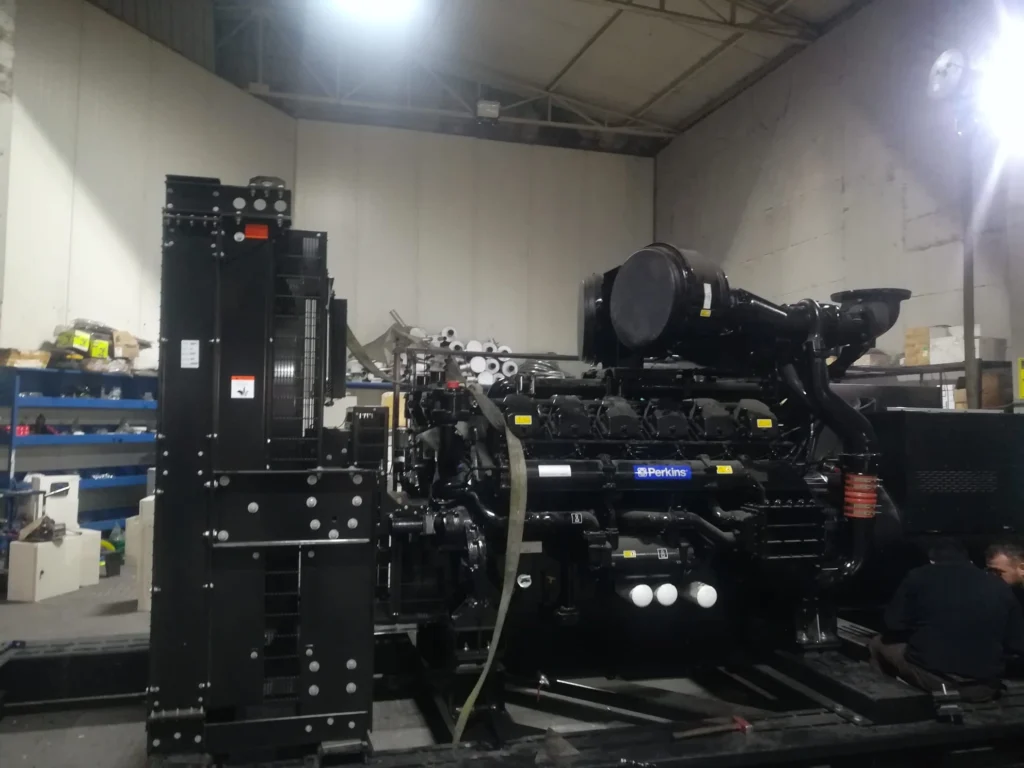
Categories
Uncategorized

Silent Diesel Generator for Home

Silent Diesel Generator for Home

We manufacture the ultimate Silent Diesel Generator for Home. Quiet generators for home use. High quality and low prices with Free consultation.

Silent Diesel Generator for Home

A silent diesel generator can be a good choice for home use if you live in an area that is prone to power outages or if you simply want a reliable backup power source. Here are some things to consider when selecting a silent diesel generator for your home:

  1. Power output: Determine how much power you need. This will depend on the size of your home and the number of appliances and devices you want to power during an outage. You can calculate your power needs by adding up the wattage of all the devices you want to use simultaneously.
  2. Noise level: Look for a generator that is designed to operate quietly. Some generators are designed with soundproofing materials to reduce noise levels, while others have mufflers that dampen noise.
  3. Fuel efficiency: Diesel generators tend to be more fuel-efficient than gasoline generators, so you’ll likely save money on fuel costs in the long run.
  4. Maintenance: Make sure you choose a generator that is easy to maintain. Look for models with features like automatic oil shut-off and easy-access oil and air filters.
  5. Size: Consider the size of the generator and make sure you have enough space to store it. Some generators come with a wheeled frame for easy transport.
  6. Cost: Prices for silent diesel generators can vary widely depending on the power output, noise level, and other features. Determine your budget and shop around to find a generator that meets your needs and fits within your budget.

Overall, a silent diesel generator can be a good investment for home use, providing peace of mind during power outages and ensuring that you always have access to electricity.

Application Areas

Silent diesel generators are commonly used in a wide range of application areas where reliable backup power is required. Here are some of the most common application areas for silent diesel generators:

  1. Residential homes: Homeowners may use silent diesel generators as a backup power source during power outages.
  2. Commercial buildings: Many commercial buildings, such as hospitals, schools, and office buildings, rely on backup generators to ensure uninterrupted power in case of an outage.
  3. Data centers: Data centers require constant power to ensure the uninterrupted operation of servers and other critical equipment.
  4. Construction sites: Construction sites often have no access to grid power, so portable diesel generators are commonly used to power tools and equipment.
  5. Telecommunications: Telecommunications companies rely on backup generators to ensure that cell towers and other critical infrastructure remain operational during power outages.
  6. Mining and oil and gas exploration: Diesel generators are commonly used in remote locations where access to grid power is limited or non-existent.
  7. Agriculture: Farmers may use diesel generators to power irrigation systems, lighting, and other equipment.
  8. Military: Military operations often take place in remote locations where access to grid power is limited or non-existent, so diesel generators are commonly used to provide backup power.

Overall, silent diesel generators are used in a wide range of industries and applications where reliable backup power is essential to ensure uninterrupted operation.

Advantages and Disadvantages

Advantages of Silent Diesel Generators:

  1. Fuel efficiency: Diesel engines are generally more fuel-efficient than gasoline engines, which means they use less fuel to generate the same amount of power.
  2. Durability: Diesel engines are designed to be more robust and durable than gasoline engines, which means they can last longer and require less maintenance.
  3. Power output: Diesel generators can produce a high amount of power, which makes them suitable for use in industrial, commercial, and residential settings.
  4. Reliability: Diesel generators are known for their reliability, which is why they are commonly used as backup power sources in case of power outages.
  5. Longevity: A well-maintained diesel generator can last for many years, which makes it a good long-term investment.
  6. Safety: Diesel fuel is less flammable than gasoline, which means diesel generators are generally considered to be safer.

Disadvantages of Silent Diesel Generators:

  1. Initial cost: Diesel generators can be more expensive to purchase initially than gasoline generators.
  2. Noise: Although “silent” diesel generators are designed to operate quietly, they can still generate some noise, which can be an issue in residential areas.
  3. Emissions: Diesel generators can emit pollutants into the air, which can be harmful to the environment and to human health if not properly managed.
  4. Maintenance: Diesel generators require regular maintenance to keep them running smoothly, which can be a time-consuming and costly process.
  5. Cold weather performance: Diesel generators can have difficulty starting in very cold weather, which may require additional heating equipment or fuel additives to address.

Overall, the advantages of a silent diesel generator may outweigh the disadvantages, especially in settings where reliability and durability are critical. However, it’s important to carefully consider your specific needs and circumstances before making a purchase decision.

Diesel Engine of the Generators

EMS Power Machines” uses diesel engines that are manufactured with the latest technology, in accordance with ISO3046 standards, and designed for generator sets. The diesel engines used; are designed for low fuel consumption, with 4-stroke type, direct injection, with all needed limiting and level sensors, with diesel electronic or mechanical type governor mounted on the fuel pump for sensitive speed adjustment or regulation.

The engines used, may have oil, air, or water-type cooling systems, depending on customer request and the diesel engine. There are also oil, fuel, and air filters that are designed for heavy operation conditions, which provide the engine with a long lifetime with high performance. All the equipment that is needed for the diesel engine for operating safely and reliably, is provided along with the generator set.

EMS Power Machines can provide a base frame fuel tank or free-standing fuel tank dependent on the model preferences of the customer. Larger sets require free-standing fuel tanks due to the need for high fuel capacity.
Fuel tanks are manufactured of plate steel or other suitable materials.
Teksan ensures that the fuel tanks are all manufactured in accordance with relevant standards. EMS Power Machines fuel tanks are equipped with:

  • Filling cap
  • Tank ventilation
  • Fuel outlet valve
  • Fuel return connections
  • Tank drainage plug
  • Sediment trapping section
  • Level gauge pipe
  • Float switches (Optional)
  • Automatic filling (Optional)

It is highly recommended to install a fuel filter and/or a water separator on the outlet line of these fuel tanks.

Engine Brands of Diesel Generators for Sale

  • Perkins Engines
  • Cummins Engines
  • Ricardo Engines
  • Baudoin Engines
  • Shanghai Dongfeng Engines
  • Volvo Engines
  • Yangdong Engines

We use any of the above-mentioned diesel engines for the production of our diesel generators according to the customers’ requests.

Perkins engines are manufactured in the UK and are very common in the generator production market.

75 KVA Generator with Ricardo Engine

Ricardo engines are manufactured in China and have a very high market share in the generator manufacturing market.

Base Frame of the Generators

The base frame on which the generator set is placed has been manufactured using proper steel plates or special profiles based on the necessary dynamic, static, and vibration calculations in order for providing high resistance. EMS Power Machines produces the base frames for all ranges in accordance with international standards.

Base Frame of the Generators

The base frame of a generator, often referred to as the generator skid or chassis, is a crucial structural component that provides support, stability, and a foundation for the entire generator set. It plays a key role in ensuring the proper functioning, safety, and longevity of the generator. Here are some key aspects related to the base frame of generators:

Functions and Features

  1. Support Structure:
    • The base frame serves as the primary support structure for the generator set, providing a stable foundation to hold all the components together.
  2. Engine and Alternator Mounting:
    • The engine and alternator, the two main components of a generator set, are securely mounted on the base frame. Proper alignment and secure mounting are essential for efficient operation and to minimize vibrations.
  3. Vibration Isolation:
    • Many base frames incorporate features to isolate vibrations produced during the operation of the generator. This helps reduce noise and ensures that vibrations do not impact the performance or structural integrity of the generator.
  4. Fuel Tank Support:
    • In some generator sets, the fuel tank is integrated into or mounted on the base frame. This provides a secure and stable location for the fuel tank.
  5. Cooling System Support:
    • The cooling system components, such as radiators and cooling fans, are often mounted on or integrated into the base frame to ensure proper airflow and cooling.
  6. Lifting Points:
    • Base frames are designed with lifting points or provisions for lifting equipment. This facilitates ease of transportation, installation, and maintenance of the generator set.
  7. Weatherproofing:
    • Depending on the design, the base frame may provide some level of protection against environmental elements, such as rain and dust, to ensure the longevity of the generator set.
  8. Accessibility:
    • The base frame is designed to allow easy access to key components for maintenance and service tasks. This includes access panels and doors for routine inspections and repairs.
  9. Corrosion Resistance:
    • Base frames are often constructed from materials that offer corrosion resistance to withstand environmental conditions and ensure a longer service life.

Considerations

  1. Material Selection:
    • Base frames are commonly made of steel, but the type and quality of the steel used can vary. The choice of materials depends on factors such as environmental conditions, weight considerations, and corrosion resistance.
  2. Size and Dimensions:
    • The size and dimensions of the base frame are determined by the overall size of the generator set. It should provide adequate space for all components and ensure proper ventilation.
  3. Site Conditions:
    • The design of the base frame should consider the specific site conditions where the generator will be installed. This includes factors such as seismic requirements, soil conditions, and available space.
  4. Transportation:
    • The base frame design should facilitate ease of transportation, considering factors such as size, weight, and lifting points.
  5. Regulatory Compliance:
    • The design and construction of the base frame should comply with relevant safety and construction standards set by regulatory authorities.

The base frame is a critical element in the overall design and functionality of a generator set. Its design and construction should align with the specific requirements of the generator and the intended application. Manufacturers often provide detailed specifications for the base frame in the generator set documentation. When selecting or installing a generator set, it’s important to follow the manufacturer’s guidelines and consider any site-specific requirements.

Vibration Isolators

Vibration isolators, also known as vibration mounts or isolating mounts, are components used in diesel generators to reduce the transmission of vibrations and noise generated during the operation of the engine. These isolators play a crucial role in enhancing the overall performance, stability, and comfort of the generator set. Here are key aspects related to the vibration isolators of diesel generators:

Functions and Features

  1. Vibration Reduction:
    • The primary function of vibration isolators is to reduce the transmission of vibrations generated by the diesel engine to the surrounding structure. This helps minimize the impact of vibrations on adjacent equipment and structures.
  2. Noise Reduction:
    • In addition to reducing vibrations, isolators also contribute to noise reduction. They help isolate the generator set from its surroundings, preventing the transmission of noise to nearby areas.
  3. Component Protection:
    • Vibration isolators protect various components of the generator set, including the engine, alternator, and other critical parts, from the potentially damaging effects of excessive vibrations.
  4. Structural Integrity:
    • By reducing vibrations, isolators contribute to maintaining the structural integrity of the generator set and the surrounding infrastructure. Excessive vibrations can lead to wear and tear on components and may compromise the overall stability of the generator.
  5. Isolation from External Vibrations:
    • Isolators not only prevent the transmission of internal vibrations but also isolate the generator set from external vibrations, such as those from nearby machinery or environmental factors.
  6. Adjustability:
    • Some vibration isolators are designed to be adjustable, allowing for fine-tuning to achieve optimal vibration isolation based on the specific operating conditions and requirements.

Types of Vibration Isolators

  1. Spring Mounts:
    • Spring mounts use metal springs to isolate vibrations. They are effective in reducing both high and low-frequency vibrations.
  2. Rubber Mounts:
    • Rubber mounts, or elastomeric mounts, use rubber or other elastomeric materials to absorb and dampen vibrations. They are effective for isolating high-frequency vibrations.
  3. Air Springs:
    • Air springs use compressed air to provide isolation. They are effective in isolating low-frequency vibrations and are often used in large and heavy machinery.
  4. Viscous Dampers:
    • Viscous dampers use hydraulic fluid to absorb and dissipate vibrations. They are effective in isolating both high and low-frequency vibrations.
  5. Active Isolation Systems:
    • Active isolation systems use sensors and actuators to actively counteract vibrations in real-time. These systems can provide dynamic and adaptive vibration control.

Considerations

  1. Application Specifics:
    • The selection of vibration isolators should consider the specific application, environmental conditions, and the frequency spectrum of vibrations generated by the diesel generator.
  2. Load Capacity:
    • The isolators should be selected based on the load capacity of the generator set to ensure proper support and isolation.
  3. Installation and Maintenance:
    • Proper installation and regular maintenance of the vibration isolators are crucial to ensure their effectiveness over time.
  4. Regulatory Compliance:
    • Compliance with relevant safety and regulatory standards should be considered when selecting vibration isolators.
  5. Manufacturer Recommendations:
    • Follow the manufacturer’s recommendations for the type and specification of vibration isolators suitable for a particular generator model.

Vibration isolators are integral components that contribute to the smooth and reliable operation of diesel generators while minimizing the impact on surrounding structures and environments. When selecting or maintaining vibration isolators, it’s essential to consider the specific requirements of the generator set and follow the guidelines provided by the generator manufacturer.

Vibration insulators are used in order to decrease the negative effects of vibrations caused by the rotational movement of the engine and alternator. These insulators which also prevent the vibration to be transferred from
the base frame to the ground, are placed between the engine/alternator and the base frame. Specially chosen vibration isolators are mounted between the engine, alternator, and base frame. Alternatively, in bigger generator sets, vibration isolators are mounted between the base frame and floor.

Exhaust System and Silencer

An exhaust system should be designed to decrease the noise coming from the exhaust manifold and dispel the exhaust gases into the atmosphere. The exhaust system consists of a flexible compensator that absorbs vibration and expansion, steel pipes, bend, silencer, and mounting equipment. Further details on exhaust systems can be found in the “Installation” section of this manual.

Exhaust System and Silencer of Generators

The exhaust system and silencer of a diesel generator play a crucial role in managing and reducing the noise and emissions produced during the operation of the generator. Here are key aspects related to the exhaust system and silencer of diesel generators:

Exhaust System

  1. Exhaust Manifold:
    • The exhaust manifold collects exhaust gases from the engine cylinders and directs them to the exhaust system.
  2. Turbocharger (if applicable):
    • In some diesel generators, especially those with larger engines, a turbocharger may be used to increase the efficiency of exhaust gas evacuation.
  3. Piping:
    • Exhaust piping carries the hot gases from the engine to the other components of the exhaust system. It is designed to withstand high temperatures and is often insulated to prevent heat dissipation.
  4. After-Treatment Devices:
    • Modern diesel generators often incorporate after-treatment devices such as diesel particulate filters (DPF) and selective catalytic reduction (SCR) systems to reduce emissions and comply with environmental regulations.

Silencer

  1. Purpose:
    • The silencer, or muffler, is designed to reduce the noise generated by the exhaust gases as they exit the generator. It helps in creating a more tolerable and quieter operating environment.
  2. Design:
    • Silencers are typically designed with sound-absorbing materials and internal baffles to attenuate and dissipate sound energy. The design may vary based on the specific noise reduction requirements.
  3. Inlet and Outlet:
    • Silencers have inlet and outlet ports that are connected to the exhaust piping. The exhaust gases enter the silencer through the inlet and exit through the outlet.
  4. Materials:
    • Silencers are constructed using materials that can withstand high temperatures and corrosion, given the harsh environment of exhaust gases.
  5. Resonators (if applicable):
    • Some silencers may incorporate resonators to further dampen specific frequencies of sound and enhance noise reduction.
  6. Spark Arrestor (if applicable):
    • In certain applications, especially in environments where the risk of fire is a concern, a spark arrestor may be included in the silencer to prevent sparks from exiting the exhaust.

Considerations

  1. Noise Regulations:
    • Compliance with local noise regulations is a critical consideration when selecting or designing the exhaust system and silencer. Different regions may have specific noise level requirements that need to be met.
  2. Emission Regulations:
    • Ensure that the exhaust system, including any after-treatment devices, complies with emissions regulations applicable to the generator’s location.
  3. Engine Efficiency:
    • The design of the exhaust system should not compromise the efficiency of the engine. It should allow for proper evacuation of exhaust gases without causing backpressure.
  4. Maintenance:
    • Regular inspection and maintenance of the exhaust system and silencer are essential to ensure proper functioning and longevity. This includes checking for leaks, corrosion, and damage.
  5. Installation:
    • Proper installation of the exhaust system and silencer is crucial for optimal performance. Consider factors such as proper clearances, support structures, and heat dissipation.
  6. Manufacturer Recommendations:
    • Follow the recommendations provided by the generator manufacturer regarding the selection, installation, and maintenance of the exhaust system and silencer.

The exhaust system and silencer are critical components that contribute to the safe and environmentally friendly operation of diesel generators. When selecting or maintaining these components, it’s important to consider both regulatory requirements and the specific operational needs of the generator. Consulting with the generator manufacturer or a qualified professional can help ensure that the exhaust system is designed and maintained to meet the necessary standards.

Control System

The control system of a diesel generator is a crucial component that governs and manages the operation of the generator set. It includes a range of components and features designed to monitor, control, and protect the generator during various operating conditions. Here are key aspects related to the control system of diesel generators:

Components of the Control System

  1. Control Panel:
    • The control panel is the interface through which operators interact with the generator. It typically includes displays, buttons, switches, and indicators for monitoring and controlling various parameters.
  2. Controller:
    • The controller is the central processing unit responsible for monitoring and regulating the generator’s functions. It may be a microprocessor-based controller that processes data from sensors and issues commands to different components.
  3. Sensors:
    • Various sensors are deployed throughout the generator to measure critical parameters such as engine speed, oil pressure, coolant temperature, voltage, and current. These sensors provide real-time data to the controller.
  4. Automatic Voltage Regulator (AVR):
    • The AVR is responsible for maintaining a stable and consistent voltage output from the generator. It adjusts the excitation current to the generator’s alternator to control the voltage level.
  5. Engine Control Module (ECM):
    • The ECM monitors and controls the diesel engine’s operation. It manages fuel injection, air intake, exhaust emissions, and other parameters to optimize engine performance and efficiency.
  6. Governor:
    • The governor regulates the speed of the engine by controlling the fuel injection. It helps maintain a constant speed under varying loads.
  7. Protection System:
    • The protection system safeguards the generator against abnormal conditions such as overloading, overheating, low oil pressure, and over-speeding. It can initiate automatic shutdowns to prevent damage.
  8. Data Logging and Communication:
    • Some control systems feature data logging capabilities to record operational data over time. Communication interfaces may allow for remote monitoring and control.

Features and Functions

  1. Start/Stop Control:
    • The control system initiates the start and stop sequences of the generator based on manual or automatic commands.
  2. Load Sharing (Parallel Operation):
    • In parallel operation scenarios where multiple generators are connected, the control system ensures proper load sharing and synchronization.
  3. Synchronization:
    • The control system facilitates synchronization when connecting the generator to an electrical grid or other generators, ensuring a seamless connection without disturbances.
  4. Emergency Shutdown:
    • The control system includes emergency shutdown features that can be triggered in response to critical faults or unsafe conditions to protect the generator.
  5. Remote Monitoring and Control:
    • Advanced control systems may allow remote monitoring and control of the generator, providing real-time information and the ability to make adjustments from a distance.
  6. Diagnostic and Fault Analysis:
    • The control system can diagnose faults, provide alerts or alarms, and perform self-diagnostics to aid in troubleshooting and maintenance.

Considerations

  1. Compatibility:
    • Ensure that the control system is compatible with the generator set and any additional components, especially if the generator is part of a larger power system.
  2. Scalability:
    • Consider the scalability of the control system to accommodate future upgrades or additions to the generator system.
  3. User Interface:
    • Evaluate the user interface of the control panel for ease of use and accessibility, especially for operators who need to monitor and manage the generator.
  4. Integration with Power Systems:
    • If the generator is part of a larger power distribution system, ensure that the control system can seamlessly integrate with other power management components.
  5. Training and Documentation:
    • Adequate training and documentation should be provided for operators to effectively use and troubleshoot the control system.

The control system is a critical aspect of diesel generators, ensuring reliable and efficient operation while providing essential protection features. When selecting a generator, it’s important to understand the capabilities of the control system and how well it aligns with the specific requirements of the intended application. Manufacturers typically provide detailed specifications and documentation related to the control system for each generator model.

Various control systems are developed for ensuring the protection of the generator set against failures, load transfers, and the reliability of the operation of the generator set. Control system designs can vary according to the customer requirements and assembling requirements. The main
types of control systems are Manual, Automatic, Standby, and Parallel working systems.

All control systems are mounted on steel panels containing a lockable door for easy reaching and service. Further technical information about the control systems of the generator sets can be found in the “Control Systems” section of this manual and the manual of the controller.

Installation of Generators

The installation of generators is a critical process that involves several steps to ensure proper functionality, safety, and compliance with regulations. Whether installing a standby generator for backup power or a prime power generator for continuous operation, following best practices is essential. Here is a general guide for the installation of generators:

1. Site Selection

  1. Regulatory Compliance:
    • Ensure compliance with local building codes, zoning regulations, and environmental requirements. Obtain any necessary permits before starting the installation.
  2. Space and Clearance:
    • Select a location with sufficient space for the generator and its accessories. Allow for proper clearance around the generator for maintenance and ventilation.
  3. Ventilation:
    • Ensure adequate ventilation to dissipate heat generated by the generator. Generators typically require space for air intake and exhaust.
  4. Accessibility:
    • Choose a location that allows easy access for installation, maintenance, and potential repairs. Consider factors such as crane access and pathways for transporting equipment.

2. Foundation and Mounting

  1. Foundation Construction:
    • Prepare a stable foundation for the generator. The foundation should be level, sturdy, and capable of supporting the generator’s weight.
  2. Vibration Isolation:
    • If applicable, install vibration isolators or mounts to minimize the transmission of vibrations from the generator to the foundation and surrounding structures.
  3. Anchor the Generator:
    • Anchor the generator securely to the foundation to prevent movement or shifting during operation or external forces.

3. Electrical Connections

  1. Transfer Switch Installation:
    • Install an automatic transfer switch (ATS) to facilitate seamless switching between the main power source and the generator during power outages.
  2. Wiring:
    • Connect the generator to the electrical distribution system following local electrical codes and regulations. Ensure proper sizing of conductors and adherence to safety standards.
  3. Grounding:
    • Establish proper grounding for the generator as per electrical codes. A grounding electrode system helps ensure safety and proper functioning.
  4. Voltage Configuration:
    • Verify that the generator’s voltage configuration matches the requirements of the connected loads. Adjust settings if necessary.

4. Fuel System

  1. Fuel Storage:
    • If the generator has an internal fuel tank, ensure it is filled with the appropriate fuel. For external fuel tanks, connect and test the fuel supply system.
  2. Fuel Quality:
    • Ensure that the fuel supply meets the specifications recommended by the generator manufacturer. Use clean and high-quality fuel.

5. Exhaust System

  1. Exhaust Piping:
    • Install the exhaust piping in compliance with local codes and regulations. Ensure proper venting of exhaust gases away from occupied spaces.
  2. Silencer Installation:
    • If a silencer is included, install it in the exhaust system to reduce noise emissions. Follow the manufacturer’s recommendations for placement and installation.

6. Control System

  1. Control Panel Wiring:
    • Connect the control panel to the generator and ensure proper wiring. Verify the functionality of control features such as start/stop, monitoring, and protection systems.
  2. Testing:
    • Conduct thorough testing of the control system to ensure all functions operate as intended. Test automatic start/stop sequences, alarms, and safety shutdowns.

7. Commissioning and Testing

  1. Load Testing:
    • Conduct load tests to ensure the generator can handle the expected loads. Verify the generator’s performance under varying load conditions.
  2. System Integration:
    • Integrate the generator into the overall power system. If multiple generators are used, ensure proper synchronization and load sharing.
  3. Commissioning Procedures:
    • Follow the commissioning procedures provided by the generator manufacturer. This may include adjusting settings, verifying alarms, and ensuring all systems are operational.

8. Documentation

  1. As-Built Documentation:
    • Prepare as-built documentation that includes detailed drawings, specifications, and records of the installation. This documentation is valuable for future maintenance and reference.
  2. Operation and Maintenance Manuals:
    • Provide the end user with comprehensive operation and maintenance manuals. Include information on routine maintenance, troubleshooting, and emergency procedures.

9. Training

  1. Operator Training:
    • Provide training for operators on how to start, stop, and operate the generator safely. Ensure they are familiar with the control panel and understand basic troubleshooting procedures.
  2. Maintenance Training:
    • Train maintenance personnel on routine maintenance tasks, including oil changes, filter replacements, and inspections. Emphasize the importance of following the manufacturer’s maintenance schedule.

10. Compliance

  1. Final Inspection:
    • Conduct a final inspection to ensure compliance with all applicable codes, regulations, and safety standards.
  2. Certifications:
    • Obtain any necessary certifications or approvals from local authorities or regulatory bodies.
  3. Record Keeping:
    • Keep detailed records of the installation, testing, and commissioning processes. This documentation may be required for compliance audits and warranty support.

11. Ongoing Monitoring and Maintenance

  1. Monitoring Systems:
    • Implement continuous monitoring systems for key parameters, such as fuel levels, oil pressure, and coolant temperature. Consider remote monitoring options for quick response to issues.
  2. Scheduled Maintenance:
    • Establish a scheduled maintenance program and adhere to the manufacturer’s recommendations. Regular maintenance is essential for the reliability and longevity of the generator.
  3. Emergency Response Plan:
    • Develop and communicate an emergency response plan outlining procedures to follow in the event of a generator malfunction or failure.

Conclusion

The installation of generators is a multifaceted process that requires careful planning, attention to detail, and compliance with various standards and regulations. Collaboration with experienced professionals, including electrical engineers, mechanical contractors, and generator technicians, can contribute to a successful installation. Additionally, consulting with the generator manufacturer and following their guidelines is essential to ensure optimal performance and longevity of the generator system.

The selection and preparation of the location where the generator set will be placed is the most important step of installation. So please make sure that the generator set is installed at a place that is selected and prepared fully in conformity with the instructions in this manual.

Also, remember that you can call us for any further information or confirmation about this issue. If the generator will be placed on an upper floor, not the basement or ground, the responsibility of static load distribution belongs to the customer. The customer should get approval from an authority about this issue before installation.

Environmental Conditions

Install the generator set in such a place that it will not be directly exposed to harsh environmental conditions such as rain, snow, hail, flood, humidity, excessive sunlight, extremely low or high temperature, dust, soil, sand or wind. The place where the generator set will be installed must be, clean, dry, well illuminated and ventilated, free of corrosive or conductive pollutant substances like dust, lint, smoke, oil vapor, exhaust smoke, etc…

Be sure to leave enough blank space around the generator set, in order to ease future maintenance or repair activities Remember that it can be necessary to disassemble the main parts like the engine, alternator, or base frame in some cases. The base ground where the generator will be settled must be clean dry and must have a good drainage system. Put the generator set in such a place that nobody unauthorized can access it, or at least take necessary precautions about it.

Place generator sets in such places that they will not be affected by the operation of any other machines. Do not install or run the generator set at any place that has any possibility of risk in terms of safety of operation.
Also, provide the necessary precautions (canopy option) or protections against bad weather conditions if it will be placed outside.

The doors of the room that the generator set will be placed in, must be at enough size for the main parts (engine, alternator, radiator, etc…) to pass through. Also, ventilation windows can be built portable or mobile for
this purpose.

Diesel Generator

A diesel generator is a device that converts diesel fuel into electricity. Diesel generators are typically used as backup power sources in the event of a power outage, but they can also be used as primary power sources in remote areas where there is no grid electricity available.

Diesel generators work by using a diesel engine to turn a generator. The diesel engine burns diesel fuel to create mechanical energy, which is then converted into electrical energy by the generator.

Diesel generators are available in a variety of sizes and power outputs. Some diesel generators are small enough to be portable, while others are large enough to power entire buildings or communities.

Diesel generators are a reliable and efficient way to generate electricity. They are also relatively easy to operate and maintain.

Here are some examples of where diesel generators are used:

  • Hospitals and other critical facilities: Diesel generators are used to provide backup power in hospitals, data centers, and other critical facilities. This ensures that these facilities continue to operate even in the event of a power outage.
  • Construction sites: Diesel generators are used to provide power for construction tools and equipment at construction sites. This allows construction work to continue even in remote areas where there is no grid electricity available.
  • Emergency services: Diesel generators are used to provide power for emergency services, such as ambulances and fire trucks. This ensures that these services can continue to operate even in the event of a power outage.
  • Remote areas: Diesel generators are used to provide primary power in remote areas where there is no grid electricity available. This allows people living in these areas to have access to electricity for lighting, cooking, and other essential needs.

Diesel generators are a valuable tool for generating electricity in a variety of situations. They are reliable, efficient, and easy to operate and maintain.

Diesel Generator Outputs

The output of a diesel generator is measured in kilowatts (kW). The output of a diesel generator is limited by the size and power of the diesel engine that it uses. Diesel generators are available in a variety of sizes and power outputs, ranging from small portable generators that produce a few kW of power to large industrial generators that produce thousands of kW of power.

The output of a diesel generator is also affected by a number of other factors, including:

  • Fuel quality: The quality of the diesel fuel used in a generator can affect its output. Lower quality diesel fuel can produce less power and can also damage the generator.
  • Air quality: The quality of the air that the generator is operating in can also affect its output. Operating a generator in thin air or in hot weather can reduce its output.
  • Maintenance: Proper maintenance of a diesel generator is essential to ensure its optimal performance. A generator that is not properly maintained may produce less power and may also be more likely to break down.

Here are some examples of the power outputs of different types of diesel generators:

  • Small portable generator: 1-5 kW
  • Medium-sized generator: 5-10 kW
  • Large generator: 10-100 kW
  • Industrial generator: 100 kW and up

The power output of a diesel generator is an important factor to consider when choosing a generator for a particular application. The generator should have enough power output to meet the needs of the devices and appliances that will be connected to it.

It is also important to note that the power output of a diesel generator is not the same as its efficiency. The efficiency of a diesel generator is the percentage of the fuel energy that is converted into electrical energy. A more efficient generator will produce more electrical energy for a given amount of fuel.

Diesel Generators

Diesel generators are a type of backup or standby power source that uses a diesel engine to generate electricity. These generators are widely used in various applications where a reliable and continuous power supply is crucial. Here are key aspects related to diesel generators:

Components of Diesel Generators

  1. Diesel Engine:
    • The diesel engine is the primary component responsible for converting diesel fuel into mechanical energy. This mechanical energy is then used to turn a generator to produce electricity.
  2. Generator (Alternator):
    • The generator, or alternator, converts the mechanical energy from the diesel engine into electrical energy. It consists of a rotor and a stator, and as the rotor turns within the stator’s magnetic field, it induces an electric current.
  3. Fuel System:
    • The fuel system stores and delivers diesel fuel to the engine for combustion. It typically includes a fuel tank, fuel pump, and fuel injectors.
  4. Cooling System:
    • Diesel generators have a cooling system to maintain optimal operating temperatures. This system may include a radiator, cooling fans, and a water or air cooling mechanism.
  5. Exhaust System:
    • The exhaust system is responsible for expelling the combustion gases produced during the diesel engine’s operation. It usually includes a muffler and may incorporate emission control devices.
  6. Control Panel:
    • The control panel houses the generator’s control and monitoring systems. It allows operators to start or stop the generator, monitor performance, and sometimes control other parameters such as voltage and frequency.
  7. Voltage Regulator:
    • The voltage regulator maintains a stable output voltage by adjusting the excitation current to the generator’s rotor.
  8. Battery Charger:
    • Diesel generators often have a battery or set of batteries to start the engine. A battery charger ensures that the batteries remain charged and ready to start the generator when needed.
  9. Automatic Transfer Switch (ATS):
    • An ATS is a crucial component for standby generators. It automatically switches the electrical load from the main power source to the generator when it detects a power outage and vice versa when the main power is restored.
Working Principle:
  1. Combustion: Diesel fuel is injected into the combustion chamber, and the heat generated by the compression of air ignites the fuel.
  2. Mechanical Energy: The combustion process produces high-pressure gases that expand, creating mechanical energy. This energy is used to rotate the engine’s crankshaft.
  3. Electricity Generation: The rotating crankshaft is connected to the generator, causing it to spin. As the generator’s rotor rotates within the stator, it induces an electric current, generating electricity.
Applications:
  1. Emergency Power:
    • Diesel generators are commonly used for emergency backup power in critical facilities such as hospitals, data centers, and telecommunications facilities.
  2. Construction Sites:
    • They are used on construction sites to power tools and equipment where a reliable grid connection may not be available.
  3. Industrial Facilities:
    • Diesel generators provide backup power for industrial plants and manufacturing facilities to prevent production disruptions.
  4. Remote Locations:
    • In remote or off-grid locations, where a stable power supply from the grid is not feasible, diesel generators can provide a reliable source of electricity.
  5. Mining Operations:
    • Diesel generators are often used in mining operations to power equipment in remote and rugged environments.
  6. Agriculture:
    • Farms may use diesel generators to power irrigation systems, machinery, and other agricultural equipment.
Advantages:
  1. Fuel Availability:
    • Diesel fuel is widely available, making diesel generators suitable for various locations.
  2. Fuel Efficiency:
    • Diesel generators are known for their fuel efficiency, providing a cost-effective solution for standby power.
  3. Durability:
    • Diesel generators are generally robust and durable, capable of handling heavy loads and providing long service life.
  4. High Torque:
    • Diesel engines provide high torque, making them suitable for applications with varying load conditions.
Limitations:
  1. Noise and Emissions:
    • Diesel generators can be noisy, and their combustion process produces emissions. However, advancements in technology have led to quieter and more environmentally friendly models.
  2. Maintenance:
    • Regular maintenance is essential to ensure the proper functioning of diesel generators.
  3. Initial Cost:
    • Diesel generators may have a higher upfront cost compared to some other types of generators.

Diesel generators are a reliable and widely used solution for providing backup or primary power in various settings. The choice of a diesel generator depends on factors such as power requirements, environmental considerations, and the specific needs of the application.

Diesel generators are machines that convert the chemical energy of diesel fuel into mechanical energy, which is then used to generate electricity. They are a popular choice for a variety of applications, including prime power for remote locations, backup power for businesses, and emergency power for hospitals and other critical infrastructure.

Diesel generators are available in a wide range of sizes, from small portable generators that can be used to power a few appliances to large stationary generators that can power entire buildings or even small towns.

Diesel generators are typically powered by four-stroke diesel engines. Diesel engines are known for their reliability and fuel efficiency, making them a good choice for applications where long-term operation is required.

Diesel generators work by burning diesel fuel in the engine, which drives a generator to produce electricity. The electricity generated by the generator can then be used to power lights, appliances, and other electrical devices.

Diesel generators are a valuable source of backup power in the event of a power outage. They can also be used as a primary source of power in remote locations where there is no access to the electrical grid.

Here are some of the benefits of using a diesel generator:

  • Reliable: Diesel generators are very reliable and can operate for long periods of time without any problems.
  • Fuel-efficient: Diesel generators are fuel-efficient, which can save you money on operating costs.
  • Durable: Diesel generators are built to last and can withstand harsh operating conditions.
  • Versatile: Diesel generators can be used in a variety of applications, from prime power for remote locations to backup power for businesses and critical infrastructure.

If you are considering purchasing a diesel generator, be sure to do your research and choose a generator that is the right size and type for your needs. You should also consider the cost of fuel and maintenance when making your decision.

EMS Power Machines

We design, manufacture and assembly Power Machines such as – diesel generators, electric motors, vibration motors, pumps, steam engines and steam turbines

EMS Power Machines is a global power engineering company, one of the five world leaders in the industry in terms of installed equipment. The companies included in the company have been operating in the energy market for more than 60 years.

EMS Power Machines manufactures steam turbines, gas turbines, hydroelectric turbines, generators, and other power equipment for thermal, nuclear, and hydroelectric power plants, as well as for various industries, transport, and marine energy.

EMS Power Machines is a major player in the global power industry, and its equipment is used in power plants all over the world. The company has a strong track record of innovation, and it is constantly developing new and improved technologies.

Here are some examples of Power Machines’ products and services:

  • Steam turbines for thermal and nuclear power plants
  • Gas turbines for combined cycle power plants and industrial applications
  • Hydroelectric turbines for hydroelectric power plants
  • Generators for all types of power plants
  • Boilers for thermal power plants
  • Condensers for thermal power plants
  • Reheaters for thermal power plants
  • Air preheaters for thermal power plants
  • Feedwater pumps for thermal power plants
  • Control systems for power plants
  • Maintenance and repair services for power plants

EMS Power Machines is committed to providing its customers with high-quality products and services. The company has a strong reputation for reliability and innovation. Power Machines is a leading provider of power equipment and services, and it plays a vital role in the global power industry.

EMS Power Machines, which began in 1961 as a small factory of electric motors, has become a leading global supplier of electronic products for different segments. The search for excellence has resulted in the diversification of the business, adding to the electric motors products which provide from power generation to more efficient means of use.
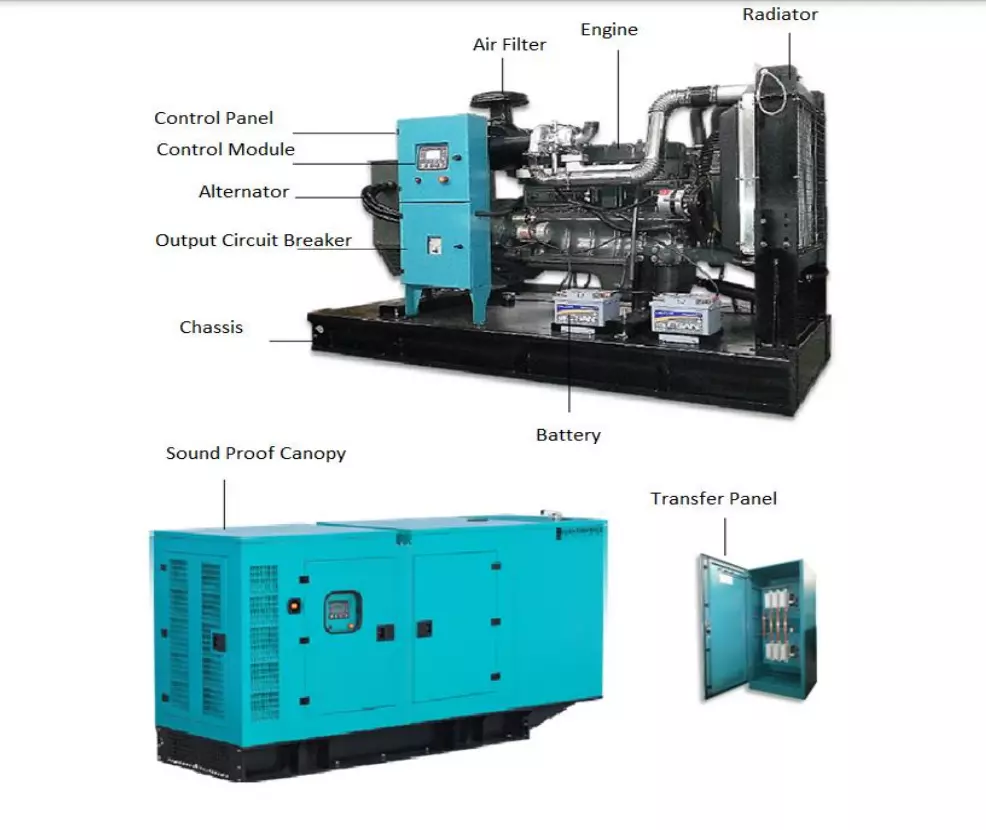
Categories
Uncategorized

Super Silent Generator

Super Silent Generator

We manufacture the Super Silent Generator for Sale. High quality and low price with Free Consultation. Spare parts warranty. Discount Price.

Super Silent Generator

A super silent generator is a type of generator that is designed to operate with a low noise level. These generators are typically used in settings where noise pollution must be minimized, such as in residential areas, hospitals, or other noise-sensitive locations. Here are some key features of super silent generators:

  1. Noise level: Super silent generators are designed to operate with a low noise level, typically ranging from 50 to 60 decibels or less. This is achieved through the use of soundproofing materials, noise-dampening enclosures, and other features designed to minimize noise.
  2. Power output: Super silent generators can produce a range of power outputs, depending on the specific model. They can be used for residential or commercial applications, and may be available in both portable and stationary configurations.
  3. Fuel efficiency: Super silent generators are typically designed to be fuel-efficient, which means they use less fuel to generate the same amount of power. This can help reduce operating costs over time.
  4. Durability: Super silent generators are designed to be durable and long-lasting, which means they can withstand heavy use and require less maintenance than other types of generators.
  5. Safety features: Super silent generators may include safety features such as automatic shut-off switches, overload protection, and low-oil shutdown to prevent damage to the generator or equipment.

Overall, super silent generators can be a good choice for settings where noise pollution must be minimized or where a low noise level is desired. However, they may be more expensive than other types of generators, and it’s important to carefully consider your specific needs and circumstances before making a purchase decision.

Why would you buy one?

There are several reasons why you might choose to buy a super silent generator:

  1. Noise pollution: If you live in a residential area, or in an area where noise pollution is a concern, a super silent generator can be a good choice. These generators are designed to operate with a low noise level, which can help reduce noise pollution and minimize disturbance to your neighbors.
  2. Safety: Super silent generators often come with safety features such as automatic shut-off switches, overload protection, and low-oil shutdown, which can help prevent damage to the generator or equipment, and ensure safe operation.
  3. Convenience: Super silent generators are typically portable and can be easily moved to different locations, which can be convenient if you need backup power for different settings or events.
  4. Efficiency: Super silent generators are typically designed to be fuel-efficient, which means they use less fuel to generate the same amount of power. This can help reduce operating costs over time.
  5. Reliability: Super silent generators are known for their reliability, which is why they are commonly used as backup power sources in case of power outages or other emergencies.

Overall, if you are looking for a generator that operates quietly, is safe, convenient, efficient, and reliable, a super silent generator may be a good choice for your needs. However, it’s important to carefully consider your specific needs and circumstances before making a purchase decision.

Advantages and Disadvantages

Advantages of Super Silent Generators:

  1. Low noise level: The biggest advantage of a super silent generator is its low noise level. These generators operate with a noise level of 50-60 decibels or less, making them ideal for use in residential areas or other noise-sensitive locations.
  2. Increased safety: Super silent generators often come with safety features such as automatic shut-off switches, overload protection, and low-oil shutdown to prevent damage to the generator or equipment, and ensure safe operation.
  3. Durability: Super silent generators are designed to be durable and long-lasting, which means they can withstand heavy use and require less maintenance than other types of generators.
  4. Portability: Super silent generators are typically portable and can be easily moved to different locations, which can be convenient if you need backup power for different settings or events.
  5. Fuel efficiency: Super silent generators are designed to be fuel-efficient, which means they use less fuel to generate the same amount of power. This can help reduce operating costs over time.

Disadvantages of Super Silent Generators:

  1. Higher cost: Super silent generators may be more expensive than other types of generators, due to the additional soundproofing and other features designed to reduce noise.
  2. Limited power output: Super silent generators are typically designed for residential or light commercial use, and may not have the power output required for heavy industrial or commercial applications.
  3. Maintenance: While super silent generators require less maintenance than other types of generators, they still require regular maintenance to keep them running smoothly.
  4. Cold weather performance: Super silent generators can have difficulty starting in very cold weather, which may require additional heating equipment or fuel additives to address.

Overall, the advantages of a super silent generator may outweigh the disadvantages, especially in settings where noise pollution must be minimized or where a low noise level is desired. However, it’s important to carefully consider your specific needs and circumstances before making a purchase decision.

Diesel Engine of the Generators

EMS Power Machines” uses diesel engines that are manufactured with the latest technology, in accordance with ISO3046 standards, and designed for generator sets. The diesel engines used; are designed for low fuel consumption, with 4-stroke type, direct injection, with all needed limiting and level sensors, with diesel electronic or mechanical type governor mounted on the fuel pump for sensitive speed adjustment or regulation.

The engines used, may have oil, air, or water-type cooling systems, depending on customer request and the diesel engine. There are also oil, fuel, and air filters that are designed for heavy operation conditions, which provide the engine with a long lifetime with high performance. All the equipment that is needed for the diesel engine for operating safely and reliably, is provided along with the generator set.

EMS Power Machines can provide a base frame fuel tank or free-standing fuel tank dependent on the model preferences of the customer. Larger sets require free-standing fuel tanks due to the need for high fuel capacity.
Fuel tanks are manufactured of plate steel or other suitable materials.
Teksan ensures that the fuel tanks are all manufactured in accordance with relevant standards. EMS Power Machines fuel tanks are equipped with:

  • Filling cap
  • Tank ventilation
  • Fuel outlet valve
  • Fuel return connections
  • Tank drainage plug
  • Sediment trapping section
  • Level gauge pipe
  • Float switches (Optional)
  • Automatic filling (Optional)

It is highly recommended to install a fuel filter and/or a water separator on the outlet line of these fuel tanks.

Engine Brands of Diesel Generators for Sale

  • Perkins Engines
  • Cummins Engines
  • Ricardo Engines
  • Baudoin Engines
  • Shanghai Dongfeng Engines
  • Volvo Engines
  • Yangdong Engines

We use any of the above-mentioned diesel engines for the production of our diesel generators according to the customers’ requests.

Perkins engines are manufactured in the UK and are very common in the generator production market.

75 KVA Generator with Ricardo Engine

Ricardo engines are manufactured in China and have a very high market share in the generator manufacturing market.

Base Frame of the Generators

The base frame on which the generator set is placed has been manufactured using proper steel plates or special profiles based on the necessary dynamic, static, and vibration calculations in order for providing high resistance. EMS Power Machines produces the base frames for all ranges in accordance with international standards.

Base Frame of the Generators

The base frame of a generator, often referred to as the generator skid or chassis, is a crucial structural component that provides support, stability, and a foundation for the entire generator set. It plays a key role in ensuring the proper functioning, safety, and longevity of the generator. Here are some key aspects related to the base frame of generators:

Functions and Features

  1. Support Structure:
    • The base frame serves as the primary support structure for the generator set, providing a stable foundation to hold all the components together.
  2. Engine and Alternator Mounting:
    • The engine and alternator, the two main components of a generator set, are securely mounted on the base frame. Proper alignment and secure mounting are essential for efficient operation and to minimize vibrations.
  3. Vibration Isolation:
    • Many base frames incorporate features to isolate vibrations produced during the operation of the generator. This helps reduce noise and ensures that vibrations do not impact the performance or structural integrity of the generator.
  4. Fuel Tank Support:
    • In some generator sets, the fuel tank is integrated into or mounted on the base frame. This provides a secure and stable location for the fuel tank.
  5. Cooling System Support:
    • The cooling system components, such as radiators and cooling fans, are often mounted on or integrated into the base frame to ensure proper airflow and cooling.
  6. Lifting Points:
    • Base frames are designed with lifting points or provisions for lifting equipment. This facilitates ease of transportation, installation, and maintenance of the generator set.
  7. Weatherproofing:
    • Depending on the design, the base frame may provide some level of protection against environmental elements, such as rain and dust, to ensure the longevity of the generator set.
  8. Accessibility:
    • The base frame is designed to allow easy access to key components for maintenance and service tasks. This includes access panels and doors for routine inspections and repairs.
  9. Corrosion Resistance:
    • Base frames are often constructed from materials that offer corrosion resistance to withstand environmental conditions and ensure a longer service life.

Considerations

  1. Material Selection:
    • Base frames are commonly made of steel, but the type and quality of the steel used can vary. The choice of materials depends on factors such as environmental conditions, weight considerations, and corrosion resistance.
  2. Size and Dimensions:
    • The size and dimensions of the base frame are determined by the overall size of the generator set. It should provide adequate space for all components and ensure proper ventilation.
  3. Site Conditions:
    • The design of the base frame should consider the specific site conditions where the generator will be installed. This includes factors such as seismic requirements, soil conditions, and available space.
  4. Transportation:
    • The base frame design should facilitate ease of transportation, considering factors such as size, weight, and lifting points.
  5. Regulatory Compliance:
    • The design and construction of the base frame should comply with relevant safety and construction standards set by regulatory authorities.

The base frame is a critical element in the overall design and functionality of a generator set. Its design and construction should align with the specific requirements of the generator and the intended application. Manufacturers often provide detailed specifications for the base frame in the generator set documentation. When selecting or installing a generator set, it’s important to follow the manufacturer’s guidelines and consider any site-specific requirements.

Vibration Isolators

Vibration isolators, also known as vibration mounts or isolating mounts, are components used in diesel generators to reduce the transmission of vibrations and noise generated during the operation of the engine. These isolators play a crucial role in enhancing the overall performance, stability, and comfort of the generator set. Here are key aspects related to the vibration isolators of diesel generators:

Functions and Features

  1. Vibration Reduction:
    • The primary function of vibration isolators is to reduce the transmission of vibrations generated by the diesel engine to the surrounding structure. This helps minimize the impact of vibrations on adjacent equipment and structures.
  2. Noise Reduction:
    • In addition to reducing vibrations, isolators also contribute to noise reduction. They help isolate the generator set from its surroundings, preventing the transmission of noise to nearby areas.
  3. Component Protection:
    • Vibration isolators protect various components of the generator set, including the engine, alternator, and other critical parts, from the potentially damaging effects of excessive vibrations.
  4. Structural Integrity:
    • By reducing vibrations, isolators contribute to maintaining the structural integrity of the generator set and the surrounding infrastructure. Excessive vibrations can lead to wear and tear on components and may compromise the overall stability of the generator.
  5. Isolation from External Vibrations:
    • Isolators not only prevent the transmission of internal vibrations but also isolate the generator set from external vibrations, such as those from nearby machinery or environmental factors.
  6. Adjustability:
    • Some vibration isolators are designed to be adjustable, allowing for fine-tuning to achieve optimal vibration isolation based on the specific operating conditions and requirements.

Types of Vibration Isolators

  1. Spring Mounts:
    • Spring mounts use metal springs to isolate vibrations. They are effective in reducing both high and low-frequency vibrations.
  2. Rubber Mounts:
    • Rubber mounts, or elastomeric mounts, use rubber or other elastomeric materials to absorb and dampen vibrations. They are effective for isolating high-frequency vibrations.
  3. Air Springs:
    • Air springs use compressed air to provide isolation. They are effective in isolating low-frequency vibrations and are often used in large and heavy machinery.
  4. Viscous Dampers:
    • Viscous dampers use hydraulic fluid to absorb and dissipate vibrations. They are effective in isolating both high and low-frequency vibrations.
  5. Active Isolation Systems:
    • Active isolation systems use sensors and actuators to actively counteract vibrations in real-time. These systems can provide dynamic and adaptive vibration control.

Considerations

  1. Application Specifics:
    • The selection of vibration isolators should consider the specific application, environmental conditions, and the frequency spectrum of vibrations generated by the diesel generator.
  2. Load Capacity:
    • The isolators should be selected based on the load capacity of the generator set to ensure proper support and isolation.
  3. Installation and Maintenance:
    • Proper installation and regular maintenance of the vibration isolators are crucial to ensure their effectiveness over time.
  4. Regulatory Compliance:
    • Compliance with relevant safety and regulatory standards should be considered when selecting vibration isolators.
  5. Manufacturer Recommendations:
    • Follow the manufacturer’s recommendations for the type and specification of vibration isolators suitable for a particular generator model.

Vibration isolators are integral components that contribute to the smooth and reliable operation of diesel generators while minimizing the impact on surrounding structures and environments. When selecting or maintaining vibration isolators, it’s essential to consider the specific requirements of the generator set and follow the guidelines provided by the generator manufacturer.

Vibration insulators are used in order to decrease the negative effects of vibrations caused by the rotational movement of the engine and alternator. These insulators which also prevent the vibration to be transferred from
the base frame to the ground, are placed between the engine/alternator and the base frame. Specially chosen vibration isolators are mounted between the engine, alternator, and base frame. Alternatively, in bigger generator sets, vibration isolators are mounted between the base frame and floor.

Exhaust System and Silencer

An exhaust system should be designed to decrease the noise coming from the exhaust manifold and dispel the exhaust gases into the atmosphere. The exhaust system consists of a flexible compensator that absorbs vibration and expansion, steel pipes, bend, silencer, and mounting equipment. Further details on exhaust systems can be found in the “Installation” section of this manual.

Exhaust System and Silencer of Generators

The exhaust system and silencer of a diesel generator play a crucial role in managing and reducing the noise and emissions produced during the operation of the generator. Here are key aspects related to the exhaust system and silencer of diesel generators:

Exhaust System

  1. Exhaust Manifold:
    • The exhaust manifold collects exhaust gases from the engine cylinders and directs them to the exhaust system.
  2. Turbocharger (if applicable):
    • In some diesel generators, especially those with larger engines, a turbocharger may be used to increase the efficiency of exhaust gas evacuation.
  3. Piping:
    • Exhaust piping carries the hot gases from the engine to the other components of the exhaust system. It is designed to withstand high temperatures and is often insulated to prevent heat dissipation.
  4. After-Treatment Devices:
    • Modern diesel generators often incorporate after-treatment devices such as diesel particulate filters (DPF) and selective catalytic reduction (SCR) systems to reduce emissions and comply with environmental regulations.

Silencer

  1. Purpose:
    • The silencer, or muffler, is designed to reduce the noise generated by the exhaust gases as they exit the generator. It helps in creating a more tolerable and quieter operating environment.
  2. Design:
    • Silencers are typically designed with sound-absorbing materials and internal baffles to attenuate and dissipate sound energy. The design may vary based on the specific noise reduction requirements.
  3. Inlet and Outlet:
    • Silencers have inlet and outlet ports that are connected to the exhaust piping. The exhaust gases enter the silencer through the inlet and exit through the outlet.
  4. Materials:
    • Silencers are constructed using materials that can withstand high temperatures and corrosion, given the harsh environment of exhaust gases.
  5. Resonators (if applicable):
    • Some silencers may incorporate resonators to further dampen specific frequencies of sound and enhance noise reduction.
  6. Spark Arrestor (if applicable):
    • In certain applications, especially in environments where the risk of fire is a concern, a spark arrestor may be included in the silencer to prevent sparks from exiting the exhaust.

Considerations

  1. Noise Regulations:
    • Compliance with local noise regulations is a critical consideration when selecting or designing the exhaust system and silencer. Different regions may have specific noise level requirements that need to be met.
  2. Emission Regulations:
    • Ensure that the exhaust system, including any after-treatment devices, complies with emissions regulations applicable to the generator’s location.
  3. Engine Efficiency:
    • The design of the exhaust system should not compromise the efficiency of the engine. It should allow for proper evacuation of exhaust gases without causing backpressure.
  4. Maintenance:
    • Regular inspection and maintenance of the exhaust system and silencer are essential to ensure proper functioning and longevity. This includes checking for leaks, corrosion, and damage.
  5. Installation:
    • Proper installation of the exhaust system and silencer is crucial for optimal performance. Consider factors such as proper clearances, support structures, and heat dissipation.
  6. Manufacturer Recommendations:
    • Follow the recommendations provided by the generator manufacturer regarding the selection, installation, and maintenance of the exhaust system and silencer.

The exhaust system and silencer are critical components that contribute to the safe and environmentally friendly operation of diesel generators. When selecting or maintaining these components, it’s important to consider both regulatory requirements and the specific operational needs of the generator. Consulting with the generator manufacturer or a qualified professional can help ensure that the exhaust system is designed and maintained to meet the necessary standards.

Control System

The control system of a diesel generator is a crucial component that governs and manages the operation of the generator set. It includes a range of components and features designed to monitor, control, and protect the generator during various operating conditions. Here are key aspects related to the control system of diesel generators:

Components of the Control System

  1. Control Panel:
    • The control panel is the interface through which operators interact with the generator. It typically includes displays, buttons, switches, and indicators for monitoring and controlling various parameters.
  2. Controller:
    • The controller is the central processing unit responsible for monitoring and regulating the generator’s functions. It may be a microprocessor-based controller that processes data from sensors and issues commands to different components.
  3. Sensors:
    • Various sensors are deployed throughout the generator to measure critical parameters such as engine speed, oil pressure, coolant temperature, voltage, and current. These sensors provide real-time data to the controller.
  4. Automatic Voltage Regulator (AVR):
    • The AVR is responsible for maintaining a stable and consistent voltage output from the generator. It adjusts the excitation current to the generator’s alternator to control the voltage level.
  5. Engine Control Module (ECM):
    • The ECM monitors and controls the diesel engine’s operation. It manages fuel injection, air intake, exhaust emissions, and other parameters to optimize engine performance and efficiency.
  6. Governor:
    • The governor regulates the speed of the engine by controlling the fuel injection. It helps maintain a constant speed under varying loads.
  7. Protection System:
    • The protection system safeguards the generator against abnormal conditions such as overloading, overheating, low oil pressure, and over-speeding. It can initiate automatic shutdowns to prevent damage.
  8. Data Logging and Communication:
    • Some control systems feature data logging capabilities to record operational data over time. Communication interfaces may allow for remote monitoring and control.

Features and Functions

  1. Start/Stop Control:
    • The control system initiates the start and stop sequences of the generator based on manual or automatic commands.
  2. Load Sharing (Parallel Operation):
    • In parallel operation scenarios where multiple generators are connected, the control system ensures proper load sharing and synchronization.
  3. Synchronization:
    • The control system facilitates synchronization when connecting the generator to an electrical grid or other generators, ensuring a seamless connection without disturbances.
  4. Emergency Shutdown:
    • The control system includes emergency shutdown features that can be triggered in response to critical faults or unsafe conditions to protect the generator.
  5. Remote Monitoring and Control:
    • Advanced control systems may allow remote monitoring and control of the generator, providing real-time information and the ability to make adjustments from a distance.
  6. Diagnostic and Fault Analysis:
    • The control system can diagnose faults, provide alerts or alarms, and perform self-diagnostics to aid in troubleshooting and maintenance.

Considerations

  1. Compatibility:
    • Ensure that the control system is compatible with the generator set and any additional components, especially if the generator is part of a larger power system.
  2. Scalability:
    • Consider the scalability of the control system to accommodate future upgrades or additions to the generator system.
  3. User Interface:
    • Evaluate the user interface of the control panel for ease of use and accessibility, especially for operators who need to monitor and manage the generator.
  4. Integration with Power Systems:
    • If the generator is part of a larger power distribution system, ensure that the control system can seamlessly integrate with other power management components.
  5. Training and Documentation:
    • Adequate training and documentation should be provided for operators to effectively use and troubleshoot the control system.

The control system is a critical aspect of diesel generators, ensuring reliable and efficient operation while providing essential protection features. When selecting a generator, it’s important to understand the capabilities of the control system and how well it aligns with the specific requirements of the intended application. Manufacturers typically provide detailed specifications and documentation related to the control system for each generator model.

Various control systems are developed for ensuring the protection of the generator set against failures, load transfers, and the reliability of the operation of the generator set. Control system designs can vary according to the customer requirements and assembling requirements. The main
types of control systems are Manual, Automatic, Standby, and Parallel working systems.

All control systems are mounted on steel panels containing a lockable door for easy reaching and service. Further technical information about the control systems of the generator sets can be found in the “Control Systems” section of this manual and the manual of the controller.

Installation of Generators

The installation of generators is a critical process that involves several steps to ensure proper functionality, safety, and compliance with regulations. Whether installing a standby generator for backup power or a prime power generator for continuous operation, following best practices is essential. Here is a general guide for the installation of generators:

1. Site Selection

  1. Regulatory Compliance:
    • Ensure compliance with local building codes, zoning regulations, and environmental requirements. Obtain any necessary permits before starting the installation.
  2. Space and Clearance:
    • Select a location with sufficient space for the generator and its accessories. Allow for proper clearance around the generator for maintenance and ventilation.
  3. Ventilation:
    • Ensure adequate ventilation to dissipate heat generated by the generator. Generators typically require space for air intake and exhaust.
  4. Accessibility:
    • Choose a location that allows easy access for installation, maintenance, and potential repairs. Consider factors such as crane access and pathways for transporting equipment.

2. Foundation and Mounting

  1. Foundation Construction:
    • Prepare a stable foundation for the generator. The foundation should be level, sturdy, and capable of supporting the generator’s weight.
  2. Vibration Isolation:
    • If applicable, install vibration isolators or mounts to minimize the transmission of vibrations from the generator to the foundation and surrounding structures.
  3. Anchor the Generator:
    • Anchor the generator securely to the foundation to prevent movement or shifting during operation or external forces.

3. Electrical Connections

  1. Transfer Switch Installation:
    • Install an automatic transfer switch (ATS) to facilitate seamless switching between the main power source and the generator during power outages.
  2. Wiring:
    • Connect the generator to the electrical distribution system following local electrical codes and regulations. Ensure proper sizing of conductors and adherence to safety standards.
  3. Grounding:
    • Establish proper grounding for the generator as per electrical codes. A grounding electrode system helps ensure safety and proper functioning.
  4. Voltage Configuration:
    • Verify that the generator’s voltage configuration matches the requirements of the connected loads. Adjust settings if necessary.

4. Fuel System

  1. Fuel Storage:
    • If the generator has an internal fuel tank, ensure it is filled with the appropriate fuel. For external fuel tanks, connect and test the fuel supply system.
  2. Fuel Quality:
    • Ensure that the fuel supply meets the specifications recommended by the generator manufacturer. Use clean and high-quality fuel.

5. Exhaust System

  1. Exhaust Piping:
    • Install the exhaust piping in compliance with local codes and regulations. Ensure proper venting of exhaust gases away from occupied spaces.
  2. Silencer Installation:
    • If a silencer is included, install it in the exhaust system to reduce noise emissions. Follow the manufacturer’s recommendations for placement and installation.

6. Control System

  1. Control Panel Wiring:
    • Connect the control panel to the generator and ensure proper wiring. Verify the functionality of control features such as start/stop, monitoring, and protection systems.
  2. Testing:
    • Conduct thorough testing of the control system to ensure all functions operate as intended. Test automatic start/stop sequences, alarms, and safety shutdowns.

7. Commissioning and Testing

  1. Load Testing:
    • Conduct load tests to ensure the generator can handle the expected loads. Verify the generator’s performance under varying load conditions.
  2. System Integration:
    • Integrate the generator into the overall power system. If multiple generators are used, ensure proper synchronization and load sharing.
  3. Commissioning Procedures:
    • Follow the commissioning procedures provided by the generator manufacturer. This may include adjusting settings, verifying alarms, and ensuring all systems are operational.

8. Documentation

  1. As-Built Documentation:
    • Prepare as-built documentation that includes detailed drawings, specifications, and records of the installation. This documentation is valuable for future maintenance and reference.
  2. Operation and Maintenance Manuals:
    • Provide the end user with comprehensive operation and maintenance manuals. Include information on routine maintenance, troubleshooting, and emergency procedures.

9. Training

  1. Operator Training:
    • Provide training for operators on how to start, stop, and operate the generator safely. Ensure they are familiar with the control panel and understand basic troubleshooting procedures.
  2. Maintenance Training:
    • Train maintenance personnel on routine maintenance tasks, including oil changes, filter replacements, and inspections. Emphasize the importance of following the manufacturer’s maintenance schedule.

10. Compliance

  1. Final Inspection:
    • Conduct a final inspection to ensure compliance with all applicable codes, regulations, and safety standards.
  2. Certifications:
    • Obtain any necessary certifications or approvals from local authorities or regulatory bodies.
  3. Record Keeping:
    • Keep detailed records of the installation, testing, and commissioning processes. This documentation may be required for compliance audits and warranty support.

11. Ongoing Monitoring and Maintenance

  1. Monitoring Systems:
    • Implement continuous monitoring systems for key parameters, such as fuel levels, oil pressure, and coolant temperature. Consider remote monitoring options for quick response to issues.
  2. Scheduled Maintenance:
    • Establish a scheduled maintenance program and adhere to the manufacturer’s recommendations. Regular maintenance is essential for the reliability and longevity of the generator.
  3. Emergency Response Plan:
    • Develop and communicate an emergency response plan outlining procedures to follow in the event of a generator malfunction or failure.

Conclusion

The installation of generators is a multifaceted process that requires careful planning, attention to detail, and compliance with various standards and regulations. Collaboration with experienced professionals, including electrical engineers, mechanical contractors, and generator technicians, can contribute to a successful installation. Additionally, consulting with the generator manufacturer and following their guidelines is essential to ensure optimal performance and longevity of the generator system.

The selection and preparation of the location where the generator set will be placed is the most important step of installation. So please make sure that the generator set is installed at a place that is selected and prepared fully in conformity with the instructions in this manual.

Also, remember that you can call us for any further information or confirmation about this issue. If the generator will be placed on an upper floor, not the basement or ground, the responsibility of static load distribution belongs to the customer. The customer should get approval from an authority about this issue before installation.

Environmental Conditions

Install the generator set in such a place that it will not be directly exposed to harsh environmental conditions such as rain, snow, hail, flood, humidity, excessive sunlight, extremely low or high temperature, dust, soil, sand or wind. The place where the generator set will be installed must be, clean, dry, well illuminated and ventilated, free of corrosive or conductive pollutant substances like dust, lint, smoke, oil vapor, exhaust smoke, etc…

Be sure to leave enough blank space around the generator set, in order to ease future maintenance or repair activities Remember that it can be necessary to disassemble the main parts like the engine, alternator, or base frame in some cases. The base ground where the generator will be settled must be clean dry and must have a good drainage system. Put the generator set in such a place that nobody unauthorized can access it, or at least take necessary precautions about it.

Place generator sets in such places that they will not be affected by the operation of any other machines. Do not install or run the generator set at any place that has any possibility of risk in terms of safety of operation.
Also, provide the necessary precautions (canopy option) or protections against bad weather conditions if it will be placed outside.

The doors of the room that the generator set will be placed in, must be at enough size for the main parts (engine, alternator, radiator, etc…) to pass through. Also, ventilation windows can be built portable or mobile for
this purpose.

Diesel Generator

A diesel generator is a device that converts diesel fuel into electricity. Diesel generators are typically used as backup power sources in the event of a power outage, but they can also be used as primary power sources in remote areas where there is no grid electricity available.

Diesel generators work by using a diesel engine to turn a generator. The diesel engine burns diesel fuel to create mechanical energy, which is then converted into electrical energy by the generator.

Diesel generators are available in a variety of sizes and power outputs. Some diesel generators are small enough to be portable, while others are large enough to power entire buildings or communities.

Diesel generators are a reliable and efficient way to generate electricity. They are also relatively easy to operate and maintain.

Here are some examples of where diesel generators are used:

  • Hospitals and other critical facilities: Diesel generators are used to provide backup power in hospitals, data centers, and other critical facilities. This ensures that these facilities continue to operate even in the event of a power outage.
  • Construction sites: Diesel generators are used to provide power for construction tools and equipment at construction sites. This allows construction work to continue even in remote areas where there is no grid electricity available.
  • Emergency services: Diesel generators are used to provide power for emergency services, such as ambulances and fire trucks. This ensures that these services can continue to operate even in the event of a power outage.
  • Remote areas: Diesel generators are used to provide primary power in remote areas where there is no grid electricity available. This allows people living in these areas to have access to electricity for lighting, cooking, and other essential needs.

Diesel generators are a valuable tool for generating electricity in a variety of situations. They are reliable, efficient, and easy to operate and maintain.

Diesel Generator Outputs

The output of a diesel generator is measured in kilowatts (kW). The output of a diesel generator is limited by the size and power of the diesel engine that it uses. Diesel generators are available in a variety of sizes and power outputs, ranging from small portable generators that produce a few kW of power to large industrial generators that produce thousands of kW of power.

The output of a diesel generator is also affected by a number of other factors, including:

  • Fuel quality: The quality of the diesel fuel used in a generator can affect its output. Lower quality diesel fuel can produce less power and can also damage the generator.
  • Air quality: The quality of the air that the generator is operating in can also affect its output. Operating a generator in thin air or in hot weather can reduce its output.
  • Maintenance: Proper maintenance of a diesel generator is essential to ensure its optimal performance. A generator that is not properly maintained may produce less power and may also be more likely to break down.

Here are some examples of the power outputs of different types of diesel generators:

  • Small portable generator: 1-5 kW
  • Medium-sized generator: 5-10 kW
  • Large generator: 10-100 kW
  • Industrial generator: 100 kW and up

The power output of a diesel generator is an important factor to consider when choosing a generator for a particular application. The generator should have enough power output to meet the needs of the devices and appliances that will be connected to it.

It is also important to note that the power output of a diesel generator is not the same as its efficiency. The efficiency of a diesel generator is the percentage of the fuel energy that is converted into electrical energy. A more efficient generator will produce more electrical energy for a given amount of fuel.

Diesel Generators

Diesel generators are a type of backup or standby power source that uses a diesel engine to generate electricity. These generators are widely used in various applications where a reliable and continuous power supply is crucial. Here are key aspects related to diesel generators:

Components of Diesel Generators

  1. Diesel Engine:
    • The diesel engine is the primary component responsible for converting diesel fuel into mechanical energy. This mechanical energy is then used to turn a generator to produce electricity.
  2. Generator (Alternator):
    • The generator, or alternator, converts the mechanical energy from the diesel engine into electrical energy. It consists of a rotor and a stator, and as the rotor turns within the stator’s magnetic field, it induces an electric current.
  3. Fuel System:
    • The fuel system stores and delivers diesel fuel to the engine for combustion. It typically includes a fuel tank, fuel pump, and fuel injectors.
  4. Cooling System:
    • Diesel generators have a cooling system to maintain optimal operating temperatures. This system may include a radiator, cooling fans, and a water or air cooling mechanism.
  5. Exhaust System:
    • The exhaust system is responsible for expelling the combustion gases produced during the diesel engine’s operation. It usually includes a muffler and may incorporate emission control devices.
  6. Control Panel:
    • The control panel houses the generator’s control and monitoring systems. It allows operators to start or stop the generator, monitor performance, and sometimes control other parameters such as voltage and frequency.
  7. Voltage Regulator:
    • The voltage regulator maintains a stable output voltage by adjusting the excitation current to the generator’s rotor.
  8. Battery Charger:
    • Diesel generators often have a battery or set of batteries to start the engine. A battery charger ensures that the batteries remain charged and ready to start the generator when needed.
  9. Automatic Transfer Switch (ATS):
    • An ATS is a crucial component for standby generators. It automatically switches the electrical load from the main power source to the generator when it detects a power outage and vice versa when the main power is restored.
Working Principle:
  1. Combustion: Diesel fuel is injected into the combustion chamber, and the heat generated by the compression of air ignites the fuel.
  2. Mechanical Energy: The combustion process produces high-pressure gases that expand, creating mechanical energy. This energy is used to rotate the engine’s crankshaft.
  3. Electricity Generation: The rotating crankshaft is connected to the generator, causing it to spin. As the generator’s rotor rotates within the stator, it induces an electric current, generating electricity.
Applications:
  1. Emergency Power:
    • Diesel generators are commonly used for emergency backup power in critical facilities such as hospitals, data centers, and telecommunications facilities.
  2. Construction Sites:
    • They are used on construction sites to power tools and equipment where a reliable grid connection may not be available.
  3. Industrial Facilities:
    • Diesel generators provide backup power for industrial plants and manufacturing facilities to prevent production disruptions.
  4. Remote Locations:
    • In remote or off-grid locations, where a stable power supply from the grid is not feasible, diesel generators can provide a reliable source of electricity.
  5. Mining Operations:
    • Diesel generators are often used in mining operations to power equipment in remote and rugged environments.
  6. Agriculture:
    • Farms may use diesel generators to power irrigation systems, machinery, and other agricultural equipment.
Advantages:
  1. Fuel Availability:
    • Diesel fuel is widely available, making diesel generators suitable for various locations.
  2. Fuel Efficiency:
    • Diesel generators are known for their fuel efficiency, providing a cost-effective solution for standby power.
  3. Durability:
    • Diesel generators are generally robust and durable, capable of handling heavy loads and providing long service life.
  4. High Torque:
    • Diesel engines provide high torque, making them suitable for applications with varying load conditions.
Limitations:
  1. Noise and Emissions:
    • Diesel generators can be noisy, and their combustion process produces emissions. However, advancements in technology have led to quieter and more environmentally friendly models.
  2. Maintenance:
    • Regular maintenance is essential to ensure the proper functioning of diesel generators.
  3. Initial Cost:
    • Diesel generators may have a higher upfront cost compared to some other types of generators.

Diesel generators are a reliable and widely used solution for providing backup or primary power in various settings. The choice of a diesel generator depends on factors such as power requirements, environmental considerations, and the specific needs of the application.

Diesel generators are machines that convert the chemical energy of diesel fuel into mechanical energy, which is then used to generate electricity. They are a popular choice for a variety of applications, including prime power for remote locations, backup power for businesses, and emergency power for hospitals and other critical infrastructure.

Diesel generators are available in a wide range of sizes, from small portable generators that can be used to power a few appliances to large stationary generators that can power entire buildings or even small towns.

Diesel generators are typically powered by four-stroke diesel engines. Diesel engines are known for their reliability and fuel efficiency, making them a good choice for applications where long-term operation is required.

Diesel generators work by burning diesel fuel in the engine, which drives a generator to produce electricity. The electricity generated by the generator can then be used to power lights, appliances, and other electrical devices.

Diesel generators are a valuable source of backup power in the event of a power outage. They can also be used as a primary source of power in remote locations where there is no access to the electrical grid.

Here are some of the benefits of using a diesel generator:

  • Reliable: Diesel generators are very reliable and can operate for long periods of time without any problems.
  • Fuel-efficient: Diesel generators are fuel-efficient, which can save you money on operating costs.
  • Durable: Diesel generators are built to last and can withstand harsh operating conditions.
  • Versatile: Diesel generators can be used in a variety of applications, from prime power for remote locations to backup power for businesses and critical infrastructure.

If you are considering purchasing a diesel generator, be sure to do your research and choose a generator that is the right size and type for your needs. You should also consider the cost of fuel and maintenance when making your decision.

EMS Power Machines

We design, manufacture and assembly Power Machines such as – diesel generators, electric motors, vibration motors, pumps, steam engines and steam turbines

EMS Power Machines is a global power engineering company, one of the five world leaders in the industry in terms of installed equipment. The companies included in the company have been operating in the energy market for more than 60 years.

EMS Power Machines manufactures steam turbines, gas turbines, hydroelectric turbines, generators, and other power equipment for thermal, nuclear, and hydroelectric power plants, as well as for various industries, transport, and marine energy.

EMS Power Machines is a major player in the global power industry, and its equipment is used in power plants all over the world. The company has a strong track record of innovation, and it is constantly developing new and improved technologies.

Here are some examples of Power Machines’ products and services:

  • Steam turbines for thermal and nuclear power plants
  • Gas turbines for combined cycle power plants and industrial applications
  • Hydroelectric turbines for hydroelectric power plants
  • Generators for all types of power plants
  • Boilers for thermal power plants
  • Condensers for thermal power plants
  • Reheaters for thermal power plants
  • Air preheaters for thermal power plants
  • Feedwater pumps for thermal power plants
  • Control systems for power plants
  • Maintenance and repair services for power plants

EMS Power Machines is committed to providing its customers with high-quality products and services. The company has a strong reputation for reliability and innovation. Power Machines is a leading provider of power equipment and services, and it plays a vital role in the global power industry.

EMS Power Machines, which began in 1961 as a small factory of electric motors, has become a leading global supplier of electronic products for different segments. The search for excellence has resulted in the diversification of the business, adding to the electric motors products which provide from power generation to more efficient means of use.

Categories
Uncategorized

Best Silent Diesel Generator

Best Silent Diesel Generator

We manufacture the Best Silent Diesel Generator for Sale. High-quality diesel engines with low prices and Free Consultation. Spare parts warranty.

Best Silent Diesel Generator

This chapter presents the major components of the electrical generator, the exciter, and the voltage regulator and explains how they relate to the
development of power by the diesel engine-driven generator unit.

As a result of this lesson, you will be able to:

  1. Describe the functions of the generator, exciter, and voltage regulator.
  2. Identify the major components of the generator and how they interrelate.
  3. Describe how diesel engine output power relates to the power demands of the generator.
  4. Describe the function of the excitation system and the associated voltage regulator.
  5. Identify the major components of the exciter and voltage regulator system.

Generator Principles

The following is a brief discussion of generator operation and its relationship to the mechanical load placed on the diesel engine.

Electromagnetic Induction

Electromagnetic induction, the basic principle of generator operation, involves the movement of an electrical conductor through a magnetic field. Figure 9-1 shows the principles being discussed in this section. As the conductor passes through the magnetic field, in this case downward, it cuts each of the lines of magnetic force (flux) which causes a current to be “induced” in the conductor. Because the conductor has a resistance, it is known from ‘ohms law’ that the voltage is equal to the current times the resistance.

Therefore, a voltage is also ‘induced’ between the two ends of the conductor. If the conductor is connected to a closed electrical circuit, this voltage would cause a current to flow. The amount of current flow is a function of the voltage induced and the electrical resistance of the load in the circuit.

The Voltage of the Best Silent Diesel Generator

The Voltage of the Best Silent Diesel Generator

The actual voltage induced in the conductor is determined by the number of lines of flux cut per unit of time. Two key factors affect the magnitude of the voltage induced.

  • The speed at which the conductor moves through the fixed magnetic field and the strength of the magnetic field determines the output voltage. This speed is a function of the rotational speed (RPM) of the generator/engine. As the speed of the engine and the generator increases, the voltage produced also increases. Since the operating speed of the engine and generator is constant in order to maintain the desired frequency, another method of voltage control must be employed.
  • The generator output voltage is most often controlled by regulating the strength (flux intensity) of the magnetic field. This is accomplished by the generator excitation system. The excitation system monitors the generator output and regulates the magnetic field to maintain the desired voltage. As the load on the generator is increased, an increase in current flow causes the voltage to drop. The excitation system senses this decrease in voltage and increases the strength of the magnetic field to return the voltage to the desired level.

Figure 9-2 shows the principles discussed above implemented into a machine to produce a voltage. In this implementation, a ‘U’ shaped form is provided with a ‘gap’ between the open ends of the ‘U’. A coil of wire is wrapped about the legs of this form to produce a magnetic field across the gap. In the gap, an armature is formed by a loop of wire. The loop exits the armature onto two slip rings.

The slip rings are contacted by brushes that connect the generator to the outside electric circuit. An engine or some other prime mover is connected to the armature causing it to rotate inside the gap. When the ‘field’ coil is energized to establish a magnetic field/flux in the gap and the armature is then rotated, a voltage is generated in the armature. The slip rings and brushes conduct this voltage out to some load “A.”

Figure 9-3 shows a blowup of the armature in the gap. As the armature is rotated in its initial position, no voltage is created because the magnetic flux is equal but opposite on both branches of the loop. This is shown in the part of the diagram labeled ‘Start.’

As the armature is turned to a position 90 degrees from the first, the two ends of the loop is acted upon in a manner wherein the voltages generated at each end of the loop are additive, as shown in the ‘1/4-cycle’ diagram. Peak output voltage is generated at each cycle point. As the armature continues to rotate, it again gets to a position of no voltage generation, shown in the ‘½-cycle diagram’.

As the rotation continues, a voltage is again generated. A close examination of the wiring out of the armature reveals that the connections have become inverted. This results in the opposite polarity of the voltage. The diagram at the bottom of the figure shows the resulting build-up and decay and opposite polarity build-up and decay again through two cycles (two rotations of the armature).

The resulting voltage build-up and decay form a sinusoidal wave that is defined as an ‘Alternating Current’ or AC. This is the basis for a single-phase alternator. Two other sets of coils offset by 120 degrees and connected to slip rings would form a machine to generate 3-phase AC power.

This is the basis for all AC 3- phase generation. If instead of using two slip rings a single ring that is split into two segments were used, as the armature rotated, there would be a buildup and decay of voltage as before, but the split slip ring would reverse the connection on each half revolution. The split slip ring configuration is commonly referred to as a ‘commutator.’

This would result in a machine that puts out a pulsating DC current. By combining a great many poles and the same number of segments on the armature commutator, an almost steady DC output would be produced. This is the principle of the DC generator or motor. The AC alternator described above has a number of problems.

The armature and its slip rings have to handle all the load current that is produced by this generator. The brushes and slip rings restrict the amount of current that can be handled. To eliminate this problem, the design and construction were changed such that the small excitation current now goes through the brushes and slip rings to the rotating armature field. The large AC current induced into the stationary stator windings is transmitted to the loads by solid connections.

This same principle also applies to AC synchronous motors as there is little difference between an AC generator and an AC synchronous motor. It is a matter of what is driving the system – an electric motor or an engine-driven generator.

This also simplifies the construction of the generator. These machines very often also are called ‘alternators’ in as much as the voltage and current are alternating. A three-phase generator/alternator is simply three single-phase machines interlaced with one another, sharing the same rotor assembly, with wiring brought out to connect each phase to the electrical
system.

The result of the interlacing of the alternator windings is shown on the voltage trace shown at the bottom of Figure 9-4. The upper part of Figure 9-4 shows how the current of each/any phase acts to produce the power. The left-most diagram shows the current in phase with the voltage. This is the case when the power factor is 1.0 (unity). The real power (KW) in that case is equal to the apparent power (KVA). These terms will be discussed later. When the current is not in phase with the voltage, there is a lesser power factor, and the KW is less than the KVA. The KW is still in phase with the voltage, but the KVA has shifted slightly due to the shift in the current. This introduced KVAR and will be explained later

Diesel Engine of the Generators

EMS Power Machines” uses diesel engines that are manufactured with the latest technology, in accordance with ISO3046 standards, and designed for generator sets. The diesel engines used; are designed for low fuel consumption, with 4-stroke type, direct injection, with all needed limiting and level sensors, with diesel electronic or mechanical type governor mounted on the fuel pump for sensitive speed adjustment or regulation.

The engines used, may have oil, air, or water-type cooling systems, depending on customer request and the diesel engine. There are also oil, fuel, and air filters that are designed for heavy operation conditions, which provide the engine with a long lifetime with high performance. All the equipment that is needed for the diesel engine for operating safely and reliably, is provided along with the generator set.

EMS Power Machines can provide a base frame fuel tank or free-standing fuel tank dependent on the model preferences of the customer. Larger sets require free-standing fuel tanks due to the need for high fuel capacity.
Fuel tanks are manufactured of plate steel or other suitable materials.
Teksan ensures that the fuel tanks are all manufactured in accordance with relevant standards. EMS Power Machines fuel tanks are equipped with:

  • Filling cap
  • Tank ventilation
  • Fuel outlet valve
  • Fuel return connections
  • Tank drainage plug
  • Sediment trapping section
  • Level gauge pipe
  • Float switches (Optional)
  • Automatic filling (Optional)

It is highly recommended to install a fuel filter and/or a water separator on the outlet line of these fuel tanks.

Engine Brands of Diesel Generators for Sale

  • Perkins Engines
  • Cummins Engines
  • Ricardo Engines
  • Baudoin Engines
  • Shanghai Dongfeng Engines
  • Volvo Engines
  • Yangdong Engines

We use any of the above-mentioned diesel engines for the production of our diesel generators according to the customers’ requests.

Perkins engines are manufactured in the UK and are very common in the generator production market.

75 KVA Generator with Ricardo Engine

Ricardo engines are manufactured in China and have a very high market share in the generator manufacturing market.

Base Frame of the Generators

The base frame on which the generator set is placed has been manufactured using proper steel plates or special profiles based on the necessary dynamic, static, and vibration calculations in order for providing high resistance. EMS Power Machines produces the base frames for all ranges in accordance with international standards.

Base Frame of the Generators

The base frame of a generator, often referred to as the generator skid or chassis, is a crucial structural component that provides support, stability, and a foundation for the entire generator set. It plays a key role in ensuring the proper functioning, safety, and longevity of the generator. Here are some key aspects related to the base frame of generators:

Functions and Features

  1. Support Structure:
    • The base frame serves as the primary support structure for the generator set, providing a stable foundation to hold all the components together.
  2. Engine and Alternator Mounting:
    • The engine and alternator, the two main components of a generator set, are securely mounted on the base frame. Proper alignment and secure mounting are essential for efficient operation and to minimize vibrations.
  3. Vibration Isolation:
    • Many base frames incorporate features to isolate vibrations produced during the operation of the generator. This helps reduce noise and ensures that vibrations do not impact the performance or structural integrity of the generator.
  4. Fuel Tank Support:
    • In some generator sets, the fuel tank is integrated into or mounted on the base frame. This provides a secure and stable location for the fuel tank.
  5. Cooling System Support:
    • The cooling system components, such as radiators and cooling fans, are often mounted on or integrated into the base frame to ensure proper airflow and cooling.
  6. Lifting Points:
    • Base frames are designed with lifting points or provisions for lifting equipment. This facilitates ease of transportation, installation, and maintenance of the generator set.
  7. Weatherproofing:
    • Depending on the design, the base frame may provide some level of protection against environmental elements, such as rain and dust, to ensure the longevity of the generator set.
  8. Accessibility:
    • The base frame is designed to allow easy access to key components for maintenance and service tasks. This includes access panels and doors for routine inspections and repairs.
  9. Corrosion Resistance:
    • Base frames are often constructed from materials that offer corrosion resistance to withstand environmental conditions and ensure a longer service life.

Considerations

  1. Material Selection:
    • Base frames are commonly made of steel, but the type and quality of the steel used can vary. The choice of materials depends on factors such as environmental conditions, weight considerations, and corrosion resistance.
  2. Size and Dimensions:
    • The size and dimensions of the base frame are determined by the overall size of the generator set. It should provide adequate space for all components and ensure proper ventilation.
  3. Site Conditions:
    • The design of the base frame should consider the specific site conditions where the generator will be installed. This includes factors such as seismic requirements, soil conditions, and available space.
  4. Transportation:
    • The base frame design should facilitate ease of transportation, considering factors such as size, weight, and lifting points.
  5. Regulatory Compliance:
    • The design and construction of the base frame should comply with relevant safety and construction standards set by regulatory authorities.

The base frame is a critical element in the overall design and functionality of a generator set. Its design and construction should align with the specific requirements of the generator and the intended application. Manufacturers often provide detailed specifications for the base frame in the generator set documentation. When selecting or installing a generator set, it’s important to follow the manufacturer’s guidelines and consider any site-specific requirements.

Vibration Isolators

Vibration isolators, also known as vibration mounts or isolating mounts, are components used in diesel generators to reduce the transmission of vibrations and noise generated during the operation of the engine. These isolators play a crucial role in enhancing the overall performance, stability, and comfort of the generator set. Here are key aspects related to the vibration isolators of diesel generators:

Functions and Features

  1. Vibration Reduction:
    • The primary function of vibration isolators is to reduce the transmission of vibrations generated by the diesel engine to the surrounding structure. This helps minimize the impact of vibrations on adjacent equipment and structures.
  2. Noise Reduction:
    • In addition to reducing vibrations, isolators also contribute to noise reduction. They help isolate the generator set from its surroundings, preventing the transmission of noise to nearby areas.
  3. Component Protection:
    • Vibration isolators protect various components of the generator set, including the engine, alternator, and other critical parts, from the potentially damaging effects of excessive vibrations.
  4. Structural Integrity:
    • By reducing vibrations, isolators contribute to maintaining the structural integrity of the generator set and the surrounding infrastructure. Excessive vibrations can lead to wear and tear on components and may compromise the overall stability of the generator.
  5. Isolation from External Vibrations:
    • Isolators not only prevent the transmission of internal vibrations but also isolate the generator set from external vibrations, such as those from nearby machinery or environmental factors.
  6. Adjustability:
    • Some vibration isolators are designed to be adjustable, allowing for fine-tuning to achieve optimal vibration isolation based on the specific operating conditions and requirements.

Types of Vibration Isolators

  1. Spring Mounts:
    • Spring mounts use metal springs to isolate vibrations. They are effective in reducing both high and low-frequency vibrations.
  2. Rubber Mounts:
    • Rubber mounts, or elastomeric mounts, use rubber or other elastomeric materials to absorb and dampen vibrations. They are effective for isolating high-frequency vibrations.
  3. Air Springs:
    • Air springs use compressed air to provide isolation. They are effective in isolating low-frequency vibrations and are often used in large and heavy machinery.
  4. Viscous Dampers:
    • Viscous dampers use hydraulic fluid to absorb and dissipate vibrations. They are effective in isolating both high and low-frequency vibrations.
  5. Active Isolation Systems:
    • Active isolation systems use sensors and actuators to actively counteract vibrations in real-time. These systems can provide dynamic and adaptive vibration control.

Considerations

  1. Application Specifics:
    • The selection of vibration isolators should consider the specific application, environmental conditions, and the frequency spectrum of vibrations generated by the diesel generator.
  2. Load Capacity:
    • The isolators should be selected based on the load capacity of the generator set to ensure proper support and isolation.
  3. Installation and Maintenance:
    • Proper installation and regular maintenance of the vibration isolators are crucial to ensure their effectiveness over time.
  4. Regulatory Compliance:
    • Compliance with relevant safety and regulatory standards should be considered when selecting vibration isolators.
  5. Manufacturer Recommendations:
    • Follow the manufacturer’s recommendations for the type and specification of vibration isolators suitable for a particular generator model.

Vibration isolators are integral components that contribute to the smooth and reliable operation of diesel generators while minimizing the impact on surrounding structures and environments. When selecting or maintaining vibration isolators, it’s essential to consider the specific requirements of the generator set and follow the guidelines provided by the generator manufacturer.

Vibration insulators are used in order to decrease the negative effects of vibrations caused by the rotational movement of the engine and alternator. These insulators which also prevent the vibration to be transferred from
the base frame to the ground, are placed between the engine/alternator and the base frame. Specially chosen vibration isolators are mounted between the engine, alternator, and base frame. Alternatively, in bigger generator sets, vibration isolators are mounted between the base frame and floor.

Exhaust System and Silencer

An exhaust system should be designed to decrease the noise coming from the exhaust manifold and dispel the exhaust gases into the atmosphere. The exhaust system consists of a flexible compensator that absorbs vibration and expansion, steel pipes, bend, silencer, and mounting equipment. Further details on exhaust systems can be found in the “Installation” section of this manual.

Exhaust System and Silencer of Generators

The exhaust system and silencer of a diesel generator play a crucial role in managing and reducing the noise and emissions produced during the operation of the generator. Here are key aspects related to the exhaust system and silencer of diesel generators:

Exhaust System

  1. Exhaust Manifold:
    • The exhaust manifold collects exhaust gases from the engine cylinders and directs them to the exhaust system.
  2. Turbocharger (if applicable):
    • In some diesel generators, especially those with larger engines, a turbocharger may be used to increase the efficiency of exhaust gas evacuation.
  3. Piping:
    • Exhaust piping carries the hot gases from the engine to the other components of the exhaust system. It is designed to withstand high temperatures and is often insulated to prevent heat dissipation.
  4. After-Treatment Devices:
    • Modern diesel generators often incorporate after-treatment devices such as diesel particulate filters (DPF) and selective catalytic reduction (SCR) systems to reduce emissions and comply with environmental regulations.

Silencer

  1. Purpose:
    • The silencer, or muffler, is designed to reduce the noise generated by the exhaust gases as they exit the generator. It helps in creating a more tolerable and quieter operating environment.
  2. Design:
    • Silencers are typically designed with sound-absorbing materials and internal baffles to attenuate and dissipate sound energy. The design may vary based on the specific noise reduction requirements.
  3. Inlet and Outlet:
    • Silencers have inlet and outlet ports that are connected to the exhaust piping. The exhaust gases enter the silencer through the inlet and exit through the outlet.
  4. Materials:
    • Silencers are constructed using materials that can withstand high temperatures and corrosion, given the harsh environment of exhaust gases.
  5. Resonators (if applicable):
    • Some silencers may incorporate resonators to further dampen specific frequencies of sound and enhance noise reduction.
  6. Spark Arrestor (if applicable):
    • In certain applications, especially in environments where the risk of fire is a concern, a spark arrestor may be included in the silencer to prevent sparks from exiting the exhaust.

Considerations

  1. Noise Regulations:
    • Compliance with local noise regulations is a critical consideration when selecting or designing the exhaust system and silencer. Different regions may have specific noise level requirements that need to be met.
  2. Emission Regulations:
    • Ensure that the exhaust system, including any after-treatment devices, complies with emissions regulations applicable to the generator’s location.
  3. Engine Efficiency:
    • The design of the exhaust system should not compromise the efficiency of the engine. It should allow for proper evacuation of exhaust gases without causing backpressure.
  4. Maintenance:
    • Regular inspection and maintenance of the exhaust system and silencer are essential to ensure proper functioning and longevity. This includes checking for leaks, corrosion, and damage.
  5. Installation:
    • Proper installation of the exhaust system and silencer is crucial for optimal performance. Consider factors such as proper clearances, support structures, and heat dissipation.
  6. Manufacturer Recommendations:
    • Follow the recommendations provided by the generator manufacturer regarding the selection, installation, and maintenance of the exhaust system and silencer.

The exhaust system and silencer are critical components that contribute to the safe and environmentally friendly operation of diesel generators. When selecting or maintaining these components, it’s important to consider both regulatory requirements and the specific operational needs of the generator. Consulting with the generator manufacturer or a qualified professional can help ensure that the exhaust system is designed and maintained to meet the necessary standards.

Control System

The control system of a diesel generator is a crucial component that governs and manages the operation of the generator set. It includes a range of components and features designed to monitor, control, and protect the generator during various operating conditions. Here are key aspects related to the control system of diesel generators:

Components of the Control System

  1. Control Panel:
    • The control panel is the interface through which operators interact with the generator. It typically includes displays, buttons, switches, and indicators for monitoring and controlling various parameters.
  2. Controller:
    • The controller is the central processing unit responsible for monitoring and regulating the generator’s functions. It may be a microprocessor-based controller that processes data from sensors and issues commands to different components.
  3. Sensors:
    • Various sensors are deployed throughout the generator to measure critical parameters such as engine speed, oil pressure, coolant temperature, voltage, and current. These sensors provide real-time data to the controller.
  4. Automatic Voltage Regulator (AVR):
    • The AVR is responsible for maintaining a stable and consistent voltage output from the generator. It adjusts the excitation current to the generator’s alternator to control the voltage level.
  5. Engine Control Module (ECM):
    • The ECM monitors and controls the diesel engine’s operation. It manages fuel injection, air intake, exhaust emissions, and other parameters to optimize engine performance and efficiency.
  6. Governor:
    • The governor regulates the speed of the engine by controlling the fuel injection. It helps maintain a constant speed under varying loads.
  7. Protection System:
    • The protection system safeguards the generator against abnormal conditions such as overloading, overheating, low oil pressure, and over-speeding. It can initiate automatic shutdowns to prevent damage.
  8. Data Logging and Communication:
    • Some control systems feature data logging capabilities to record operational data over time. Communication interfaces may allow for remote monitoring and control.

Features and Functions

  1. Start/Stop Control:
    • The control system initiates the start and stop sequences of the generator based on manual or automatic commands.
  2. Load Sharing (Parallel Operation):
    • In parallel operation scenarios where multiple generators are connected, the control system ensures proper load sharing and synchronization.
  3. Synchronization:
    • The control system facilitates synchronization when connecting the generator to an electrical grid or other generators, ensuring a seamless connection without disturbances.
  4. Emergency Shutdown:
    • The control system includes emergency shutdown features that can be triggered in response to critical faults or unsafe conditions to protect the generator.
  5. Remote Monitoring and Control:
    • Advanced control systems may allow remote monitoring and control of the generator, providing real-time information and the ability to make adjustments from a distance.
  6. Diagnostic and Fault Analysis:
    • The control system can diagnose faults, provide alerts or alarms, and perform self-diagnostics to aid in troubleshooting and maintenance.

Considerations

  1. Compatibility:
    • Ensure that the control system is compatible with the generator set and any additional components, especially if the generator is part of a larger power system.
  2. Scalability:
    • Consider the scalability of the control system to accommodate future upgrades or additions to the generator system.
  3. User Interface:
    • Evaluate the user interface of the control panel for ease of use and accessibility, especially for operators who need to monitor and manage the generator.
  4. Integration with Power Systems:
    • If the generator is part of a larger power distribution system, ensure that the control system can seamlessly integrate with other power management components.
  5. Training and Documentation:
    • Adequate training and documentation should be provided for operators to effectively use and troubleshoot the control system.

The control system is a critical aspect of diesel generators, ensuring reliable and efficient operation while providing essential protection features. When selecting a generator, it’s important to understand the capabilities of the control system and how well it aligns with the specific requirements of the intended application. Manufacturers typically provide detailed specifications and documentation related to the control system for each generator model.

Various control systems are developed for ensuring the protection of the generator set against failures, load transfers, and the reliability of the operation of the generator set. Control system designs can vary according to the customer requirements and assembling requirements. The main
types of control systems are Manual, Automatic, Standby, and Parallel working systems.

All control systems are mounted on steel panels containing a lockable door for easy reaching and service. Further technical information about the control systems of the generator sets can be found in the “Control Systems” section of this manual and the manual of the controller.

Installation of Generators

The installation of generators is a critical process that involves several steps to ensure proper functionality, safety, and compliance with regulations. Whether installing a standby generator for backup power or a prime power generator for continuous operation, following best practices is essential. Here is a general guide for the installation of generators:

1. Site Selection

  1. Regulatory Compliance:
    • Ensure compliance with local building codes, zoning regulations, and environmental requirements. Obtain any necessary permits before starting the installation.
  2. Space and Clearance:
    • Select a location with sufficient space for the generator and its accessories. Allow for proper clearance around the generator for maintenance and ventilation.
  3. Ventilation:
    • Ensure adequate ventilation to dissipate heat generated by the generator. Generators typically require space for air intake and exhaust.
  4. Accessibility:
    • Choose a location that allows easy access for installation, maintenance, and potential repairs. Consider factors such as crane access and pathways for transporting equipment.

2. Foundation and Mounting

  1. Foundation Construction:
    • Prepare a stable foundation for the generator. The foundation should be level, sturdy, and capable of supporting the generator’s weight.
  2. Vibration Isolation:
    • If applicable, install vibration isolators or mounts to minimize the transmission of vibrations from the generator to the foundation and surrounding structures.
  3. Anchor the Generator:
    • Anchor the generator securely to the foundation to prevent movement or shifting during operation or external forces.

3. Electrical Connections

  1. Transfer Switch Installation:
    • Install an automatic transfer switch (ATS) to facilitate seamless switching between the main power source and the generator during power outages.
  2. Wiring:
    • Connect the generator to the electrical distribution system following local electrical codes and regulations. Ensure proper sizing of conductors and adherence to safety standards.
  3. Grounding:
    • Establish proper grounding for the generator as per electrical codes. A grounding electrode system helps ensure safety and proper functioning.
  4. Voltage Configuration:
    • Verify that the generator’s voltage configuration matches the requirements of the connected loads. Adjust settings if necessary.

4. Fuel System

  1. Fuel Storage:
    • If the generator has an internal fuel tank, ensure it is filled with the appropriate fuel. For external fuel tanks, connect and test the fuel supply system.
  2. Fuel Quality:
    • Ensure that the fuel supply meets the specifications recommended by the generator manufacturer. Use clean and high-quality fuel.

5. Exhaust System

  1. Exhaust Piping:
    • Install the exhaust piping in compliance with local codes and regulations. Ensure proper venting of exhaust gases away from occupied spaces.
  2. Silencer Installation:
    • If a silencer is included, install it in the exhaust system to reduce noise emissions. Follow the manufacturer’s recommendations for placement and installation.

6. Control System

  1. Control Panel Wiring:
    • Connect the control panel to the generator and ensure proper wiring. Verify the functionality of control features such as start/stop, monitoring, and protection systems.
  2. Testing:
    • Conduct thorough testing of the control system to ensure all functions operate as intended. Test automatic start/stop sequences, alarms, and safety shutdowns.

7. Commissioning and Testing

  1. Load Testing:
    • Conduct load tests to ensure the generator can handle the expected loads. Verify the generator’s performance under varying load conditions.
  2. System Integration:
    • Integrate the generator into the overall power system. If multiple generators are used, ensure proper synchronization and load sharing.
  3. Commissioning Procedures:
    • Follow the commissioning procedures provided by the generator manufacturer. This may include adjusting settings, verifying alarms, and ensuring all systems are operational.

8. Documentation

  1. As-Built Documentation:
    • Prepare as-built documentation that includes detailed drawings, specifications, and records of the installation. This documentation is valuable for future maintenance and reference.
  2. Operation and Maintenance Manuals:
    • Provide the end user with comprehensive operation and maintenance manuals. Include information on routine maintenance, troubleshooting, and emergency procedures.

9. Training

  1. Operator Training:
    • Provide training for operators on how to start, stop, and operate the generator safely. Ensure they are familiar with the control panel and understand basic troubleshooting procedures.
  2. Maintenance Training:
    • Train maintenance personnel on routine maintenance tasks, including oil changes, filter replacements, and inspections. Emphasize the importance of following the manufacturer’s maintenance schedule.

10. Compliance

  1. Final Inspection:
    • Conduct a final inspection to ensure compliance with all applicable codes, regulations, and safety standards.
  2. Certifications:
    • Obtain any necessary certifications or approvals from local authorities or regulatory bodies.
  3. Record Keeping:
    • Keep detailed records of the installation, testing, and commissioning processes. This documentation may be required for compliance audits and warranty support.

11. Ongoing Monitoring and Maintenance

  1. Monitoring Systems:
    • Implement continuous monitoring systems for key parameters, such as fuel levels, oil pressure, and coolant temperature. Consider remote monitoring options for quick response to issues.
  2. Scheduled Maintenance:
    • Establish a scheduled maintenance program and adhere to the manufacturer’s recommendations. Regular maintenance is essential for the reliability and longevity of the generator.
  3. Emergency Response Plan:
    • Develop and communicate an emergency response plan outlining procedures to follow in the event of a generator malfunction or failure.

Conclusion

The installation of generators is a multifaceted process that requires careful planning, attention to detail, and compliance with various standards and regulations. Collaboration with experienced professionals, including electrical engineers, mechanical contractors, and generator technicians, can contribute to a successful installation. Additionally, consulting with the generator manufacturer and following their guidelines is essential to ensure optimal performance and longevity of the generator system.

The selection and preparation of the location where the generator set will be placed is the most important step of installation. So please make sure that the generator set is installed at a place that is selected and prepared fully in conformity with the instructions in this manual.

Also, remember that you can call us for any further information or confirmation about this issue. If the generator will be placed on an upper floor, not the basement or ground, the responsibility of static load distribution belongs to the customer. The customer should get approval from an authority about this issue before installation.

Environmental Conditions

Install the generator set in such a place that it will not be directly exposed to harsh environmental conditions such as rain, snow, hail, flood, humidity, excessive sunlight, extremely low or high temperature, dust, soil, sand or wind. The place where the generator set will be installed must be, clean, dry, well illuminated and ventilated, free of corrosive or conductive pollutant substances like dust, lint, smoke, oil vapor, exhaust smoke, etc…

Be sure to leave enough blank space around the generator set, in order to ease future maintenance or repair activities Remember that it can be necessary to disassemble the main parts like the engine, alternator, or base frame in some cases. The base ground where the generator will be settled must be clean dry and must have a good drainage system. Put the generator set in such a place that nobody unauthorized can access it, or at least take necessary precautions about it.

Place generator sets in such places that they will not be affected by the operation of any other machines. Do not install or run the generator set at any place that has any possibility of risk in terms of safety of operation.
Also, provide the necessary precautions (canopy option) or protections against bad weather conditions if it will be placed outside.

The doors of the room that the generator set will be placed in, must be at enough size for the main parts (engine, alternator, radiator, etc…) to pass through. Also, ventilation windows can be built portable or mobile for
this purpose.

Diesel Generator

A diesel generator is a device that converts diesel fuel into electricity. Diesel generators are typically used as backup power sources in the event of a power outage, but they can also be used as primary power sources in remote areas where there is no grid electricity available.

Diesel generators work by using a diesel engine to turn a generator. The diesel engine burns diesel fuel to create mechanical energy, which is then converted into electrical energy by the generator.

Diesel generators are available in a variety of sizes and power outputs. Some diesel generators are small enough to be portable, while others are large enough to power entire buildings or communities.

Diesel generators are a reliable and efficient way to generate electricity. They are also relatively easy to operate and maintain.

Here are some examples of where diesel generators are used:

  • Hospitals and other critical facilities: Diesel generators are used to provide backup power in hospitals, data centers, and other critical facilities. This ensures that these facilities continue to operate even in the event of a power outage.
  • Construction sites: Diesel generators are used to provide power for construction tools and equipment at construction sites. This allows construction work to continue even in remote areas where there is no grid electricity available.
  • Emergency services: Diesel generators are used to provide power for emergency services, such as ambulances and fire trucks. This ensures that these services can continue to operate even in the event of a power outage.
  • Remote areas: Diesel generators are used to provide primary power in remote areas where there is no grid electricity available. This allows people living in these areas to have access to electricity for lighting, cooking, and other essential needs.

Diesel generators are a valuable tool for generating electricity in a variety of situations. They are reliable, efficient, and easy to operate and maintain.

Diesel Generator Outputs

The output of a diesel generator is measured in kilowatts (kW). The output of a diesel generator is limited by the size and power of the diesel engine that it uses. Diesel generators are available in a variety of sizes and power outputs, ranging from small portable generators that produce a few kW of power to large industrial generators that produce thousands of kW of power.

The output of a diesel generator is also affected by a number of other factors, including:

  • Fuel quality: The quality of the diesel fuel used in a generator can affect its output. Lower quality diesel fuel can produce less power and can also damage the generator.
  • Air quality: The quality of the air that the generator is operating in can also affect its output. Operating a generator in thin air or in hot weather can reduce its output.
  • Maintenance: Proper maintenance of a diesel generator is essential to ensure its optimal performance. A generator that is not properly maintained may produce less power and may also be more likely to break down.

Here are some examples of the power outputs of different types of diesel generators:

  • Small portable generator: 1-5 kW
  • Medium-sized generator: 5-10 kW
  • Large generator: 10-100 kW
  • Industrial generator: 100 kW and up

The power output of a diesel generator is an important factor to consider when choosing a generator for a particular application. The generator should have enough power output to meet the needs of the devices and appliances that will be connected to it.

It is also important to note that the power output of a diesel generator is not the same as its efficiency. The efficiency of a diesel generator is the percentage of the fuel energy that is converted into electrical energy. A more efficient generator will produce more electrical energy for a given amount of fuel.

Diesel Generators

Diesel generators are a type of backup or standby power source that uses a diesel engine to generate electricity. These generators are widely used in various applications where a reliable and continuous power supply is crucial. Here are key aspects related to diesel generators:

Components of Diesel Generators

  1. Diesel Engine:
    • The diesel engine is the primary component responsible for converting diesel fuel into mechanical energy. This mechanical energy is then used to turn a generator to produce electricity.
  2. Generator (Alternator):
    • The generator, or alternator, converts the mechanical energy from the diesel engine into electrical energy. It consists of a rotor and a stator, and as the rotor turns within the stator’s magnetic field, it induces an electric current.
  3. Fuel System:
    • The fuel system stores and delivers diesel fuel to the engine for combustion. It typically includes a fuel tank, fuel pump, and fuel injectors.
  4. Cooling System:
    • Diesel generators have a cooling system to maintain optimal operating temperatures. This system may include a radiator, cooling fans, and a water or air cooling mechanism.
  5. Exhaust System:
    • The exhaust system is responsible for expelling the combustion gases produced during the diesel engine’s operation. It usually includes a muffler and may incorporate emission control devices.
  6. Control Panel:
    • The control panel houses the generator’s control and monitoring systems. It allows operators to start or stop the generator, monitor performance, and sometimes control other parameters such as voltage and frequency.
  7. Voltage Regulator:
    • The voltage regulator maintains a stable output voltage by adjusting the excitation current to the generator’s rotor.
  8. Battery Charger:
    • Diesel generators often have a battery or set of batteries to start the engine. A battery charger ensures that the batteries remain charged and ready to start the generator when needed.
  9. Automatic Transfer Switch (ATS):
    • An ATS is a crucial component for standby generators. It automatically switches the electrical load from the main power source to the generator when it detects a power outage and vice versa when the main power is restored.
Working Principle:
  1. Combustion: Diesel fuel is injected into the combustion chamber, and the heat generated by the compression of air ignites the fuel.
  2. Mechanical Energy: The combustion process produces high-pressure gases that expand, creating mechanical energy. This energy is used to rotate the engine’s crankshaft.
  3. Electricity Generation: The rotating crankshaft is connected to the generator, causing it to spin. As the generator’s rotor rotates within the stator, it induces an electric current, generating electricity.
Applications:
  1. Emergency Power:
    • Diesel generators are commonly used for emergency backup power in critical facilities such as hospitals, data centers, and telecommunications facilities.
  2. Construction Sites:
    • They are used on construction sites to power tools and equipment where a reliable grid connection may not be available.
  3. Industrial Facilities:
    • Diesel generators provide backup power for industrial plants and manufacturing facilities to prevent production disruptions.
  4. Remote Locations:
    • In remote or off-grid locations, where a stable power supply from the grid is not feasible, diesel generators can provide a reliable source of electricity.
  5. Mining Operations:
    • Diesel generators are often used in mining operations to power equipment in remote and rugged environments.
  6. Agriculture:
    • Farms may use diesel generators to power irrigation systems, machinery, and other agricultural equipment.
Advantages:
  1. Fuel Availability:
    • Diesel fuel is widely available, making diesel generators suitable for various locations.
  2. Fuel Efficiency:
    • Diesel generators are known for their fuel efficiency, providing a cost-effective solution for standby power.
  3. Durability:
    • Diesel generators are generally robust and durable, capable of handling heavy loads and providing long service life.
  4. High Torque:
    • Diesel engines provide high torque, making them suitable for applications with varying load conditions.
Limitations:
  1. Noise and Emissions:
    • Diesel generators can be noisy, and their combustion process produces emissions. However, advancements in technology have led to quieter and more environmentally friendly models.
  2. Maintenance:
    • Regular maintenance is essential to ensure the proper functioning of diesel generators.
  3. Initial Cost:
    • Diesel generators may have a higher upfront cost compared to some other types of generators.

Diesel generators are a reliable and widely used solution for providing backup or primary power in various settings. The choice of a diesel generator depends on factors such as power requirements, environmental considerations, and the specific needs of the application.

Diesel generators are machines that convert the chemical energy of diesel fuel into mechanical energy, which is then used to generate electricity. They are a popular choice for a variety of applications, including prime power for remote locations, backup power for businesses, and emergency power for hospitals and other critical infrastructure.

Diesel generators are available in a wide range of sizes, from small portable generators that can be used to power a few appliances to large stationary generators that can power entire buildings or even small towns.

Diesel generators are typically powered by four-stroke diesel engines. Diesel engines are known for their reliability and fuel efficiency, making them a good choice for applications where long-term operation is required.

Diesel generators work by burning diesel fuel in the engine, which drives a generator to produce electricity. The electricity generated by the generator can then be used to power lights, appliances, and other electrical devices.

Diesel generators are a valuable source of backup power in the event of a power outage. They can also be used as a primary source of power in remote locations where there is no access to the electrical grid.

Here are some of the benefits of using a diesel generator:

  • Reliable: Diesel generators are very reliable and can operate for long periods of time without any problems.
  • Fuel-efficient: Diesel generators are fuel-efficient, which can save you money on operating costs.
  • Durable: Diesel generators are built to last and can withstand harsh operating conditions.
  • Versatile: Diesel generators can be used in a variety of applications, from prime power for remote locations to backup power for businesses and critical infrastructure.

If you are considering purchasing a diesel generator, be sure to do your research and choose a generator that is the right size and type for your needs. You should also consider the cost of fuel and maintenance when making your decision.

EMS Power Machines

We design, manufacture and assembly Power Machines such as – diesel generators, electric motors, vibration motors, pumps, steam engines and steam turbines

EMS Power Machines is a global power engineering company, one of the five world leaders in the industry in terms of installed equipment. The companies included in the company have been operating in the energy market for more than 60 years.

EMS Power Machines manufactures steam turbines, gas turbines, hydroelectric turbines, generators, and other power equipment for thermal, nuclear, and hydroelectric power plants, as well as for various industries, transport, and marine energy.

EMS Power Machines is a major player in the global power industry, and its equipment is used in power plants all over the world. The company has a strong track record of innovation, and it is constantly developing new and improved technologies.

Here are some examples of Power Machines’ products and services:

  • Steam turbines for thermal and nuclear power plants
  • Gas turbines for combined cycle power plants and industrial applications
  • Hydroelectric turbines for hydroelectric power plants
  • Generators for all types of power plants
  • Boilers for thermal power plants
  • Condensers for thermal power plants
  • Reheaters for thermal power plants
  • Air preheaters for thermal power plants
  • Feedwater pumps for thermal power plants
  • Control systems for power plants
  • Maintenance and repair services for power plants

EMS Power Machines is committed to providing its customers with high-quality products and services. The company has a strong reputation for reliability and innovation. Power Machines is a leading provider of power equipment and services, and it plays a vital role in the global power industry.

EMS Power Machines, which began in 1961 as a small factory of electric motors, has become a leading global supplier of electronic products for different segments. The search for excellence has resulted in the diversification of the business, adding to the electric motors products which provide from power generation to more efficient means of use.

Categories
Uncategorized

Used Silent Generator for Sale

Used Silent Generator for Sale

We offer a Used Silent Generator for Sale from the manufacturer. Good condition with high quality and low price. Spare parts warranty. Free consultation.

Figure 9-5 shows a cutaway of a typical generator. The generator consists of a shaft on which is mounted a hub, more often called the spider. The spider may be attached to the shaft by a press fit, with or without keys, or by a flange and bolting. The spider has slots into which the field pole pieces are attached. Together, this makes up the ‘rotor’.

Used Silent Generator

The rotor assembly usually also includes slip rings used to convey the field current into the field windings. These windings are wrapped around the pole pieces. A view of a rotor and shaft assembly is shown in Figure 9.7. The stator core consists of special steel stampings, called laminations, with slots to hold the stator windings. The stator core has spaces between some of the laminations through which air is forced by fans on the rotor assembly.

This is to provide cooling for the stator core and the windings. A steel framework supports and aligns the stator core assembly. The steel framework also usually supports the bearings of the generator. Some
generators are supplied with two dedicated bearings, one at each end of the generator rotor assembly.

Others are supplied with an outboard bearing at the far end of the generator; the engine end bearing supports the other end of the generator. The wiring in the stator slots is grouped in sections. The number for each phase matches the number of poles on the rotor. These various sections are wired together around the periphery of the stator.

Used Silent Generator

The end of these groups are gathered together and brought out to the generator’s electrical connection box. Figure 9-6 shows an assembled generator, ready for installation to an engine. This particular machine has a shaft-driven exciter unit, the smaller diameter cylinder shown on the end of the generator. Figures 9-6 through Figure 9-22 show various parts and aspects of the assembly of the parts of the generator.

Another key element in the output of the generator is the frequency. Frequency is a function of the rotational speed (RPM) of the engine and the number of poles (magnetic fields) in the generator as shown in the following equation. As the operating speed of the engine and generator is reduced, the number of poles must be increased to achieve 60 hertz. An EDG operating at 450 RPM would require twice as many poles as a unit operating at 900 RPM. Once designed, the number of poles in an alternating current (AC) machine is fixed.

As the electrical conductors move through the magnetic field of the generator, an opposing magnetic field is created around the conductors. This opposing field resists the movement of the conductors through
the generator’s magnetic field. The physical force, or power, provided by the diesel engine must be sufficient to overcome the resistance of the opposing field in order to achieve the desired voltage and frequency.

As the load on the generator increases in the form of an increase in current demand, the excitation system increases the density of the magnetic flux by increasing the current in the generator field. This
increases the resistance to the movement of the conductors through the field.

Used Silent Generator

As a result, the generator-induced voltage decreases momentarily until the excitation system compensates to return the voltage to its previous level. Since the load was increased with a relatively constant voltage, the output current (and hence, output power) of the generator must increase. This power demand is also felt by the diesel engine which is trying to maintain the speed constant as the load from the generator increases.

Alternating current (AC) generators of this type are driven by high-horsepower diesel engines in nuclear applications, which require stable and accurate means of control. Licensee Technical Specifications stipulate voltage and frequency limits during fast start, sequential loading, load
rejection testing, and normal operation. For a generic EDG, typical voltage and frequency limits are 4160 + 420 volts (10%) and 60 + 1.2 Hz (2%) respectively.

Generator frequency control is accomplished by the engine governor sensing speed changes from the desired speed set point. The governor then adjusts the fuel to the engine as required to keep the engine operating at the desired (set point) speed.

Large AC generators commonly use a combination Exciter-Voltage Regulation system to maintain generator field current under varying electrical loads. The basic voltage regulation system is designed to
automatically regulate generator output terminal voltage within close tolerances of a specified value. The generic regulation system is a ‘closed-loop feedback system in which the generator output voltage is automatically compared to a reference voltage.

The error signal is used to change generator excitation. The excitation is discussed in more detail in section 9.5. The generic EDG must be capable of accepting loads assigned by the auto-sequencing system while maintaining a voltage above a minimum of 75% of the nominal voltage (25% voltage dip). The EDG Voltage Regulator is essential to correct the EDG output voltage.

It is powered from a class 1E power supply and is tested for satisfactory operation during periodic EDG surveillance testing. If the Voltage Regulator is inoperable, the EDG is inoperable. The generator exciter varies the strength of the generator rotor field current, either automatically during auto-sequencing or manually from the control room or EDG
control cabinet.

The generic plant FSAR specifies governor and voltage regulator comparison testing (bench-marking) to demonstrate the acceptable performance of both subsystems when experiencing major load changes. This testing is incorporated into Technical Specification surveillance items.

For discussion involving the EDG electrical characteristics and electrical load, several parameters associated with AC machines are defined. These include real power, reactive power, apparent power, and power factor.
Generators are normally rated by the KVA they are designed to produce. This is normally at a power factor of 0.8 per NEMA 1 standards. Sometimes, the generator is rated in KW, but then the power factor must
also, be stated.

The real power in an alternating current (AC) system refers to the true electrical power that is converted to mechanical energy such as a motor driving a pump. This power is measured in watts or kilowatts (kW) (or mega-watts – MW) for large electrical systems.

Diesel Engine of the Generators

EMS Power Machines” uses diesel engines that are manufactured with the latest technology, in accordance with ISO3046 standards, and designed for generator sets. The diesel engines used; are designed for low fuel consumption, with 4-stroke type, direct injection, with all needed limiting and level sensors, with diesel electronic or mechanical type governor mounted on the fuel pump for sensitive speed adjustment or regulation.

The engines used, may have oil, air, or water-type cooling systems, depending on customer request and the diesel engine. There are also oil, fuel, and air filters that are designed for heavy operation conditions, which provide the engine with a long lifetime with high performance. All the equipment that is needed for the diesel engine for operating safely and reliably, is provided along with the generator set.

EMS Power Machines can provide a base frame fuel tank or free-standing fuel tank dependent on the model preferences of the customer. Larger sets require free-standing fuel tanks due to the need for high fuel capacity.
Fuel tanks are manufactured of plate steel or other suitable materials.
Teksan ensures that the fuel tanks are all manufactured in accordance with relevant standards. EMS Power Machines fuel tanks are equipped with:

  • Filling cap
  • Tank ventilation
  • Fuel outlet valve
  • Fuel return connections
  • Tank drainage plug
  • Sediment trapping section
  • Level gauge pipe
  • Float switches (Optional)
  • Automatic filling (Optional)

It is highly recommended to install a fuel filter and/or a water separator on the outlet line of these fuel tanks.

Engine Brands of Diesel Generators for Sale

  • Perkins Engines
  • Cummins Engines
  • Ricardo Engines
  • Baudoin Engines
  • Shanghai Dongfeng Engines
  • Volvo Engines
  • Yangdong Engines

We use any of the above-mentioned diesel engines for the production of our diesel generators according to the customers’ requests.

Perkins engines are manufactured in the UK and are very common in the generator production market.

75 KVA Generator with Ricardo Engine

Ricardo engines are manufactured in China and have a very high market share in the generator manufacturing market.

Base Frame of the Generators

The base frame on which the generator set is placed has been manufactured using proper steel plates or special profiles based on the necessary dynamic, static, and vibration calculations in order for providing high resistance. EMS Power Machines produces the base frames for all ranges in accordance with international standards.

Base Frame of the Generators

The base frame of a generator, often referred to as the generator skid or chassis, is a crucial structural component that provides support, stability, and a foundation for the entire generator set. It plays a key role in ensuring the proper functioning, safety, and longevity of the generator. Here are some key aspects related to the base frame of generators:

Functions and Features

  1. Support Structure:
    • The base frame serves as the primary support structure for the generator set, providing a stable foundation to hold all the components together.
  2. Engine and Alternator Mounting:
    • The engine and alternator, the two main components of a generator set, are securely mounted on the base frame. Proper alignment and secure mounting are essential for efficient operation and to minimize vibrations.
  3. Vibration Isolation:
    • Many base frames incorporate features to isolate vibrations produced during the operation of the generator. This helps reduce noise and ensures that vibrations do not impact the performance or structural integrity of the generator.
  4. Fuel Tank Support:
    • In some generator sets, the fuel tank is integrated into or mounted on the base frame. This provides a secure and stable location for the fuel tank.
  5. Cooling System Support:
    • The cooling system components, such as radiators and cooling fans, are often mounted on or integrated into the base frame to ensure proper airflow and cooling.
  6. Lifting Points:
    • Base frames are designed with lifting points or provisions for lifting equipment. This facilitates ease of transportation, installation, and maintenance of the generator set.
  7. Weatherproofing:
    • Depending on the design, the base frame may provide some level of protection against environmental elements, such as rain and dust, to ensure the longevity of the generator set.
  8. Accessibility:
    • The base frame is designed to allow easy access to key components for maintenance and service tasks. This includes access panels and doors for routine inspections and repairs.
  9. Corrosion Resistance:
    • Base frames are often constructed from materials that offer corrosion resistance to withstand environmental conditions and ensure a longer service life.

Considerations

  1. Material Selection:
    • Base frames are commonly made of steel, but the type and quality of the steel used can vary. The choice of materials depends on factors such as environmental conditions, weight considerations, and corrosion resistance.
  2. Size and Dimensions:
    • The size and dimensions of the base frame are determined by the overall size of the generator set. It should provide adequate space for all components and ensure proper ventilation.
  3. Site Conditions:
    • The design of the base frame should consider the specific site conditions where the generator will be installed. This includes factors such as seismic requirements, soil conditions, and available space.
  4. Transportation:
    • The base frame design should facilitate ease of transportation, considering factors such as size, weight, and lifting points.
  5. Regulatory Compliance:
    • The design and construction of the base frame should comply with relevant safety and construction standards set by regulatory authorities.

The base frame is a critical element in the overall design and functionality of a generator set. Its design and construction should align with the specific requirements of the generator and the intended application. Manufacturers often provide detailed specifications for the base frame in the generator set documentation. When selecting or installing a generator set, it’s important to follow the manufacturer’s guidelines and consider any site-specific requirements.

Vibration Isolators

Vibration isolators, also known as vibration mounts or isolating mounts, are components used in diesel generators to reduce the transmission of vibrations and noise generated during the operation of the engine. These isolators play a crucial role in enhancing the overall performance, stability, and comfort of the generator set. Here are key aspects related to the vibration isolators of diesel generators:

Functions and Features

  1. Vibration Reduction:
    • The primary function of vibration isolators is to reduce the transmission of vibrations generated by the diesel engine to the surrounding structure. This helps minimize the impact of vibrations on adjacent equipment and structures.
  2. Noise Reduction:
    • In addition to reducing vibrations, isolators also contribute to noise reduction. They help isolate the generator set from its surroundings, preventing the transmission of noise to nearby areas.
  3. Component Protection:
    • Vibration isolators protect various components of the generator set, including the engine, alternator, and other critical parts, from the potentially damaging effects of excessive vibrations.
  4. Structural Integrity:
    • By reducing vibrations, isolators contribute to maintaining the structural integrity of the generator set and the surrounding infrastructure. Excessive vibrations can lead to wear and tear on components and may compromise the overall stability of the generator.
  5. Isolation from External Vibrations:
    • Isolators not only prevent the transmission of internal vibrations but also isolate the generator set from external vibrations, such as those from nearby machinery or environmental factors.
  6. Adjustability:
    • Some vibration isolators are designed to be adjustable, allowing for fine-tuning to achieve optimal vibration isolation based on the specific operating conditions and requirements.

Types of Vibration Isolators

  1. Spring Mounts:
    • Spring mounts use metal springs to isolate vibrations. They are effective in reducing both high and low-frequency vibrations.
  2. Rubber Mounts:
    • Rubber mounts, or elastomeric mounts, use rubber or other elastomeric materials to absorb and dampen vibrations. They are effective for isolating high-frequency vibrations.
  3. Air Springs:
    • Air springs use compressed air to provide isolation. They are effective in isolating low-frequency vibrations and are often used in large and heavy machinery.
  4. Viscous Dampers:
    • Viscous dampers use hydraulic fluid to absorb and dissipate vibrations. They are effective in isolating both high and low-frequency vibrations.
  5. Active Isolation Systems:
    • Active isolation systems use sensors and actuators to actively counteract vibrations in real-time. These systems can provide dynamic and adaptive vibration control.

Considerations

  1. Application Specifics:
    • The selection of vibration isolators should consider the specific application, environmental conditions, and the frequency spectrum of vibrations generated by the diesel generator.
  2. Load Capacity:
    • The isolators should be selected based on the load capacity of the generator set to ensure proper support and isolation.
  3. Installation and Maintenance:
    • Proper installation and regular maintenance of the vibration isolators are crucial to ensure their effectiveness over time.
  4. Regulatory Compliance:
    • Compliance with relevant safety and regulatory standards should be considered when selecting vibration isolators.
  5. Manufacturer Recommendations:
    • Follow the manufacturer’s recommendations for the type and specification of vibration isolators suitable for a particular generator model.

Vibration isolators are integral components that contribute to the smooth and reliable operation of diesel generators while minimizing the impact on surrounding structures and environments. When selecting or maintaining vibration isolators, it’s essential to consider the specific requirements of the generator set and follow the guidelines provided by the generator manufacturer.

Vibration insulators are used in order to decrease the negative effects of vibrations caused by the rotational movement of the engine and alternator. These insulators which also prevent the vibration to be transferred from
the base frame to the ground, are placed between the engine/alternator and the base frame. Specially chosen vibration isolators are mounted between the engine, alternator, and base frame. Alternatively, in bigger generator sets, vibration isolators are mounted between the base frame and floor.

Exhaust System and Silencer

An exhaust system should be designed to decrease the noise coming from the exhaust manifold and dispel the exhaust gases into the atmosphere. The exhaust system consists of a flexible compensator that absorbs vibration and expansion, steel pipes, bend, silencer, and mounting equipment. Further details on exhaust systems can be found in the “Installation” section of this manual.

Exhaust System and Silencer of Generators

The exhaust system and silencer of a diesel generator play a crucial role in managing and reducing the noise and emissions produced during the operation of the generator. Here are key aspects related to the exhaust system and silencer of diesel generators:

Exhaust System

  1. Exhaust Manifold:
    • The exhaust manifold collects exhaust gases from the engine cylinders and directs them to the exhaust system.
  2. Turbocharger (if applicable):
    • In some diesel generators, especially those with larger engines, a turbocharger may be used to increase the efficiency of exhaust gas evacuation.
  3. Piping:
    • Exhaust piping carries the hot gases from the engine to the other components of the exhaust system. It is designed to withstand high temperatures and is often insulated to prevent heat dissipation.
  4. After-Treatment Devices:
    • Modern diesel generators often incorporate after-treatment devices such as diesel particulate filters (DPF) and selective catalytic reduction (SCR) systems to reduce emissions and comply with environmental regulations.

Silencer

  1. Purpose:
    • The silencer, or muffler, is designed to reduce the noise generated by the exhaust gases as they exit the generator. It helps in creating a more tolerable and quieter operating environment.
  2. Design:
    • Silencers are typically designed with sound-absorbing materials and internal baffles to attenuate and dissipate sound energy. The design may vary based on the specific noise reduction requirements.
  3. Inlet and Outlet:
    • Silencers have inlet and outlet ports that are connected to the exhaust piping. The exhaust gases enter the silencer through the inlet and exit through the outlet.
  4. Materials:
    • Silencers are constructed using materials that can withstand high temperatures and corrosion, given the harsh environment of exhaust gases.
  5. Resonators (if applicable):
    • Some silencers may incorporate resonators to further dampen specific frequencies of sound and enhance noise reduction.
  6. Spark Arrestor (if applicable):
    • In certain applications, especially in environments where the risk of fire is a concern, a spark arrestor may be included in the silencer to prevent sparks from exiting the exhaust.

Considerations

  1. Noise Regulations:
    • Compliance with local noise regulations is a critical consideration when selecting or designing the exhaust system and silencer. Different regions may have specific noise level requirements that need to be met.
  2. Emission Regulations:
    • Ensure that the exhaust system, including any after-treatment devices, complies with emissions regulations applicable to the generator’s location.
  3. Engine Efficiency:
    • The design of the exhaust system should not compromise the efficiency of the engine. It should allow for proper evacuation of exhaust gases without causing backpressure.
  4. Maintenance:
    • Regular inspection and maintenance of the exhaust system and silencer are essential to ensure proper functioning and longevity. This includes checking for leaks, corrosion, and damage.
  5. Installation:
    • Proper installation of the exhaust system and silencer is crucial for optimal performance. Consider factors such as proper clearances, support structures, and heat dissipation.
  6. Manufacturer Recommendations:
    • Follow the recommendations provided by the generator manufacturer regarding the selection, installation, and maintenance of the exhaust system and silencer.

The exhaust system and silencer are critical components that contribute to the safe and environmentally friendly operation of diesel generators. When selecting or maintaining these components, it’s important to consider both regulatory requirements and the specific operational needs of the generator. Consulting with the generator manufacturer or a qualified professional can help ensure that the exhaust system is designed and maintained to meet the necessary standards.

Control System

The control system of a diesel generator is a crucial component that governs and manages the operation of the generator set. It includes a range of components and features designed to monitor, control, and protect the generator during various operating conditions. Here are key aspects related to the control system of diesel generators:

Components of the Control System

  1. Control Panel:
    • The control panel is the interface through which operators interact with the generator. It typically includes displays, buttons, switches, and indicators for monitoring and controlling various parameters.
  2. Controller:
    • The controller is the central processing unit responsible for monitoring and regulating the generator’s functions. It may be a microprocessor-based controller that processes data from sensors and issues commands to different components.
  3. Sensors:
    • Various sensors are deployed throughout the generator to measure critical parameters such as engine speed, oil pressure, coolant temperature, voltage, and current. These sensors provide real-time data to the controller.
  4. Automatic Voltage Regulator (AVR):
    • The AVR is responsible for maintaining a stable and consistent voltage output from the generator. It adjusts the excitation current to the generator’s alternator to control the voltage level.
  5. Engine Control Module (ECM):
    • The ECM monitors and controls the diesel engine’s operation. It manages fuel injection, air intake, exhaust emissions, and other parameters to optimize engine performance and efficiency.
  6. Governor:
    • The governor regulates the speed of the engine by controlling the fuel injection. It helps maintain a constant speed under varying loads.
  7. Protection System:
    • The protection system safeguards the generator against abnormal conditions such as overloading, overheating, low oil pressure, and over-speeding. It can initiate automatic shutdowns to prevent damage.
  8. Data Logging and Communication:
    • Some control systems feature data logging capabilities to record operational data over time. Communication interfaces may allow for remote monitoring and control.

Features and Functions

  1. Start/Stop Control:
    • The control system initiates the start and stop sequences of the generator based on manual or automatic commands.
  2. Load Sharing (Parallel Operation):
    • In parallel operation scenarios where multiple generators are connected, the control system ensures proper load sharing and synchronization.
  3. Synchronization:
    • The control system facilitates synchronization when connecting the generator to an electrical grid or other generators, ensuring a seamless connection without disturbances.
  4. Emergency Shutdown:
    • The control system includes emergency shutdown features that can be triggered in response to critical faults or unsafe conditions to protect the generator.
  5. Remote Monitoring and Control:
    • Advanced control systems may allow remote monitoring and control of the generator, providing real-time information and the ability to make adjustments from a distance.
  6. Diagnostic and Fault Analysis:
    • The control system can diagnose faults, provide alerts or alarms, and perform self-diagnostics to aid in troubleshooting and maintenance.

Considerations

  1. Compatibility:
    • Ensure that the control system is compatible with the generator set and any additional components, especially if the generator is part of a larger power system.
  2. Scalability:
    • Consider the scalability of the control system to accommodate future upgrades or additions to the generator system.
  3. User Interface:
    • Evaluate the user interface of the control panel for ease of use and accessibility, especially for operators who need to monitor and manage the generator.
  4. Integration with Power Systems:
    • If the generator is part of a larger power distribution system, ensure that the control system can seamlessly integrate with other power management components.
  5. Training and Documentation:
    • Adequate training and documentation should be provided for operators to effectively use and troubleshoot the control system.

The control system is a critical aspect of diesel generators, ensuring reliable and efficient operation while providing essential protection features. When selecting a generator, it’s important to understand the capabilities of the control system and how well it aligns with the specific requirements of the intended application. Manufacturers typically provide detailed specifications and documentation related to the control system for each generator model.

Various control systems are developed for ensuring the protection of the generator set against failures, load transfers, and the reliability of the operation of the generator set. Control system designs can vary according to the customer requirements and assembling requirements. The main
types of control systems are Manual, Automatic, Standby, and Parallel working systems.

All control systems are mounted on steel panels containing a lockable door for easy reaching and service. Further technical information about the control systems of the generator sets can be found in the “Control Systems” section of this manual and the manual of the controller.

Installation of Generators

The installation of generators is a critical process that involves several steps to ensure proper functionality, safety, and compliance with regulations. Whether installing a standby generator for backup power or a prime power generator for continuous operation, following best practices is essential. Here is a general guide for the installation of generators:

1. Site Selection

  1. Regulatory Compliance:
    • Ensure compliance with local building codes, zoning regulations, and environmental requirements. Obtain any necessary permits before starting the installation.
  2. Space and Clearance:
    • Select a location with sufficient space for the generator and its accessories. Allow for proper clearance around the generator for maintenance and ventilation.
  3. Ventilation:
    • Ensure adequate ventilation to dissipate heat generated by the generator. Generators typically require space for air intake and exhaust.
  4. Accessibility:
    • Choose a location that allows easy access for installation, maintenance, and potential repairs. Consider factors such as crane access and pathways for transporting equipment.

2. Foundation and Mounting

  1. Foundation Construction:
    • Prepare a stable foundation for the generator. The foundation should be level, sturdy, and capable of supporting the generator’s weight.
  2. Vibration Isolation:
    • If applicable, install vibration isolators or mounts to minimize the transmission of vibrations from the generator to the foundation and surrounding structures.
  3. Anchor the Generator:
    • Anchor the generator securely to the foundation to prevent movement or shifting during operation or external forces.

3. Electrical Connections

  1. Transfer Switch Installation:
    • Install an automatic transfer switch (ATS) to facilitate seamless switching between the main power source and the generator during power outages.
  2. Wiring:
    • Connect the generator to the electrical distribution system following local electrical codes and regulations. Ensure proper sizing of conductors and adherence to safety standards.
  3. Grounding:
    • Establish proper grounding for the generator as per electrical codes. A grounding electrode system helps ensure safety and proper functioning.
  4. Voltage Configuration:
    • Verify that the generator’s voltage configuration matches the requirements of the connected loads. Adjust settings if necessary.

4. Fuel System

  1. Fuel Storage:
    • If the generator has an internal fuel tank, ensure it is filled with the appropriate fuel. For external fuel tanks, connect and test the fuel supply system.
  2. Fuel Quality:
    • Ensure that the fuel supply meets the specifications recommended by the generator manufacturer. Use clean and high-quality fuel.

5. Exhaust System

  1. Exhaust Piping:
    • Install the exhaust piping in compliance with local codes and regulations. Ensure proper venting of exhaust gases away from occupied spaces.
  2. Silencer Installation:
    • If a silencer is included, install it in the exhaust system to reduce noise emissions. Follow the manufacturer’s recommendations for placement and installation.

6. Control System

  1. Control Panel Wiring:
    • Connect the control panel to the generator and ensure proper wiring. Verify the functionality of control features such as start/stop, monitoring, and protection systems.
  2. Testing:
    • Conduct thorough testing of the control system to ensure all functions operate as intended. Test automatic start/stop sequences, alarms, and safety shutdowns.

7. Commissioning and Testing

  1. Load Testing:
    • Conduct load tests to ensure the generator can handle the expected loads. Verify the generator’s performance under varying load conditions.
  2. System Integration:
    • Integrate the generator into the overall power system. If multiple generators are used, ensure proper synchronization and load sharing.
  3. Commissioning Procedures:
    • Follow the commissioning procedures provided by the generator manufacturer. This may include adjusting settings, verifying alarms, and ensuring all systems are operational.

8. Documentation

  1. As-Built Documentation:
    • Prepare as-built documentation that includes detailed drawings, specifications, and records of the installation. This documentation is valuable for future maintenance and reference.
  2. Operation and Maintenance Manuals:
    • Provide the end user with comprehensive operation and maintenance manuals. Include information on routine maintenance, troubleshooting, and emergency procedures.

9. Training

  1. Operator Training:
    • Provide training for operators on how to start, stop, and operate the generator safely. Ensure they are familiar with the control panel and understand basic troubleshooting procedures.
  2. Maintenance Training:
    • Train maintenance personnel on routine maintenance tasks, including oil changes, filter replacements, and inspections. Emphasize the importance of following the manufacturer’s maintenance schedule.

10. Compliance

  1. Final Inspection:
    • Conduct a final inspection to ensure compliance with all applicable codes, regulations, and safety standards.
  2. Certifications:
    • Obtain any necessary certifications or approvals from local authorities or regulatory bodies.
  3. Record Keeping:
    • Keep detailed records of the installation, testing, and commissioning processes. This documentation may be required for compliance audits and warranty support.

11. Ongoing Monitoring and Maintenance

  1. Monitoring Systems:
    • Implement continuous monitoring systems for key parameters, such as fuel levels, oil pressure, and coolant temperature. Consider remote monitoring options for quick response to issues.
  2. Scheduled Maintenance:
    • Establish a scheduled maintenance program and adhere to the manufacturer’s recommendations. Regular maintenance is essential for the reliability and longevity of the generator.
  3. Emergency Response Plan:
    • Develop and communicate an emergency response plan outlining procedures to follow in the event of a generator malfunction or failure.

Conclusion

The installation of generators is a multifaceted process that requires careful planning, attention to detail, and compliance with various standards and regulations. Collaboration with experienced professionals, including electrical engineers, mechanical contractors, and generator technicians, can contribute to a successful installation. Additionally, consulting with the generator manufacturer and following their guidelines is essential to ensure optimal performance and longevity of the generator system.

The selection and preparation of the location where the generator set will be placed is the most important step of installation. So please make sure that the generator set is installed at a place that is selected and prepared fully in conformity with the instructions in this manual.

Also, remember that you can call us for any further information or confirmation about this issue. If the generator will be placed on an upper floor, not the basement or ground, the responsibility of static load distribution belongs to the customer. The customer should get approval from an authority about this issue before installation.

Environmental Conditions

Install the generator set in such a place that it will not be directly exposed to harsh environmental conditions such as rain, snow, hail, flood, humidity, excessive sunlight, extremely low or high temperature, dust, soil, sand or wind. The place where the generator set will be installed must be, clean, dry, well illuminated and ventilated, free of corrosive or conductive pollutant substances like dust, lint, smoke, oil vapor, exhaust smoke, etc…

Be sure to leave enough blank space around the generator set, in order to ease future maintenance or repair activities Remember that it can be necessary to disassemble the main parts like the engine, alternator, or base frame in some cases. The base ground where the generator will be settled must be clean dry and must have a good drainage system. Put the generator set in such a place that nobody unauthorized can access it, or at least take necessary precautions about it.

Place generator sets in such places that they will not be affected by the operation of any other machines. Do not install or run the generator set at any place that has any possibility of risk in terms of safety of operation.
Also, provide the necessary precautions (canopy option) or protections against bad weather conditions if it will be placed outside.

The doors of the room that the generator set will be placed in, must be at enough size for the main parts (engine, alternator, radiator, etc…) to pass through. Also, ventilation windows can be built portable or mobile for
this purpose.

Diesel Generator

A diesel generator is a device that converts diesel fuel into electricity. Diesel generators are typically used as backup power sources in the event of a power outage, but they can also be used as primary power sources in remote areas where there is no grid electricity available.

Diesel generators work by using a diesel engine to turn a generator. The diesel engine burns diesel fuel to create mechanical energy, which is then converted into electrical energy by the generator.

Diesel generators are available in a variety of sizes and power outputs. Some diesel generators are small enough to be portable, while others are large enough to power entire buildings or communities.

Diesel generators are a reliable and efficient way to generate electricity. They are also relatively easy to operate and maintain.

Here are some examples of where diesel generators are used:

  • Hospitals and other critical facilities: Diesel generators are used to provide backup power in hospitals, data centers, and other critical facilities. This ensures that these facilities continue to operate even in the event of a power outage.
  • Construction sites: Diesel generators are used to provide power for construction tools and equipment at construction sites. This allows construction work to continue even in remote areas where there is no grid electricity available.
  • Emergency services: Diesel generators are used to provide power for emergency services, such as ambulances and fire trucks. This ensures that these services can continue to operate even in the event of a power outage.
  • Remote areas: Diesel generators are used to provide primary power in remote areas where there is no grid electricity available. This allows people living in these areas to have access to electricity for lighting, cooking, and other essential needs.

Diesel generators are a valuable tool for generating electricity in a variety of situations. They are reliable, efficient, and easy to operate and maintain.

Diesel Generator Outputs

The output of a diesel generator is measured in kilowatts (kW). The output of a diesel generator is limited by the size and power of the diesel engine that it uses. Diesel generators are available in a variety of sizes and power outputs, ranging from small portable generators that produce a few kW of power to large industrial generators that produce thousands of kW of power.

The output of a diesel generator is also affected by a number of other factors, including:

  • Fuel quality: The quality of the diesel fuel used in a generator can affect its output. Lower quality diesel fuel can produce less power and can also damage the generator.
  • Air quality: The quality of the air that the generator is operating in can also affect its output. Operating a generator in thin air or in hot weather can reduce its output.
  • Maintenance: Proper maintenance of a diesel generator is essential to ensure its optimal performance. A generator that is not properly maintained may produce less power and may also be more likely to break down.

Here are some examples of the power outputs of different types of diesel generators:

  • Small portable generator: 1-5 kW
  • Medium-sized generator: 5-10 kW
  • Large generator: 10-100 kW
  • Industrial generator: 100 kW and up

The power output of a diesel generator is an important factor to consider when choosing a generator for a particular application. The generator should have enough power output to meet the needs of the devices and appliances that will be connected to it.

It is also important to note that the power output of a diesel generator is not the same as its efficiency. The efficiency of a diesel generator is the percentage of the fuel energy that is converted into electrical energy. A more efficient generator will produce more electrical energy for a given amount of fuel.

Diesel Generators

Diesel generators are a type of backup or standby power source that uses a diesel engine to generate electricity. These generators are widely used in various applications where a reliable and continuous power supply is crucial. Here are key aspects related to diesel generators:

Components of Diesel Generators

  1. Diesel Engine:
    • The diesel engine is the primary component responsible for converting diesel fuel into mechanical energy. This mechanical energy is then used to turn a generator to produce electricity.
  2. Generator (Alternator):
    • The generator, or alternator, converts the mechanical energy from the diesel engine into electrical energy. It consists of a rotor and a stator, and as the rotor turns within the stator’s magnetic field, it induces an electric current.
  3. Fuel System:
    • The fuel system stores and delivers diesel fuel to the engine for combustion. It typically includes a fuel tank, fuel pump, and fuel injectors.
  4. Cooling System:
    • Diesel generators have a cooling system to maintain optimal operating temperatures. This system may include a radiator, cooling fans, and a water or air cooling mechanism.
  5. Exhaust System:
    • The exhaust system is responsible for expelling the combustion gases produced during the diesel engine’s operation. It usually includes a muffler and may incorporate emission control devices.
  6. Control Panel:
    • The control panel houses the generator’s control and monitoring systems. It allows operators to start or stop the generator, monitor performance, and sometimes control other parameters such as voltage and frequency.
  7. Voltage Regulator:
    • The voltage regulator maintains a stable output voltage by adjusting the excitation current to the generator’s rotor.
  8. Battery Charger:
    • Diesel generators often have a battery or set of batteries to start the engine. A battery charger ensures that the batteries remain charged and ready to start the generator when needed.
  9. Automatic Transfer Switch (ATS):
    • An ATS is a crucial component for standby generators. It automatically switches the electrical load from the main power source to the generator when it detects a power outage and vice versa when the main power is restored.
Working Principle:
  1. Combustion: Diesel fuel is injected into the combustion chamber, and the heat generated by the compression of air ignites the fuel.
  2. Mechanical Energy: The combustion process produces high-pressure gases that expand, creating mechanical energy. This energy is used to rotate the engine’s crankshaft.
  3. Electricity Generation: The rotating crankshaft is connected to the generator, causing it to spin. As the generator’s rotor rotates within the stator, it induces an electric current, generating electricity.
Applications:
  1. Emergency Power:
    • Diesel generators are commonly used for emergency backup power in critical facilities such as hospitals, data centers, and telecommunications facilities.
  2. Construction Sites:
    • They are used on construction sites to power tools and equipment where a reliable grid connection may not be available.
  3. Industrial Facilities:
    • Diesel generators provide backup power for industrial plants and manufacturing facilities to prevent production disruptions.
  4. Remote Locations:
    • In remote or off-grid locations, where a stable power supply from the grid is not feasible, diesel generators can provide a reliable source of electricity.
  5. Mining Operations:
    • Diesel generators are often used in mining operations to power equipment in remote and rugged environments.
  6. Agriculture:
    • Farms may use diesel generators to power irrigation systems, machinery, and other agricultural equipment.
Advantages:
  1. Fuel Availability:
    • Diesel fuel is widely available, making diesel generators suitable for various locations.
  2. Fuel Efficiency:
    • Diesel generators are known for their fuel efficiency, providing a cost-effective solution for standby power.
  3. Durability:
    • Diesel generators are generally robust and durable, capable of handling heavy loads and providing long service life.
  4. High Torque:
    • Diesel engines provide high torque, making them suitable for applications with varying load conditions.
Limitations:
  1. Noise and Emissions:
    • Diesel generators can be noisy, and their combustion process produces emissions. However, advancements in technology have led to quieter and more environmentally friendly models.
  2. Maintenance:
    • Regular maintenance is essential to ensure the proper functioning of diesel generators.
  3. Initial Cost:
    • Diesel generators may have a higher upfront cost compared to some other types of generators.

Diesel generators are a reliable and widely used solution for providing backup or primary power in various settings. The choice of a diesel generator depends on factors such as power requirements, environmental considerations, and the specific needs of the application.

Diesel generators are machines that convert the chemical energy of diesel fuel into mechanical energy, which is then used to generate electricity. They are a popular choice for a variety of applications, including prime power for remote locations, backup power for businesses, and emergency power for hospitals and other critical infrastructure.

Diesel generators are available in a wide range of sizes, from small portable generators that can be used to power a few appliances to large stationary generators that can power entire buildings or even small towns.

Diesel generators are typically powered by four-stroke diesel engines. Diesel engines are known for their reliability and fuel efficiency, making them a good choice for applications where long-term operation is required.

Diesel generators work by burning diesel fuel in the engine, which drives a generator to produce electricity. The electricity generated by the generator can then be used to power lights, appliances, and other electrical devices.

Diesel generators are a valuable source of backup power in the event of a power outage. They can also be used as a primary source of power in remote locations where there is no access to the electrical grid.

Here are some of the benefits of using a diesel generator:

  • Reliable: Diesel generators are very reliable and can operate for long periods of time without any problems.
  • Fuel-efficient: Diesel generators are fuel-efficient, which can save you money on operating costs.
  • Durable: Diesel generators are built to last and can withstand harsh operating conditions.
  • Versatile: Diesel generators can be used in a variety of applications, from prime power for remote locations to backup power for businesses and critical infrastructure.

If you are considering purchasing a diesel generator, be sure to do your research and choose a generator that is the right size and type for your needs. You should also consider the cost of fuel and maintenance when making your decision.

EMS Power Machines

We design, manufacture and assembly Power Machines such as – diesel generators, electric motors, vibration motors, pumps, steam engines and steam turbines

EMS Power Machines is a global power engineering company, one of the five world leaders in the industry in terms of installed equipment. The companies included in the company have been operating in the energy market for more than 60 years.

EMS Power Machines manufactures steam turbines, gas turbines, hydroelectric turbines, generators, and other power equipment for thermal, nuclear, and hydroelectric power plants, as well as for various industries, transport, and marine energy.

EMS Power Machines is a major player in the global power industry, and its equipment is used in power plants all over the world. The company has a strong track record of innovation, and it is constantly developing new and improved technologies.

Here are some examples of Power Machines’ products and services:

  • Steam turbines for thermal and nuclear power plants
  • Gas turbines for combined cycle power plants and industrial applications
  • Hydroelectric turbines for hydroelectric power plants
  • Generators for all types of power plants
  • Boilers for thermal power plants
  • Condensers for thermal power plants
  • Reheaters for thermal power plants
  • Air preheaters for thermal power plants
  • Feedwater pumps for thermal power plants
  • Control systems for power plants
  • Maintenance and repair services for power plants

EMS Power Machines is committed to providing its customers with high-quality products and services. The company has a strong reputation for reliability and innovation. Power Machines is a leading provider of power equipment and services, and it plays a vital role in the global power industry.

EMS Power Machines, which began in 1961 as a small factory of electric motors, has become a leading global supplier of electronic products for different segments. The search for excellence has resulted in the diversification of the business, adding to the electric motors products which provide from power generation to more efficient means of use.

Categories
Uncategorized

Used 40 kva Generator for Sale

Used 40 kva Generator for Sale

We offer a Used 40 kva Generator for Sale. Second-hand generators in good condition with high-quality and low price. Spare parts warranty.

As the electrical conductors move through the magnetic field of the Generator for Sale, an opposing magnetic field is created around the conductors. This opposing field resists the movement of the conductors through the generator’s magnetic field.

The physical force, or power, provided by the diesel engine must be sufficient to overcome the resistance of the opposing field in order to achieve the desired voltage and frequency. As the load on the generator increases in the form of an increase in current demand, the excitation system increases the density of the magnetic flux by increasing the current in the generator field. This increases the resistance to the movement of the conductors through the field.

As a result, the generator-induced voltage decreases momentarily until the excitation system compensates to return the voltage to its previous level. Since the load was increased with a relatively constant voltage, the output current (and hence, output power) of the generator must increase. This power demand is also felt by the diesel engine which is trying to maintain the speed constant as the load from the generator increases.

Generator for Sale

Alternating current (AC) generators of this type are driven by high-horsepower diesel engines in nuclear applications, which require stable and accurate means of control. Licensee Technical Specifications stipulate voltage and frequency limits during fast start, sequential loading, load
rejection testing, and normal operation. For a generic EDG, typical voltage and frequency limits are 4160 + 420 volts (10%) and 60 + 1.2 Hz (2%) respectively.

Frequency Control

Generator frequency control is accomplished by the engine governor
sensing speed changes from the desired speed set point. The governor then adjusts the fuel to the engine as required to keep the engine operating at the desired (set point) speed.

Large AC generators commonly use a combination Exciter-Voltage Regulation system to maintain generator field current under varying electrical loads. The basic voltage regulation system is designed to
automatically regulate generator output terminal voltage within close tolerances of a specified value.

The generic regulation system is a ‘closed loop’ feedback system in which the generator output voltage is automatically compared to a reference voltage. The error signal is used to change generator excitation. The excitation is discussed in more detail in section 9.5. The generic EDG must be capable of accepting loads assigned by the auto-sequencing system while maintaining a voltage above a minimum of 75% of the nominal voltage (25% voltage dip).

The EDG Voltage Regulator is essential to correct the EDG output voltage. It is powered from a class 1E power supply and is tested for satisfactory operation during periodic EDG surveillance testing. If the Voltage Regulator is inoperable, the EDG is inoperable.

The generator exciter varies the strength of the generator rotor field current, either automatically during auto-sequencing or manually from the control room or EDG control cabinet. The generic plant FSAR specifies governor and voltage regulator comparison test-ing (bench-marking) to demonstrate acceptable performance of both subsystems when experiencing major load changes. This testing is incorporated into Technical Specification surveillance items.

For discussion involving the EDG electrical characteristics and electrical load, several parameters associated with AC machines are defined. These include real power, reactive power, apparent power, and power factor.

Generators are normally rated by the KVA they are designed to produce. This is normally at a power factor of 0.8 per NEMA 1 standards. Sometimes, the generator is rated in KW, but then the power factor must
also be stated.

Real power in an alternating current (AC) system refers to the true electrical power that is converted to mechanical energy such as a motor driving a pump. This power is measured in watts or kilowatts (kW) (or mega-watts – MW) for large electrical systems.

Diesel Engine of the Generators

EMS Power Machines” uses diesel engines that are manufactured with the latest technology, in accordance with ISO3046 standards, and designed for generator sets. The diesel engines used; are designed for low fuel consumption, with 4-stroke type, direct injection, with all needed limiting and level sensors, with diesel electronic or mechanical type governor mounted on the fuel pump for sensitive speed adjustment or regulation.

The engines used, may have oil, air, or water-type cooling systems, depending on customer request and the diesel engine. There are also oil, fuel, and air filters that are designed for heavy operation conditions, which provide the engine with a long lifetime with high performance. All the equipment that is needed for the diesel engine for operating safely and reliably, is provided along with the generator set.

EMS Power Machines can provide a base frame fuel tank or free-standing fuel tank dependent on the model preferences of the customer. Larger sets require free-standing fuel tanks due to the need for high fuel capacity.
Fuel tanks are manufactured of plate steel or other suitable materials.
Teksan ensures that the fuel tanks are all manufactured in accordance with relevant standards. EMS Power Machines fuel tanks are equipped with:

  • Filling cap
  • Tank ventilation
  • Fuel outlet valve
  • Fuel return connections
  • Tank drainage plug
  • Sediment trapping section
  • Level gauge pipe
  • Float switches (Optional)
  • Automatic filling (Optional)

It is highly recommended to install a fuel filter and/or a water separator on the outlet line of these fuel tanks.

Engine Brands of Diesel Generators for Sale

  • Perkins Engines
  • Cummins Engines
  • Ricardo Engines
  • Baudoin Engines
  • Shanghai Dongfeng Engines
  • Volvo Engines
  • Yangdong Engines

We use any of the above-mentioned diesel engines for the production of our diesel generators according to the customers’ requests.

Perkins engines are manufactured in the UK and are very common in the generator production market.

75 KVA Generator with Ricardo Engine

Ricardo engines are manufactured in China and have a very high market share in the generator manufacturing market.

Base Frame of the Generators

The base frame on which the generator set is placed has been manufactured using proper steel plates or special profiles based on the necessary dynamic, static, and vibration calculations in order for providing high resistance. EMS Power Machines produces the base frames for all ranges in accordance with international standards.

Base Frame of the Generators

The base frame of a generator, often referred to as the generator skid or chassis, is a crucial structural component that provides support, stability, and a foundation for the entire generator set. It plays a key role in ensuring the proper functioning, safety, and longevity of the generator. Here are some key aspects related to the base frame of generators:

Functions and Features

  1. Support Structure:
    • The base frame serves as the primary support structure for the generator set, providing a stable foundation to hold all the components together.
  2. Engine and Alternator Mounting:
    • The engine and alternator, the two main components of a generator set, are securely mounted on the base frame. Proper alignment and secure mounting are essential for efficient operation and to minimize vibrations.
  3. Vibration Isolation:
    • Many base frames incorporate features to isolate vibrations produced during the operation of the generator. This helps reduce noise and ensures that vibrations do not impact the performance or structural integrity of the generator.
  4. Fuel Tank Support:
    • In some generator sets, the fuel tank is integrated into or mounted on the base frame. This provides a secure and stable location for the fuel tank.
  5. Cooling System Support:
    • The cooling system components, such as radiators and cooling fans, are often mounted on or integrated into the base frame to ensure proper airflow and cooling.
  6. Lifting Points:
    • Base frames are designed with lifting points or provisions for lifting equipment. This facilitates ease of transportation, installation, and maintenance of the generator set.
  7. Weatherproofing:
    • Depending on the design, the base frame may provide some level of protection against environmental elements, such as rain and dust, to ensure the longevity of the generator set.
  8. Accessibility:
    • The base frame is designed to allow easy access to key components for maintenance and service tasks. This includes access panels and doors for routine inspections and repairs.
  9. Corrosion Resistance:
    • Base frames are often constructed from materials that offer corrosion resistance to withstand environmental conditions and ensure a longer service life.

Considerations

  1. Material Selection:
    • Base frames are commonly made of steel, but the type and quality of the steel used can vary. The choice of materials depends on factors such as environmental conditions, weight considerations, and corrosion resistance.
  2. Size and Dimensions:
    • The size and dimensions of the base frame are determined by the overall size of the generator set. It should provide adequate space for all components and ensure proper ventilation.
  3. Site Conditions:
    • The design of the base frame should consider the specific site conditions where the generator will be installed. This includes factors such as seismic requirements, soil conditions, and available space.
  4. Transportation:
    • The base frame design should facilitate ease of transportation, considering factors such as size, weight, and lifting points.
  5. Regulatory Compliance:
    • The design and construction of the base frame should comply with relevant safety and construction standards set by regulatory authorities.

The base frame is a critical element in the overall design and functionality of a generator set. Its design and construction should align with the specific requirements of the generator and the intended application. Manufacturers often provide detailed specifications for the base frame in the generator set documentation. When selecting or installing a generator set, it’s important to follow the manufacturer’s guidelines and consider any site-specific requirements.

Vibration Isolators

Vibration isolators, also known as vibration mounts or isolating mounts, are components used in diesel generators to reduce the transmission of vibrations and noise generated during the operation of the engine. These isolators play a crucial role in enhancing the overall performance, stability, and comfort of the generator set. Here are key aspects related to the vibration isolators of diesel generators:

Functions and Features

  1. Vibration Reduction:
    • The primary function of vibration isolators is to reduce the transmission of vibrations generated by the diesel engine to the surrounding structure. This helps minimize the impact of vibrations on adjacent equipment and structures.
  2. Noise Reduction:
    • In addition to reducing vibrations, isolators also contribute to noise reduction. They help isolate the generator set from its surroundings, preventing the transmission of noise to nearby areas.
  3. Component Protection:
    • Vibration isolators protect various components of the generator set, including the engine, alternator, and other critical parts, from the potentially damaging effects of excessive vibrations.
  4. Structural Integrity:
    • By reducing vibrations, isolators contribute to maintaining the structural integrity of the generator set and the surrounding infrastructure. Excessive vibrations can lead to wear and tear on components and may compromise the overall stability of the generator.
  5. Isolation from External Vibrations:
    • Isolators not only prevent the transmission of internal vibrations but also isolate the generator set from external vibrations, such as those from nearby machinery or environmental factors.
  6. Adjustability:
    • Some vibration isolators are designed to be adjustable, allowing for fine-tuning to achieve optimal vibration isolation based on the specific operating conditions and requirements.

Types of Vibration Isolators

  1. Spring Mounts:
    • Spring mounts use metal springs to isolate vibrations. They are effective in reducing both high and low-frequency vibrations.
  2. Rubber Mounts:
    • Rubber mounts, or elastomeric mounts, use rubber or other elastomeric materials to absorb and dampen vibrations. They are effective for isolating high-frequency vibrations.
  3. Air Springs:
    • Air springs use compressed air to provide isolation. They are effective in isolating low-frequency vibrations and are often used in large and heavy machinery.
  4. Viscous Dampers:
    • Viscous dampers use hydraulic fluid to absorb and dissipate vibrations. They are effective in isolating both high and low-frequency vibrations.
  5. Active Isolation Systems:
    • Active isolation systems use sensors and actuators to actively counteract vibrations in real-time. These systems can provide dynamic and adaptive vibration control.

Considerations

  1. Application Specifics:
    • The selection of vibration isolators should consider the specific application, environmental conditions, and the frequency spectrum of vibrations generated by the diesel generator.
  2. Load Capacity:
    • The isolators should be selected based on the load capacity of the generator set to ensure proper support and isolation.
  3. Installation and Maintenance:
    • Proper installation and regular maintenance of the vibration isolators are crucial to ensure their effectiveness over time.
  4. Regulatory Compliance:
    • Compliance with relevant safety and regulatory standards should be considered when selecting vibration isolators.
  5. Manufacturer Recommendations:
    • Follow the manufacturer’s recommendations for the type and specification of vibration isolators suitable for a particular generator model.

Vibration isolators are integral components that contribute to the smooth and reliable operation of diesel generators while minimizing the impact on surrounding structures and environments. When selecting or maintaining vibration isolators, it’s essential to consider the specific requirements of the generator set and follow the guidelines provided by the generator manufacturer.

Vibration insulators are used in order to decrease the negative effects of vibrations caused by the rotational movement of the engine and alternator. These insulators which also prevent the vibration to be transferred from
the base frame to the ground, are placed between the engine/alternator and the base frame. Specially chosen vibration isolators are mounted between the engine, alternator, and base frame. Alternatively, in bigger generator sets, vibration isolators are mounted between the base frame and floor.

Exhaust System and Silencer

An exhaust system should be designed to decrease the noise coming from the exhaust manifold and dispel the exhaust gases into the atmosphere. The exhaust system consists of a flexible compensator that absorbs vibration and expansion, steel pipes, bend, silencer, and mounting equipment. Further details on exhaust systems can be found in the “Installation” section of this manual.

Exhaust System and Silencer of Generators

The exhaust system and silencer of a diesel generator play a crucial role in managing and reducing the noise and emissions produced during the operation of the generator. Here are key aspects related to the exhaust system and silencer of diesel generators:

Exhaust System

  1. Exhaust Manifold:
    • The exhaust manifold collects exhaust gases from the engine cylinders and directs them to the exhaust system.
  2. Turbocharger (if applicable):
    • In some diesel generators, especially those with larger engines, a turbocharger may be used to increase the efficiency of exhaust gas evacuation.
  3. Piping:
    • Exhaust piping carries the hot gases from the engine to the other components of the exhaust system. It is designed to withstand high temperatures and is often insulated to prevent heat dissipation.
  4. After-Treatment Devices:
    • Modern diesel generators often incorporate after-treatment devices such as diesel particulate filters (DPF) and selective catalytic reduction (SCR) systems to reduce emissions and comply with environmental regulations.

Silencer

  1. Purpose:
    • The silencer, or muffler, is designed to reduce the noise generated by the exhaust gases as they exit the generator. It helps in creating a more tolerable and quieter operating environment.
  2. Design:
    • Silencers are typically designed with sound-absorbing materials and internal baffles to attenuate and dissipate sound energy. The design may vary based on the specific noise reduction requirements.
  3. Inlet and Outlet:
    • Silencers have inlet and outlet ports that are connected to the exhaust piping. The exhaust gases enter the silencer through the inlet and exit through the outlet.
  4. Materials:
    • Silencers are constructed using materials that can withstand high temperatures and corrosion, given the harsh environment of exhaust gases.
  5. Resonators (if applicable):
    • Some silencers may incorporate resonators to further dampen specific frequencies of sound and enhance noise reduction.
  6. Spark Arrestor (if applicable):
    • In certain applications, especially in environments where the risk of fire is a concern, a spark arrestor may be included in the silencer to prevent sparks from exiting the exhaust.

Considerations

  1. Noise Regulations:
    • Compliance with local noise regulations is a critical consideration when selecting or designing the exhaust system and silencer. Different regions may have specific noise level requirements that need to be met.
  2. Emission Regulations:
    • Ensure that the exhaust system, including any after-treatment devices, complies with emissions regulations applicable to the generator’s location.
  3. Engine Efficiency:
    • The design of the exhaust system should not compromise the efficiency of the engine. It should allow for proper evacuation of exhaust gases without causing backpressure.
  4. Maintenance:
    • Regular inspection and maintenance of the exhaust system and silencer are essential to ensure proper functioning and longevity. This includes checking for leaks, corrosion, and damage.
  5. Installation:
    • Proper installation of the exhaust system and silencer is crucial for optimal performance. Consider factors such as proper clearances, support structures, and heat dissipation.
  6. Manufacturer Recommendations:
    • Follow the recommendations provided by the generator manufacturer regarding the selection, installation, and maintenance of the exhaust system and silencer.

The exhaust system and silencer are critical components that contribute to the safe and environmentally friendly operation of diesel generators. When selecting or maintaining these components, it’s important to consider both regulatory requirements and the specific operational needs of the generator. Consulting with the generator manufacturer or a qualified professional can help ensure that the exhaust system is designed and maintained to meet the necessary standards.

Control System

The control system of a diesel generator is a crucial component that governs and manages the operation of the generator set. It includes a range of components and features designed to monitor, control, and protect the generator during various operating conditions. Here are key aspects related to the control system of diesel generators:

Components of the Control System

  1. Control Panel:
    • The control panel is the interface through which operators interact with the generator. It typically includes displays, buttons, switches, and indicators for monitoring and controlling various parameters.
  2. Controller:
    • The controller is the central processing unit responsible for monitoring and regulating the generator’s functions. It may be a microprocessor-based controller that processes data from sensors and issues commands to different components.
  3. Sensors:
    • Various sensors are deployed throughout the generator to measure critical parameters such as engine speed, oil pressure, coolant temperature, voltage, and current. These sensors provide real-time data to the controller.
  4. Automatic Voltage Regulator (AVR):
    • The AVR is responsible for maintaining a stable and consistent voltage output from the generator. It adjusts the excitation current to the generator’s alternator to control the voltage level.
  5. Engine Control Module (ECM):
    • The ECM monitors and controls the diesel engine’s operation. It manages fuel injection, air intake, exhaust emissions, and other parameters to optimize engine performance and efficiency.
  6. Governor:
    • The governor regulates the speed of the engine by controlling the fuel injection. It helps maintain a constant speed under varying loads.
  7. Protection System:
    • The protection system safeguards the generator against abnormal conditions such as overloading, overheating, low oil pressure, and over-speeding. It can initiate automatic shutdowns to prevent damage.
  8. Data Logging and Communication:
    • Some control systems feature data logging capabilities to record operational data over time. Communication interfaces may allow for remote monitoring and control.

Features and Functions

  1. Start/Stop Control:
    • The control system initiates the start and stop sequences of the generator based on manual or automatic commands.
  2. Load Sharing (Parallel Operation):
    • In parallel operation scenarios where multiple generators are connected, the control system ensures proper load sharing and synchronization.
  3. Synchronization:
    • The control system facilitates synchronization when connecting the generator to an electrical grid or other generators, ensuring a seamless connection without disturbances.
  4. Emergency Shutdown:
    • The control system includes emergency shutdown features that can be triggered in response to critical faults or unsafe conditions to protect the generator.
  5. Remote Monitoring and Control:
    • Advanced control systems may allow remote monitoring and control of the generator, providing real-time information and the ability to make adjustments from a distance.
  6. Diagnostic and Fault Analysis:
    • The control system can diagnose faults, provide alerts or alarms, and perform self-diagnostics to aid in troubleshooting and maintenance.

Considerations

  1. Compatibility:
    • Ensure that the control system is compatible with the generator set and any additional components, especially if the generator is part of a larger power system.
  2. Scalability:
    • Consider the scalability of the control system to accommodate future upgrades or additions to the generator system.
  3. User Interface:
    • Evaluate the user interface of the control panel for ease of use and accessibility, especially for operators who need to monitor and manage the generator.
  4. Integration with Power Systems:
    • If the generator is part of a larger power distribution system, ensure that the control system can seamlessly integrate with other power management components.
  5. Training and Documentation:
    • Adequate training and documentation should be provided for operators to effectively use and troubleshoot the control system.

The control system is a critical aspect of diesel generators, ensuring reliable and efficient operation while providing essential protection features. When selecting a generator, it’s important to understand the capabilities of the control system and how well it aligns with the specific requirements of the intended application. Manufacturers typically provide detailed specifications and documentation related to the control system for each generator model.

Various control systems are developed for ensuring the protection of the generator set against failures, load transfers, and the reliability of the operation of the generator set. Control system designs can vary according to the customer requirements and assembling requirements. The main
types of control systems are Manual, Automatic, Standby, and Parallel working systems.

All control systems are mounted on steel panels containing a lockable door for easy reaching and service. Further technical information about the control systems of the generator sets can be found in the “Control Systems” section of this manual and the manual of the controller.

Installation of Generators

The installation of generators is a critical process that involves several steps to ensure proper functionality, safety, and compliance with regulations. Whether installing a standby generator for backup power or a prime power generator for continuous operation, following best practices is essential. Here is a general guide for the installation of generators:

1. Site Selection

  1. Regulatory Compliance:
    • Ensure compliance with local building codes, zoning regulations, and environmental requirements. Obtain any necessary permits before starting the installation.
  2. Space and Clearance:
    • Select a location with sufficient space for the generator and its accessories. Allow for proper clearance around the generator for maintenance and ventilation.
  3. Ventilation:
    • Ensure adequate ventilation to dissipate heat generated by the generator. Generators typically require space for air intake and exhaust.
  4. Accessibility:
    • Choose a location that allows easy access for installation, maintenance, and potential repairs. Consider factors such as crane access and pathways for transporting equipment.

2. Foundation and Mounting

  1. Foundation Construction:
    • Prepare a stable foundation for the generator. The foundation should be level, sturdy, and capable of supporting the generator’s weight.
  2. Vibration Isolation:
    • If applicable, install vibration isolators or mounts to minimize the transmission of vibrations from the generator to the foundation and surrounding structures.
  3. Anchor the Generator:
    • Anchor the generator securely to the foundation to prevent movement or shifting during operation or external forces.

3. Electrical Connections

  1. Transfer Switch Installation:
    • Install an automatic transfer switch (ATS) to facilitate seamless switching between the main power source and the generator during power outages.
  2. Wiring:
    • Connect the generator to the electrical distribution system following local electrical codes and regulations. Ensure proper sizing of conductors and adherence to safety standards.
  3. Grounding:
    • Establish proper grounding for the generator as per electrical codes. A grounding electrode system helps ensure safety and proper functioning.
  4. Voltage Configuration:
    • Verify that the generator’s voltage configuration matches the requirements of the connected loads. Adjust settings if necessary.

4. Fuel System

  1. Fuel Storage:
    • If the generator has an internal fuel tank, ensure it is filled with the appropriate fuel. For external fuel tanks, connect and test the fuel supply system.
  2. Fuel Quality:
    • Ensure that the fuel supply meets the specifications recommended by the generator manufacturer. Use clean and high-quality fuel.

5. Exhaust System

  1. Exhaust Piping:
    • Install the exhaust piping in compliance with local codes and regulations. Ensure proper venting of exhaust gases away from occupied spaces.
  2. Silencer Installation:
    • If a silencer is included, install it in the exhaust system to reduce noise emissions. Follow the manufacturer’s recommendations for placement and installation.

6. Control System

  1. Control Panel Wiring:
    • Connect the control panel to the generator and ensure proper wiring. Verify the functionality of control features such as start/stop, monitoring, and protection systems.
  2. Testing:
    • Conduct thorough testing of the control system to ensure all functions operate as intended. Test automatic start/stop sequences, alarms, and safety shutdowns.

7. Commissioning and Testing

  1. Load Testing:
    • Conduct load tests to ensure the generator can handle the expected loads. Verify the generator’s performance under varying load conditions.
  2. System Integration:
    • Integrate the generator into the overall power system. If multiple generators are used, ensure proper synchronization and load sharing.
  3. Commissioning Procedures:
    • Follow the commissioning procedures provided by the generator manufacturer. This may include adjusting settings, verifying alarms, and ensuring all systems are operational.

8. Documentation

  1. As-Built Documentation:
    • Prepare as-built documentation that includes detailed drawings, specifications, and records of the installation. This documentation is valuable for future maintenance and reference.
  2. Operation and Maintenance Manuals:
    • Provide the end user with comprehensive operation and maintenance manuals. Include information on routine maintenance, troubleshooting, and emergency procedures.

9. Training

  1. Operator Training:
    • Provide training for operators on how to start, stop, and operate the generator safely. Ensure they are familiar with the control panel and understand basic troubleshooting procedures.
  2. Maintenance Training:
    • Train maintenance personnel on routine maintenance tasks, including oil changes, filter replacements, and inspections. Emphasize the importance of following the manufacturer’s maintenance schedule.

10. Compliance

  1. Final Inspection:
    • Conduct a final inspection to ensure compliance with all applicable codes, regulations, and safety standards.
  2. Certifications:
    • Obtain any necessary certifications or approvals from local authorities or regulatory bodies.
  3. Record Keeping:
    • Keep detailed records of the installation, testing, and commissioning processes. This documentation may be required for compliance audits and warranty support.

11. Ongoing Monitoring and Maintenance

  1. Monitoring Systems:
    • Implement continuous monitoring systems for key parameters, such as fuel levels, oil pressure, and coolant temperature. Consider remote monitoring options for quick response to issues.
  2. Scheduled Maintenance:
    • Establish a scheduled maintenance program and adhere to the manufacturer’s recommendations. Regular maintenance is essential for the reliability and longevity of the generator.
  3. Emergency Response Plan:
    • Develop and communicate an emergency response plan outlining procedures to follow in the event of a generator malfunction or failure.

Conclusion

The installation of generators is a multifaceted process that requires careful planning, attention to detail, and compliance with various standards and regulations. Collaboration with experienced professionals, including electrical engineers, mechanical contractors, and generator technicians, can contribute to a successful installation. Additionally, consulting with the generator manufacturer and following their guidelines is essential to ensure optimal performance and longevity of the generator system.

The selection and preparation of the location where the generator set will be placed is the most important step of installation. So please make sure that the generator set is installed at a place that is selected and prepared fully in conformity with the instructions in this manual.

Also, remember that you can call us for any further information or confirmation about this issue. If the generator will be placed on an upper floor, not the basement or ground, the responsibility of static load distribution belongs to the customer. The customer should get approval from an authority about this issue before installation.

Environmental Conditions

Install the generator set in such a place that it will not be directly exposed to harsh environmental conditions such as rain, snow, hail, flood, humidity, excessive sunlight, extremely low or high temperature, dust, soil, sand or wind. The place where the generator set will be installed must be, clean, dry, well illuminated and ventilated, free of corrosive or conductive pollutant substances like dust, lint, smoke, oil vapor, exhaust smoke, etc…

Be sure to leave enough blank space around the generator set, in order to ease future maintenance or repair activities Remember that it can be necessary to disassemble the main parts like the engine, alternator, or base frame in some cases. The base ground where the generator will be settled must be clean dry and must have a good drainage system. Put the generator set in such a place that nobody unauthorized can access it, or at least take necessary precautions about it.

Place generator sets in such places that they will not be affected by the operation of any other machines. Do not install or run the generator set at any place that has any possibility of risk in terms of safety of operation.
Also, provide the necessary precautions (canopy option) or protections against bad weather conditions if it will be placed outside.

The doors of the room that the generator set will be placed in, must be at enough size for the main parts (engine, alternator, radiator, etc…) to pass through. Also, ventilation windows can be built portable or mobile for
this purpose.

Diesel Generator

A diesel generator is a device that converts diesel fuel into electricity. Diesel generators are typically used as backup power sources in the event of a power outage, but they can also be used as primary power sources in remote areas where there is no grid electricity available.

Diesel generators work by using a diesel engine to turn a generator. The diesel engine burns diesel fuel to create mechanical energy, which is then converted into electrical energy by the generator.

Diesel generators are available in a variety of sizes and power outputs. Some diesel generators are small enough to be portable, while others are large enough to power entire buildings or communities.

Diesel generators are a reliable and efficient way to generate electricity. They are also relatively easy to operate and maintain.

Here are some examples of where diesel generators are used:

  • Hospitals and other critical facilities: Diesel generators are used to provide backup power in hospitals, data centers, and other critical facilities. This ensures that these facilities continue to operate even in the event of a power outage.
  • Construction sites: Diesel generators are used to provide power for construction tools and equipment at construction sites. This allows construction work to continue even in remote areas where there is no grid electricity available.
  • Emergency services: Diesel generators are used to provide power for emergency services, such as ambulances and fire trucks. This ensures that these services can continue to operate even in the event of a power outage.
  • Remote areas: Diesel generators are used to provide primary power in remote areas where there is no grid electricity available. This allows people living in these areas to have access to electricity for lighting, cooking, and other essential needs.

Diesel generators are a valuable tool for generating electricity in a variety of situations. They are reliable, efficient, and easy to operate and maintain.

Diesel Generator Outputs

The output of a diesel generator is measured in kilowatts (kW). The output of a diesel generator is limited by the size and power of the diesel engine that it uses. Diesel generators are available in a variety of sizes and power outputs, ranging from small portable generators that produce a few kW of power to large industrial generators that produce thousands of kW of power.

The output of a diesel generator is also affected by a number of other factors, including:

  • Fuel quality: The quality of the diesel fuel used in a generator can affect its output. Lower quality diesel fuel can produce less power and can also damage the generator.
  • Air quality: The quality of the air that the generator is operating in can also affect its output. Operating a generator in thin air or in hot weather can reduce its output.
  • Maintenance: Proper maintenance of a diesel generator is essential to ensure its optimal performance. A generator that is not properly maintained may produce less power and may also be more likely to break down.

Here are some examples of the power outputs of different types of diesel generators:

  • Small portable generator: 1-5 kW
  • Medium-sized generator: 5-10 kW
  • Large generator: 10-100 kW
  • Industrial generator: 100 kW and up

The power output of a diesel generator is an important factor to consider when choosing a generator for a particular application. The generator should have enough power output to meet the needs of the devices and appliances that will be connected to it.

It is also important to note that the power output of a diesel generator is not the same as its efficiency. The efficiency of a diesel generator is the percentage of the fuel energy that is converted into electrical energy. A more efficient generator will produce more electrical energy for a given amount of fuel.

Diesel Generators

Diesel generators are a type of backup or standby power source that uses a diesel engine to generate electricity. These generators are widely used in various applications where a reliable and continuous power supply is crucial. Here are key aspects related to diesel generators:

Components of Diesel Generators

  1. Diesel Engine:
    • The diesel engine is the primary component responsible for converting diesel fuel into mechanical energy. This mechanical energy is then used to turn a generator to produce electricity.
  2. Generator (Alternator):
    • The generator, or alternator, converts the mechanical energy from the diesel engine into electrical energy. It consists of a rotor and a stator, and as the rotor turns within the stator’s magnetic field, it induces an electric current.
  3. Fuel System:
    • The fuel system stores and delivers diesel fuel to the engine for combustion. It typically includes a fuel tank, fuel pump, and fuel injectors.
  4. Cooling System:
    • Diesel generators have a cooling system to maintain optimal operating temperatures. This system may include a radiator, cooling fans, and a water or air cooling mechanism.
  5. Exhaust System:
    • The exhaust system is responsible for expelling the combustion gases produced during the diesel engine’s operation. It usually includes a muffler and may incorporate emission control devices.
  6. Control Panel:
    • The control panel houses the generator’s control and monitoring systems. It allows operators to start or stop the generator, monitor performance, and sometimes control other parameters such as voltage and frequency.
  7. Voltage Regulator:
    • The voltage regulator maintains a stable output voltage by adjusting the excitation current to the generator’s rotor.
  8. Battery Charger:
    • Diesel generators often have a battery or set of batteries to start the engine. A battery charger ensures that the batteries remain charged and ready to start the generator when needed.
  9. Automatic Transfer Switch (ATS):
    • An ATS is a crucial component for standby generators. It automatically switches the electrical load from the main power source to the generator when it detects a power outage and vice versa when the main power is restored.
Working Principle:
  1. Combustion: Diesel fuel is injected into the combustion chamber, and the heat generated by the compression of air ignites the fuel.
  2. Mechanical Energy: The combustion process produces high-pressure gases that expand, creating mechanical energy. This energy is used to rotate the engine’s crankshaft.
  3. Electricity Generation: The rotating crankshaft is connected to the generator, causing it to spin. As the generator’s rotor rotates within the stator, it induces an electric current, generating electricity.
Applications:
  1. Emergency Power:
    • Diesel generators are commonly used for emergency backup power in critical facilities such as hospitals, data centers, and telecommunications facilities.
  2. Construction Sites:
    • They are used on construction sites to power tools and equipment where a reliable grid connection may not be available.
  3. Industrial Facilities:
    • Diesel generators provide backup power for industrial plants and manufacturing facilities to prevent production disruptions.
  4. Remote Locations:
    • In remote or off-grid locations, where a stable power supply from the grid is not feasible, diesel generators can provide a reliable source of electricity.
  5. Mining Operations:
    • Diesel generators are often used in mining operations to power equipment in remote and rugged environments.
  6. Agriculture:
    • Farms may use diesel generators to power irrigation systems, machinery, and other agricultural equipment.
Advantages:
  1. Fuel Availability:
    • Diesel fuel is widely available, making diesel generators suitable for various locations.
  2. Fuel Efficiency:
    • Diesel generators are known for their fuel efficiency, providing a cost-effective solution for standby power.
  3. Durability:
    • Diesel generators are generally robust and durable, capable of handling heavy loads and providing long service life.
  4. High Torque:
    • Diesel engines provide high torque, making them suitable for applications with varying load conditions.
Limitations:
  1. Noise and Emissions:
    • Diesel generators can be noisy, and their combustion process produces emissions. However, advancements in technology have led to quieter and more environmentally friendly models.
  2. Maintenance:
    • Regular maintenance is essential to ensure the proper functioning of diesel generators.
  3. Initial Cost:
    • Diesel generators may have a higher upfront cost compared to some other types of generators.

Diesel generators are a reliable and widely used solution for providing backup or primary power in various settings. The choice of a diesel generator depends on factors such as power requirements, environmental considerations, and the specific needs of the application.

Diesel generators are machines that convert the chemical energy of diesel fuel into mechanical energy, which is then used to generate electricity. They are a popular choice for a variety of applications, including prime power for remote locations, backup power for businesses, and emergency power for hospitals and other critical infrastructure.

Diesel generators are available in a wide range of sizes, from small portable generators that can be used to power a few appliances to large stationary generators that can power entire buildings or even small towns.

Diesel generators are typically powered by four-stroke diesel engines. Diesel engines are known for their reliability and fuel efficiency, making them a good choice for applications where long-term operation is required.

Diesel generators work by burning diesel fuel in the engine, which drives a generator to produce electricity. The electricity generated by the generator can then be used to power lights, appliances, and other electrical devices.

Diesel generators are a valuable source of backup power in the event of a power outage. They can also be used as a primary source of power in remote locations where there is no access to the electrical grid.

Here are some of the benefits of using a diesel generator:

  • Reliable: Diesel generators are very reliable and can operate for long periods of time without any problems.
  • Fuel-efficient: Diesel generators are fuel-efficient, which can save you money on operating costs.
  • Durable: Diesel generators are built to last and can withstand harsh operating conditions.
  • Versatile: Diesel generators can be used in a variety of applications, from prime power for remote locations to backup power for businesses and critical infrastructure.

If you are considering purchasing a diesel generator, be sure to do your research and choose a generator that is the right size and type for your needs. You should also consider the cost of fuel and maintenance when making your decision.

EMS Power Machines

We design, manufacture and assembly Power Machines such as – diesel generators, electric motors, vibration motors, pumps, steam engines and steam turbines

EMS Power Machines is a global power engineering company, one of the five world leaders in the industry in terms of installed equipment. The companies included in the company have been operating in the energy market for more than 60 years.

EMS Power Machines manufactures steam turbines, gas turbines, hydroelectric turbines, generators, and other power equipment for thermal, nuclear, and hydroelectric power plants, as well as for various industries, transport, and marine energy.

EMS Power Machines is a major player in the global power industry, and its equipment is used in power plants all over the world. The company has a strong track record of innovation, and it is constantly developing new and improved technologies.

Here are some examples of Power Machines’ products and services:

  • Steam turbines for thermal and nuclear power plants
  • Gas turbines for combined cycle power plants and industrial applications
  • Hydroelectric turbines for hydroelectric power plants
  • Generators for all types of power plants
  • Boilers for thermal power plants
  • Condensers for thermal power plants
  • Reheaters for thermal power plants
  • Air preheaters for thermal power plants
  • Feedwater pumps for thermal power plants
  • Control systems for power plants
  • Maintenance and repair services for power plants

EMS Power Machines is committed to providing its customers with high-quality products and services. The company has a strong reputation for reliability and innovation. Power Machines is a leading provider of power equipment and services, and it plays a vital role in the global power industry.

EMS Power Machines, which began in 1961 as a small factory of electric motors, has become a leading global supplier of electronic products for different segments. The search for excellence has resulted in the diversification of the business, adding to the electric motors products which provide from power generation to more efficient means of use.

Categories
Uncategorized

Cheap Used Generators for Sale

Cheap Used Generators for Sale

We offer Cheap Used Generators for Sale from the manufacturer of generators. High quality, low price in good condition second-hand generators.

Figure 9-5 shows a cutaway of a typical Used Generator for Sale. The Used Generators for Sale consist of a shaft on which is mounted a hub, more often called the spider. The spider may be attached to the shaft by a press fit, with or without keys, or by a flange and bolting. The spider has slots into which the field
pole pieces are attached.

Together, this makes up the ‘rotor’. The rotor assembly usually also includes slip rings used to convey the field current into the field windings. These windings are wrapped around the pole pieces. A view of a rotor and shaft assembly is shown in Figure 9.7.

The stator core consists of special steel stampings, called laminations, with slots to hold the stator windings. The stator core has spaces between some of the laminations through which air is forced by fans on the rotor assembly. This is to provide cooling for the stator core and the windings. A steel framework supports and aligns the stator core assembly. The steel framework also usually supports the bearings of the Used Generators for Sale.

Some Used Generators for Sale are supplied with two dedicated bearings, one at each end of the generator rotor assembly. Others are supplied with an outboard bearing at the far end of the generator; the engine end bearing supports the other end of the generator. The wiring in the stator slots is grouped in sections. The number for each phase matches the number of poles on the rotor. These various sections are wired together around the periphery of the stator.

The end of these groups are gathered together and brought out to the Used Generators for Sale electrical connection box. Figure 9-6 shows an assembled Used Generators for Sale, ready for installation to an engine. This particular machine has a shaft-driven exciter unit, the smaller diameter cylinder shown on the end of the Used Generators for Sale. Figures 9-6 through Figure 9-22 show various parts and aspects of the assembly of the parts of the generator.

Diesel Engine of the Generators

EMS Power Machines” uses diesel engines that are manufactured with the latest technology, in accordance with ISO3046 standards, and designed for generator sets. The diesel engines used; are designed for low fuel consumption, with 4-stroke type, direct injection, with all needed limiting and level sensors, with diesel electronic or mechanical type governor mounted on the fuel pump for sensitive speed adjustment or regulation.

The engines used, may have oil, air, or water-type cooling systems, depending on customer request and the diesel engine. There are also oil, fuel, and air filters that are designed for heavy operation conditions, which provide the engine with a long lifetime with high performance. All the equipment that is needed for the diesel engine for operating safely and reliably, is provided along with the generator set.

EMS Power Machines can provide a base frame fuel tank or free-standing fuel tank dependent on the model preferences of the customer. Larger sets require free-standing fuel tanks due to the need for high fuel capacity.
Fuel tanks are manufactured of plate steel or other suitable materials.
Teksan ensures that the fuel tanks are all manufactured in accordance with relevant standards. EMS Power Machines fuel tanks are equipped with:

  • Filling cap
  • Tank ventilation
  • Fuel outlet valve
  • Fuel return connections
  • Tank drainage plug
  • Sediment trapping section
  • Level gauge pipe
  • Float switches (Optional)
  • Automatic filling (Optional)

It is highly recommended to install a fuel filter and/or a water separator on the outlet line of these fuel tanks.

Engine Brands of Diesel Generators for Sale

  • Perkins Engines
  • Cummins Engines
  • Ricardo Engines
  • Baudoin Engines
  • Shanghai Dongfeng Engines
  • Volvo Engines
  • Yangdong Engines

We use any of the above-mentioned diesel engines for the production of our diesel generators according to the customers’ requests.

Perkins engines are manufactured in the UK and are very common in the generator production market.

75 KVA Generator with Ricardo Engine

Ricardo engines are manufactured in China and have a very high market share in the generator manufacturing market.

Base Frame of the Generators

The base frame on which the generator set is placed has been manufactured using proper steel plates or special profiles based on the necessary dynamic, static, and vibration calculations in order for providing high resistance. EMS Power Machines produces the base frames for all ranges in accordance with international standards.

Base Frame of the Generators

The base frame of a generator, often referred to as the generator skid or chassis, is a crucial structural component that provides support, stability, and a foundation for the entire generator set. It plays a key role in ensuring the proper functioning, safety, and longevity of the generator. Here are some key aspects related to the base frame of generators:

Functions and Features

  1. Support Structure:
    • The base frame serves as the primary support structure for the generator set, providing a stable foundation to hold all the components together.
  2. Engine and Alternator Mounting:
    • The engine and alternator, the two main components of a generator set, are securely mounted on the base frame. Proper alignment and secure mounting are essential for efficient operation and to minimize vibrations.
  3. Vibration Isolation:
    • Many base frames incorporate features to isolate vibrations produced during the operation of the generator. This helps reduce noise and ensures that vibrations do not impact the performance or structural integrity of the generator.
  4. Fuel Tank Support:
    • In some generator sets, the fuel tank is integrated into or mounted on the base frame. This provides a secure and stable location for the fuel tank.
  5. Cooling System Support:
    • The cooling system components, such as radiators and cooling fans, are often mounted on or integrated into the base frame to ensure proper airflow and cooling.
  6. Lifting Points:
    • Base frames are designed with lifting points or provisions for lifting equipment. This facilitates ease of transportation, installation, and maintenance of the generator set.
  7. Weatherproofing:
    • Depending on the design, the base frame may provide some level of protection against environmental elements, such as rain and dust, to ensure the longevity of the generator set.
  8. Accessibility:
    • The base frame is designed to allow easy access to key components for maintenance and service tasks. This includes access panels and doors for routine inspections and repairs.
  9. Corrosion Resistance:
    • Base frames are often constructed from materials that offer corrosion resistance to withstand environmental conditions and ensure a longer service life.

Considerations

  1. Material Selection:
    • Base frames are commonly made of steel, but the type and quality of the steel used can vary. The choice of materials depends on factors such as environmental conditions, weight considerations, and corrosion resistance.
  2. Size and Dimensions:
    • The size and dimensions of the base frame are determined by the overall size of the generator set. It should provide adequate space for all components and ensure proper ventilation.
  3. Site Conditions:
    • The design of the base frame should consider the specific site conditions where the generator will be installed. This includes factors such as seismic requirements, soil conditions, and available space.
  4. Transportation:
    • The base frame design should facilitate ease of transportation, considering factors such as size, weight, and lifting points.
  5. Regulatory Compliance:
    • The design and construction of the base frame should comply with relevant safety and construction standards set by regulatory authorities.

The base frame is a critical element in the overall design and functionality of a generator set. Its design and construction should align with the specific requirements of the generator and the intended application. Manufacturers often provide detailed specifications for the base frame in the generator set documentation. When selecting or installing a generator set, it’s important to follow the manufacturer’s guidelines and consider any site-specific requirements.

Vibration Isolators

Vibration isolators, also known as vibration mounts or isolating mounts, are components used in diesel generators to reduce the transmission of vibrations and noise generated during the operation of the engine. These isolators play a crucial role in enhancing the overall performance, stability, and comfort of the generator set. Here are key aspects related to the vibration isolators of diesel generators:

Functions and Features

  1. Vibration Reduction:
    • The primary function of vibration isolators is to reduce the transmission of vibrations generated by the diesel engine to the surrounding structure. This helps minimize the impact of vibrations on adjacent equipment and structures.
  2. Noise Reduction:
    • In addition to reducing vibrations, isolators also contribute to noise reduction. They help isolate the generator set from its surroundings, preventing the transmission of noise to nearby areas.
  3. Component Protection:
    • Vibration isolators protect various components of the generator set, including the engine, alternator, and other critical parts, from the potentially damaging effects of excessive vibrations.
  4. Structural Integrity:
    • By reducing vibrations, isolators contribute to maintaining the structural integrity of the generator set and the surrounding infrastructure. Excessive vibrations can lead to wear and tear on components and may compromise the overall stability of the generator.
  5. Isolation from External Vibrations:
    • Isolators not only prevent the transmission of internal vibrations but also isolate the generator set from external vibrations, such as those from nearby machinery or environmental factors.
  6. Adjustability:
    • Some vibration isolators are designed to be adjustable, allowing for fine-tuning to achieve optimal vibration isolation based on the specific operating conditions and requirements.

Types of Vibration Isolators

  1. Spring Mounts:
    • Spring mounts use metal springs to isolate vibrations. They are effective in reducing both high and low-frequency vibrations.
  2. Rubber Mounts:
    • Rubber mounts, or elastomeric mounts, use rubber or other elastomeric materials to absorb and dampen vibrations. They are effective for isolating high-frequency vibrations.
  3. Air Springs:
    • Air springs use compressed air to provide isolation. They are effective in isolating low-frequency vibrations and are often used in large and heavy machinery.
  4. Viscous Dampers:
    • Viscous dampers use hydraulic fluid to absorb and dissipate vibrations. They are effective in isolating both high and low-frequency vibrations.
  5. Active Isolation Systems:
    • Active isolation systems use sensors and actuators to actively counteract vibrations in real-time. These systems can provide dynamic and adaptive vibration control.

Considerations

  1. Application Specifics:
    • The selection of vibration isolators should consider the specific application, environmental conditions, and the frequency spectrum of vibrations generated by the diesel generator.
  2. Load Capacity:
    • The isolators should be selected based on the load capacity of the generator set to ensure proper support and isolation.
  3. Installation and Maintenance:
    • Proper installation and regular maintenance of the vibration isolators are crucial to ensure their effectiveness over time.
  4. Regulatory Compliance:
    • Compliance with relevant safety and regulatory standards should be considered when selecting vibration isolators.
  5. Manufacturer Recommendations:
    • Follow the manufacturer’s recommendations for the type and specification of vibration isolators suitable for a particular generator model.

Vibration isolators are integral components that contribute to the smooth and reliable operation of diesel generators while minimizing the impact on surrounding structures and environments. When selecting or maintaining vibration isolators, it’s essential to consider the specific requirements of the generator set and follow the guidelines provided by the generator manufacturer.

Vibration insulators are used in order to decrease the negative effects of vibrations caused by the rotational movement of the engine and alternator. These insulators which also prevent the vibration to be transferred from
the base frame to the ground, are placed between the engine/alternator and the base frame. Specially chosen vibration isolators are mounted between the engine, alternator, and base frame. Alternatively, in bigger generator sets, vibration isolators are mounted between the base frame and floor.

Exhaust System and Silencer

An exhaust system should be designed to decrease the noise coming from the exhaust manifold and dispel the exhaust gases into the atmosphere. The exhaust system consists of a flexible compensator that absorbs vibration and expansion, steel pipes, bend, silencer, and mounting equipment. Further details on exhaust systems can be found in the “Installation” section of this manual.

Exhaust System and Silencer of Generators

The exhaust system and silencer of a diesel generator play a crucial role in managing and reducing the noise and emissions produced during the operation of the generator. Here are key aspects related to the exhaust system and silencer of diesel generators:

Exhaust System

  1. Exhaust Manifold:
    • The exhaust manifold collects exhaust gases from the engine cylinders and directs them to the exhaust system.
  2. Turbocharger (if applicable):
    • In some diesel generators, especially those with larger engines, a turbocharger may be used to increase the efficiency of exhaust gas evacuation.
  3. Piping:
    • Exhaust piping carries the hot gases from the engine to the other components of the exhaust system. It is designed to withstand high temperatures and is often insulated to prevent heat dissipation.
  4. After-Treatment Devices:
    • Modern diesel generators often incorporate after-treatment devices such as diesel particulate filters (DPF) and selective catalytic reduction (SCR) systems to reduce emissions and comply with environmental regulations.

Silencer

  1. Purpose:
    • The silencer, or muffler, is designed to reduce the noise generated by the exhaust gases as they exit the generator. It helps in creating a more tolerable and quieter operating environment.
  2. Design:
    • Silencers are typically designed with sound-absorbing materials and internal baffles to attenuate and dissipate sound energy. The design may vary based on the specific noise reduction requirements.
  3. Inlet and Outlet:
    • Silencers have inlet and outlet ports that are connected to the exhaust piping. The exhaust gases enter the silencer through the inlet and exit through the outlet.
  4. Materials:
    • Silencers are constructed using materials that can withstand high temperatures and corrosion, given the harsh environment of exhaust gases.
  5. Resonators (if applicable):
    • Some silencers may incorporate resonators to further dampen specific frequencies of sound and enhance noise reduction.
  6. Spark Arrestor (if applicable):
    • In certain applications, especially in environments where the risk of fire is a concern, a spark arrestor may be included in the silencer to prevent sparks from exiting the exhaust.

Considerations

  1. Noise Regulations:
    • Compliance with local noise regulations is a critical consideration when selecting or designing the exhaust system and silencer. Different regions may have specific noise level requirements that need to be met.
  2. Emission Regulations:
    • Ensure that the exhaust system, including any after-treatment devices, complies with emissions regulations applicable to the generator’s location.
  3. Engine Efficiency:
    • The design of the exhaust system should not compromise the efficiency of the engine. It should allow for proper evacuation of exhaust gases without causing backpressure.
  4. Maintenance:
    • Regular inspection and maintenance of the exhaust system and silencer are essential to ensure proper functioning and longevity. This includes checking for leaks, corrosion, and damage.
  5. Installation:
    • Proper installation of the exhaust system and silencer is crucial for optimal performance. Consider factors such as proper clearances, support structures, and heat dissipation.
  6. Manufacturer Recommendations:
    • Follow the recommendations provided by the generator manufacturer regarding the selection, installation, and maintenance of the exhaust system and silencer.

The exhaust system and silencer are critical components that contribute to the safe and environmentally friendly operation of diesel generators. When selecting or maintaining these components, it’s important to consider both regulatory requirements and the specific operational needs of the generator. Consulting with the generator manufacturer or a qualified professional can help ensure that the exhaust system is designed and maintained to meet the necessary standards.

Control System

The control system of a diesel generator is a crucial component that governs and manages the operation of the generator set. It includes a range of components and features designed to monitor, control, and protect the generator during various operating conditions. Here are key aspects related to the control system of diesel generators:

Components of the Control System

  1. Control Panel:
    • The control panel is the interface through which operators interact with the generator. It typically includes displays, buttons, switches, and indicators for monitoring and controlling various parameters.
  2. Controller:
    • The controller is the central processing unit responsible for monitoring and regulating the generator’s functions. It may be a microprocessor-based controller that processes data from sensors and issues commands to different components.
  3. Sensors:
    • Various sensors are deployed throughout the generator to measure critical parameters such as engine speed, oil pressure, coolant temperature, voltage, and current. These sensors provide real-time data to the controller.
  4. Automatic Voltage Regulator (AVR):
    • The AVR is responsible for maintaining a stable and consistent voltage output from the generator. It adjusts the excitation current to the generator’s alternator to control the voltage level.
  5. Engine Control Module (ECM):
    • The ECM monitors and controls the diesel engine’s operation. It manages fuel injection, air intake, exhaust emissions, and other parameters to optimize engine performance and efficiency.
  6. Governor:
    • The governor regulates the speed of the engine by controlling the fuel injection. It helps maintain a constant speed under varying loads.
  7. Protection System:
    • The protection system safeguards the generator against abnormal conditions such as overloading, overheating, low oil pressure, and over-speeding. It can initiate automatic shutdowns to prevent damage.
  8. Data Logging and Communication:
    • Some control systems feature data logging capabilities to record operational data over time. Communication interfaces may allow for remote monitoring and control.

Features and Functions

  1. Start/Stop Control:
    • The control system initiates the start and stop sequences of the generator based on manual or automatic commands.
  2. Load Sharing (Parallel Operation):
    • In parallel operation scenarios where multiple generators are connected, the control system ensures proper load sharing and synchronization.
  3. Synchronization:
    • The control system facilitates synchronization when connecting the generator to an electrical grid or other generators, ensuring a seamless connection without disturbances.
  4. Emergency Shutdown:
    • The control system includes emergency shutdown features that can be triggered in response to critical faults or unsafe conditions to protect the generator.
  5. Remote Monitoring and Control:
    • Advanced control systems may allow remote monitoring and control of the generator, providing real-time information and the ability to make adjustments from a distance.
  6. Diagnostic and Fault Analysis:
    • The control system can diagnose faults, provide alerts or alarms, and perform self-diagnostics to aid in troubleshooting and maintenance.

Considerations

  1. Compatibility:
    • Ensure that the control system is compatible with the generator set and any additional components, especially if the generator is part of a larger power system.
  2. Scalability:
    • Consider the scalability of the control system to accommodate future upgrades or additions to the generator system.
  3. User Interface:
    • Evaluate the user interface of the control panel for ease of use and accessibility, especially for operators who need to monitor and manage the generator.
  4. Integration with Power Systems:
    • If the generator is part of a larger power distribution system, ensure that the control system can seamlessly integrate with other power management components.
  5. Training and Documentation:
    • Adequate training and documentation should be provided for operators to effectively use and troubleshoot the control system.

The control system is a critical aspect of diesel generators, ensuring reliable and efficient operation while providing essential protection features. When selecting a generator, it’s important to understand the capabilities of the control system and how well it aligns with the specific requirements of the intended application. Manufacturers typically provide detailed specifications and documentation related to the control system for each generator model.

Various control systems are developed for ensuring the protection of the generator set against failures, load transfers, and the reliability of the operation of the generator set. Control system designs can vary according to the customer requirements and assembling requirements. The main
types of control systems are Manual, Automatic, Standby, and Parallel working systems.

All control systems are mounted on steel panels containing a lockable door for easy reaching and service. Further technical information about the control systems of the generator sets can be found in the “Control Systems” section of this manual and the manual of the controller.

Installation of Generators

The installation of generators is a critical process that involves several steps to ensure proper functionality, safety, and compliance with regulations. Whether installing a standby generator for backup power or a prime power generator for continuous operation, following best practices is essential. Here is a general guide for the installation of generators:

1. Site Selection

  1. Regulatory Compliance:
    • Ensure compliance with local building codes, zoning regulations, and environmental requirements. Obtain any necessary permits before starting the installation.
  2. Space and Clearance:
    • Select a location with sufficient space for the generator and its accessories. Allow for proper clearance around the generator for maintenance and ventilation.
  3. Ventilation:
    • Ensure adequate ventilation to dissipate heat generated by the generator. Generators typically require space for air intake and exhaust.
  4. Accessibility:
    • Choose a location that allows easy access for installation, maintenance, and potential repairs. Consider factors such as crane access and pathways for transporting equipment.

2. Foundation and Mounting

  1. Foundation Construction:
    • Prepare a stable foundation for the generator. The foundation should be level, sturdy, and capable of supporting the generator’s weight.
  2. Vibration Isolation:
    • If applicable, install vibration isolators or mounts to minimize the transmission of vibrations from the generator to the foundation and surrounding structures.
  3. Anchor the Generator:
    • Anchor the generator securely to the foundation to prevent movement or shifting during operation or external forces.

3. Electrical Connections

  1. Transfer Switch Installation:
    • Install an automatic transfer switch (ATS) to facilitate seamless switching between the main power source and the generator during power outages.
  2. Wiring:
    • Connect the generator to the electrical distribution system following local electrical codes and regulations. Ensure proper sizing of conductors and adherence to safety standards.
  3. Grounding:
    • Establish proper grounding for the generator as per electrical codes. A grounding electrode system helps ensure safety and proper functioning.
  4. Voltage Configuration:
    • Verify that the generator’s voltage configuration matches the requirements of the connected loads. Adjust settings if necessary.

4. Fuel System

  1. Fuel Storage:
    • If the generator has an internal fuel tank, ensure it is filled with the appropriate fuel. For external fuel tanks, connect and test the fuel supply system.
  2. Fuel Quality:
    • Ensure that the fuel supply meets the specifications recommended by the generator manufacturer. Use clean and high-quality fuel.

5. Exhaust System

  1. Exhaust Piping:
    • Install the exhaust piping in compliance with local codes and regulations. Ensure proper venting of exhaust gases away from occupied spaces.
  2. Silencer Installation:
    • If a silencer is included, install it in the exhaust system to reduce noise emissions. Follow the manufacturer’s recommendations for placement and installation.

6. Control System

  1. Control Panel Wiring:
    • Connect the control panel to the generator and ensure proper wiring. Verify the functionality of control features such as start/stop, monitoring, and protection systems.
  2. Testing:
    • Conduct thorough testing of the control system to ensure all functions operate as intended. Test automatic start/stop sequences, alarms, and safety shutdowns.

7. Commissioning and Testing

  1. Load Testing:
    • Conduct load tests to ensure the generator can handle the expected loads. Verify the generator’s performance under varying load conditions.
  2. System Integration:
    • Integrate the generator into the overall power system. If multiple generators are used, ensure proper synchronization and load sharing.
  3. Commissioning Procedures:
    • Follow the commissioning procedures provided by the generator manufacturer. This may include adjusting settings, verifying alarms, and ensuring all systems are operational.

8. Documentation

  1. As-Built Documentation:
    • Prepare as-built documentation that includes detailed drawings, specifications, and records of the installation. This documentation is valuable for future maintenance and reference.
  2. Operation and Maintenance Manuals:
    • Provide the end user with comprehensive operation and maintenance manuals. Include information on routine maintenance, troubleshooting, and emergency procedures.

9. Training

  1. Operator Training:
    • Provide training for operators on how to start, stop, and operate the generator safely. Ensure they are familiar with the control panel and understand basic troubleshooting procedures.
  2. Maintenance Training:
    • Train maintenance personnel on routine maintenance tasks, including oil changes, filter replacements, and inspections. Emphasize the importance of following the manufacturer’s maintenance schedule.

10. Compliance

  1. Final Inspection:
    • Conduct a final inspection to ensure compliance with all applicable codes, regulations, and safety standards.
  2. Certifications:
    • Obtain any necessary certifications or approvals from local authorities or regulatory bodies.
  3. Record Keeping:
    • Keep detailed records of the installation, testing, and commissioning processes. This documentation may be required for compliance audits and warranty support.

11. Ongoing Monitoring and Maintenance

  1. Monitoring Systems:
    • Implement continuous monitoring systems for key parameters, such as fuel levels, oil pressure, and coolant temperature. Consider remote monitoring options for quick response to issues.
  2. Scheduled Maintenance:
    • Establish a scheduled maintenance program and adhere to the manufacturer’s recommendations. Regular maintenance is essential for the reliability and longevity of the generator.
  3. Emergency Response Plan:
    • Develop and communicate an emergency response plan outlining procedures to follow in the event of a generator malfunction or failure.

Conclusion

The installation of generators is a multifaceted process that requires careful planning, attention to detail, and compliance with various standards and regulations. Collaboration with experienced professionals, including electrical engineers, mechanical contractors, and generator technicians, can contribute to a successful installation. Additionally, consulting with the generator manufacturer and following their guidelines is essential to ensure optimal performance and longevity of the generator system.

The selection and preparation of the location where the generator set will be placed is the most important step of installation. So please make sure that the generator set is installed at a place that is selected and prepared fully in conformity with the instructions in this manual.

Also, remember that you can call us for any further information or confirmation about this issue. If the generator will be placed on an upper floor, not the basement or ground, the responsibility of static load distribution belongs to the customer. The customer should get approval from an authority about this issue before installation.

Environmental Conditions

Install the generator set in such a place that it will not be directly exposed to harsh environmental conditions such as rain, snow, hail, flood, humidity, excessive sunlight, extremely low or high temperature, dust, soil, sand or wind. The place where the generator set will be installed must be, clean, dry, well illuminated and ventilated, free of corrosive or conductive pollutant substances like dust, lint, smoke, oil vapor, exhaust smoke, etc…

Be sure to leave enough blank space around the generator set, in order to ease future maintenance or repair activities Remember that it can be necessary to disassemble the main parts like the engine, alternator, or base frame in some cases. The base ground where the generator will be settled must be clean dry and must have a good drainage system. Put the generator set in such a place that nobody unauthorized can access it, or at least take necessary precautions about it.

Place generator sets in such places that they will not be affected by the operation of any other machines. Do not install or run the generator set at any place that has any possibility of risk in terms of safety of operation.
Also, provide the necessary precautions (canopy option) or protections against bad weather conditions if it will be placed outside.

The doors of the room that the generator set will be placed in, must be at enough size for the main parts (engine, alternator, radiator, etc…) to pass through. Also, ventilation windows can be built portable or mobile for
this purpose.

Diesel Generator

A diesel generator is a device that converts diesel fuel into electricity. Diesel generators are typically used as backup power sources in the event of a power outage, but they can also be used as primary power sources in remote areas where there is no grid electricity available.

Diesel generators work by using a diesel engine to turn a generator. The diesel engine burns diesel fuel to create mechanical energy, which is then converted into electrical energy by the generator.

Diesel generators are available in a variety of sizes and power outputs. Some diesel generators are small enough to be portable, while others are large enough to power entire buildings or communities.

Diesel generators are a reliable and efficient way to generate electricity. They are also relatively easy to operate and maintain.

Here are some examples of where diesel generators are used:

  • Hospitals and other critical facilities: Diesel generators are used to provide backup power in hospitals, data centers, and other critical facilities. This ensures that these facilities continue to operate even in the event of a power outage.
  • Construction sites: Diesel generators are used to provide power for construction tools and equipment at construction sites. This allows construction work to continue even in remote areas where there is no grid electricity available.
  • Emergency services: Diesel generators are used to provide power for emergency services, such as ambulances and fire trucks. This ensures that these services can continue to operate even in the event of a power outage.
  • Remote areas: Diesel generators are used to provide primary power in remote areas where there is no grid electricity available. This allows people living in these areas to have access to electricity for lighting, cooking, and other essential needs.

Diesel generators are a valuable tool for generating electricity in a variety of situations. They are reliable, efficient, and easy to operate and maintain.

Diesel Generator Outputs

The output of a diesel generator is measured in kilowatts (kW). The output of a diesel generator is limited by the size and power of the diesel engine that it uses. Diesel generators are available in a variety of sizes and power outputs, ranging from small portable generators that produce a few kW of power to large industrial generators that produce thousands of kW of power.

The output of a diesel generator is also affected by a number of other factors, including:

  • Fuel quality: The quality of the diesel fuel used in a generator can affect its output. Lower quality diesel fuel can produce less power and can also damage the generator.
  • Air quality: The quality of the air that the generator is operating in can also affect its output. Operating a generator in thin air or in hot weather can reduce its output.
  • Maintenance: Proper maintenance of a diesel generator is essential to ensure its optimal performance. A generator that is not properly maintained may produce less power and may also be more likely to break down.

Here are some examples of the power outputs of different types of diesel generators:

  • Small portable generator: 1-5 kW
  • Medium-sized generator: 5-10 kW
  • Large generator: 10-100 kW
  • Industrial generator: 100 kW and up

The power output of a diesel generator is an important factor to consider when choosing a generator for a particular application. The generator should have enough power output to meet the needs of the devices and appliances that will be connected to it.

It is also important to note that the power output of a diesel generator is not the same as its efficiency. The efficiency of a diesel generator is the percentage of the fuel energy that is converted into electrical energy. A more efficient generator will produce more electrical energy for a given amount of fuel.

Diesel Generators

Diesel generators are a type of backup or standby power source that uses a diesel engine to generate electricity. These generators are widely used in various applications where a reliable and continuous power supply is crucial. Here are key aspects related to diesel generators:

Components of Diesel Generators

  1. Diesel Engine:
    • The diesel engine is the primary component responsible for converting diesel fuel into mechanical energy. This mechanical energy is then used to turn a generator to produce electricity.
  2. Generator (Alternator):
    • The generator, or alternator, converts the mechanical energy from the diesel engine into electrical energy. It consists of a rotor and a stator, and as the rotor turns within the stator’s magnetic field, it induces an electric current.
  3. Fuel System:
    • The fuel system stores and delivers diesel fuel to the engine for combustion. It typically includes a fuel tank, fuel pump, and fuel injectors.
  4. Cooling System:
    • Diesel generators have a cooling system to maintain optimal operating temperatures. This system may include a radiator, cooling fans, and a water or air cooling mechanism.
  5. Exhaust System:
    • The exhaust system is responsible for expelling the combustion gases produced during the diesel engine’s operation. It usually includes a muffler and may incorporate emission control devices.
  6. Control Panel:
    • The control panel houses the generator’s control and monitoring systems. It allows operators to start or stop the generator, monitor performance, and sometimes control other parameters such as voltage and frequency.
  7. Voltage Regulator:
    • The voltage regulator maintains a stable output voltage by adjusting the excitation current to the generator’s rotor.
  8. Battery Charger:
    • Diesel generators often have a battery or set of batteries to start the engine. A battery charger ensures that the batteries remain charged and ready to start the generator when needed.
  9. Automatic Transfer Switch (ATS):
    • An ATS is a crucial component for standby generators. It automatically switches the electrical load from the main power source to the generator when it detects a power outage and vice versa when the main power is restored.
Working Principle:
  1. Combustion: Diesel fuel is injected into the combustion chamber, and the heat generated by the compression of air ignites the fuel.
  2. Mechanical Energy: The combustion process produces high-pressure gases that expand, creating mechanical energy. This energy is used to rotate the engine’s crankshaft.
  3. Electricity Generation: The rotating crankshaft is connected to the generator, causing it to spin. As the generator’s rotor rotates within the stator, it induces an electric current, generating electricity.
Applications:
  1. Emergency Power:
    • Diesel generators are commonly used for emergency backup power in critical facilities such as hospitals, data centers, and telecommunications facilities.
  2. Construction Sites:
    • They are used on construction sites to power tools and equipment where a reliable grid connection may not be available.
  3. Industrial Facilities:
    • Diesel generators provide backup power for industrial plants and manufacturing facilities to prevent production disruptions.
  4. Remote Locations:
    • In remote or off-grid locations, where a stable power supply from the grid is not feasible, diesel generators can provide a reliable source of electricity.
  5. Mining Operations:
    • Diesel generators are often used in mining operations to power equipment in remote and rugged environments.
  6. Agriculture:
    • Farms may use diesel generators to power irrigation systems, machinery, and other agricultural equipment.
Advantages:
  1. Fuel Availability:
    • Diesel fuel is widely available, making diesel generators suitable for various locations.
  2. Fuel Efficiency:
    • Diesel generators are known for their fuel efficiency, providing a cost-effective solution for standby power.
  3. Durability:
    • Diesel generators are generally robust and durable, capable of handling heavy loads and providing long service life.
  4. High Torque:
    • Diesel engines provide high torque, making them suitable for applications with varying load conditions.
Limitations:
  1. Noise and Emissions:
    • Diesel generators can be noisy, and their combustion process produces emissions. However, advancements in technology have led to quieter and more environmentally friendly models.
  2. Maintenance:
    • Regular maintenance is essential to ensure the proper functioning of diesel generators.
  3. Initial Cost:
    • Diesel generators may have a higher upfront cost compared to some other types of generators.

Diesel generators are a reliable and widely used solution for providing backup or primary power in various settings. The choice of a diesel generator depends on factors such as power requirements, environmental considerations, and the specific needs of the application.

Diesel generators are machines that convert the chemical energy of diesel fuel into mechanical energy, which is then used to generate electricity. They are a popular choice for a variety of applications, including prime power for remote locations, backup power for businesses, and emergency power for hospitals and other critical infrastructure.

Diesel generators are available in a wide range of sizes, from small portable generators that can be used to power a few appliances to large stationary generators that can power entire buildings or even small towns.

Diesel generators are typically powered by four-stroke diesel engines. Diesel engines are known for their reliability and fuel efficiency, making them a good choice for applications where long-term operation is required.

Diesel generators work by burning diesel fuel in the engine, which drives a generator to produce electricity. The electricity generated by the generator can then be used to power lights, appliances, and other electrical devices.

Diesel generators are a valuable source of backup power in the event of a power outage. They can also be used as a primary source of power in remote locations where there is no access to the electrical grid.

Here are some of the benefits of using a diesel generator:

  • Reliable: Diesel generators are very reliable and can operate for long periods of time without any problems.
  • Fuel-efficient: Diesel generators are fuel-efficient, which can save you money on operating costs.
  • Durable: Diesel generators are built to last and can withstand harsh operating conditions.
  • Versatile: Diesel generators can be used in a variety of applications, from prime power for remote locations to backup power for businesses and critical infrastructure.

If you are considering purchasing a diesel generator, be sure to do your research and choose a generator that is the right size and type for your needs. You should also consider the cost of fuel and maintenance when making your decision.

EMS Power Machines

We design, manufacture and assembly Power Machines such as – diesel generators, electric motors, vibration motors, pumps, steam engines and steam turbines

EMS Power Machines is a global power engineering company, one of the five world leaders in the industry in terms of installed equipment. The companies included in the company have been operating in the energy market for more than 60 years.

EMS Power Machines manufactures steam turbines, gas turbines, hydroelectric turbines, generators, and other power equipment for thermal, nuclear, and hydroelectric power plants, as well as for various industries, transport, and marine energy.

EMS Power Machines is a major player in the global power industry, and its equipment is used in power plants all over the world. The company has a strong track record of innovation, and it is constantly developing new and improved technologies.

Here are some examples of Power Machines’ products and services:

  • Steam turbines for thermal and nuclear power plants
  • Gas turbines for combined cycle power plants and industrial applications
  • Hydroelectric turbines for hydroelectric power plants
  • Generators for all types of power plants
  • Boilers for thermal power plants
  • Condensers for thermal power plants
  • Reheaters for thermal power plants
  • Air preheaters for thermal power plants
  • Feedwater pumps for thermal power plants
  • Control systems for power plants
  • Maintenance and repair services for power plants

EMS Power Machines is committed to providing its customers with high-quality products and services. The company has a strong reputation for reliability and innovation. Power Machines is a leading provider of power equipment and services, and it plays a vital role in the global power industry.

EMS Power Machines, which began in 1961 as a small factory of electric motors, has become a leading global supplier of electronic products for different segments. The search for excellence has resulted in the diversification of the business, adding to the electric motors products which provide from power generation to more efficient means of use.

Categories
Uncategorized

German Generators for Sale

German Generators for Sale

We supply German Generators for Sale. High-quality diesel engines with low prices. 2 years guarantee and spare parts warranty with Free consultation.

German Generators for Sale

The figure shows the principles discussed above implemented into a machine to produce a voltage. In this implementation, a ‘U’ shaped form is provided with a ‘gap’ between the open ends of the ‘U’. A coil of wire is wrapped about the legs of this form to produce a magnetic field across the gap. In the gap, an armature is formed by a loop of wire. The loop exits the armature onto two slip rings.

German Generators for Sale

The slip rings are contacted by brushes that connect the german generators for sale to the outside electric circuit. An engine or some other prime mover is connected to the armature causing it to rotate inside the gap. When the ‘field’ coil is energized to establish a magnetic field/flux in the gap and the armature is then rotated, a voltage is generated in the armature. The slip rings and brushes conduct this voltage out to some load “A.”

The figure shows a blowup of the armature in the gap. As the armature is rotated in its initial position, no voltage is created because the magnetic flux is equal but opposite on both branches of the loop.

Working Principle of the german generators for sale

This is shown in the part of the diagram labeled ‘Start.’ As the armature is turned to a position 90 degrees from the first, the two ends of the loop are acted upon in a manner wherein the voltages generated at each end of the loop are additive, as shown in the ‘1/4-cycle’ diagram. The peak output voltage is generated at each cycle point. As the armature continues to rotate, it again gets to a position of no voltage generation, shown in the ‘½-cycle diagram’. As the rotation continues, a voltage is again generated. A close examination of the wiring out of the armature reveals that the connections have become inverted.

This results in the opposite polarity of the voltage. The diagram at the bottom of the figure shows the resulting build-up and decay and opposite polarity build-up and decay again through two cycles (two rotations of the armature). The resulting voltage build-up and decay form a sinusoidal wave that is defined as an ‘Alternating Current’ or AC. This is the basis for a single-phase alternator. Two other sets of coils offset by 120 degrees and connected to slip rings would form a machine to generate 3-phase AC power. This is the basis for all AC 3- phase generation.

If instead of using two slip rings a single ring that is split into two segments were used, as the armature rotated, there would be a buildup and decay of voltage as before, but the split slip ring would reverse the connection on each half revolution. The split slip ring configuration is commonly referred to as a ‘commutator.’ This would result in a machine that puts out a pulsating DC current. By combining a great many poles and the same number of segments on the armature commutator, an almost steady DC output would be produced. This is the principle of the DC german generators for sale or motor.

The AC alternator described above has a number of problems. The armature and its slip rings have to handle all the load current that is produced by these german generators for sale. The brushes and slip rings restrict the amount of current that can be handled. To eliminate this problem, the design and construction was changed such that the small excitation current now goes through the brushes and slip rings to the rotating armature field.

The large AC current induced into the stationary stator windings is transmitted to the loads by solid connections. This same principle also applies to AC synchronous motors as there is little difference between an AC german generator for sale and an AC synchronous motor. It is a matter of what is driving the system – an electric motor or an engine-driven generator.

This also simplifies the construction of the german generators for sale. These machines very often also are called ‘alternators’ in as much as the voltage and current are alternating. A three-phase german generators for sale/alternator is simply three single-phase machines interlaced with one another, sharing the same rotor assembly, with wiring brought out to connect each phase to the electrical system.

The result of the interlacing of the alternator windings is shown on the voltage trace shown at the bottom of Figure 9-4. The upper part of Figure 9-4 shows how the current of each/any phase acts to produce the power. The left-most diagram shows the current in phase with the voltage. This is the case when the power factor is 1.0 (unity). The real power (KW) in
that case is equal to the apparent power (KVA). These terms will be discussed later.

When the current is not in phase with the voltage, there is a lesser power factor, and the KW is less than the KVA. The KW is still in phase with the voltage, but the KVA has shifted slightly due to the shift in the current. This introduced KVAR and will be explained later.

Diesel Engine of the Generators

EMS Power Machines” uses diesel engines that are manufactured with the latest technology, in accordance with ISO3046 standards, and designed for generator sets. The diesel engines used; are designed for low fuel consumption, with 4-stroke type, direct injection, with all needed limiting and level sensors, with diesel electronic or mechanical type governor mounted on the fuel pump for sensitive speed adjustment or regulation.

The engines used, may have oil, air, or water-type cooling systems, depending on customer request and the diesel engine. There are also oil, fuel, and air filters that are designed for heavy operation conditions, which provide the engine with a long lifetime with high performance. All the equipment that is needed for the diesel engine for operating safely and reliably, is provided along with the generator set.

EMS Power Machines can provide a base frame fuel tank or free-standing fuel tank dependent on the model preferences of the customer. Larger sets require free-standing fuel tanks due to the need for high fuel capacity.
Fuel tanks are manufactured of plate steel or other suitable materials.
Teksan ensures that the fuel tanks are all manufactured in accordance with relevant standards. EMS Power Machines fuel tanks are equipped with:

  • Filling cap
  • Tank ventilation
  • Fuel outlet valve
  • Fuel return connections
  • Tank drainage plug
  • Sediment trapping section
  • Level gauge pipe
  • Float switches (Optional)
  • Automatic filling (Optional)

It is highly recommended to install a fuel filter and/or a water separator on the outlet line of these fuel tanks.

Engine Brands of Diesel Generators for Sale

  • Perkins Engines
  • Cummins Engines
  • Ricardo Engines
  • Baudoin Engines
  • Shanghai Dongfeng Engines
  • Volvo Engines
  • Yangdong Engines

We use any of the above-mentioned diesel engines for the production of our diesel generators according to the customers’ requests.

Perkins engines are manufactured in the UK and are very common in the generator production market.

75 KVA Generator with Ricardo Engine

Ricardo engines are manufactured in China and have a very high market share in the generator manufacturing market.

Base Frame of the Generators

The base frame on which the generator set is placed has been manufactured using proper steel plates or special profiles based on the necessary dynamic, static, and vibration calculations in order for providing high resistance. EMS Power Machines produces the base frames for all ranges in accordance with international standards.

Base Frame of the Generators

The base frame of a generator, often referred to as the generator skid or chassis, is a crucial structural component that provides support, stability, and a foundation for the entire generator set. It plays a key role in ensuring the proper functioning, safety, and longevity of the generator. Here are some key aspects related to the base frame of generators:

Functions and Features

  1. Support Structure:
    • The base frame serves as the primary support structure for the generator set, providing a stable foundation to hold all the components together.
  2. Engine and Alternator Mounting:
    • The engine and alternator, the two main components of a generator set, are securely mounted on the base frame. Proper alignment and secure mounting are essential for efficient operation and to minimize vibrations.
  3. Vibration Isolation:
    • Many base frames incorporate features to isolate vibrations produced during the operation of the generator. This helps reduce noise and ensures that vibrations do not impact the performance or structural integrity of the generator.
  4. Fuel Tank Support:
    • In some generator sets, the fuel tank is integrated into or mounted on the base frame. This provides a secure and stable location for the fuel tank.
  5. Cooling System Support:
    • The cooling system components, such as radiators and cooling fans, are often mounted on or integrated into the base frame to ensure proper airflow and cooling.
  6. Lifting Points:
    • Base frames are designed with lifting points or provisions for lifting equipment. This facilitates ease of transportation, installation, and maintenance of the generator set.
  7. Weatherproofing:
    • Depending on the design, the base frame may provide some level of protection against environmental elements, such as rain and dust, to ensure the longevity of the generator set.
  8. Accessibility:
    • The base frame is designed to allow easy access to key components for maintenance and service tasks. This includes access panels and doors for routine inspections and repairs.
  9. Corrosion Resistance:
    • Base frames are often constructed from materials that offer corrosion resistance to withstand environmental conditions and ensure a longer service life.

Considerations

  1. Material Selection:
    • Base frames are commonly made of steel, but the type and quality of the steel used can vary. The choice of materials depends on factors such as environmental conditions, weight considerations, and corrosion resistance.
  2. Size and Dimensions:
    • The size and dimensions of the base frame are determined by the overall size of the generator set. It should provide adequate space for all components and ensure proper ventilation.
  3. Site Conditions:
    • The design of the base frame should consider the specific site conditions where the generator will be installed. This includes factors such as seismic requirements, soil conditions, and available space.
  4. Transportation:
    • The base frame design should facilitate ease of transportation, considering factors such as size, weight, and lifting points.
  5. Regulatory Compliance:
    • The design and construction of the base frame should comply with relevant safety and construction standards set by regulatory authorities.

The base frame is a critical element in the overall design and functionality of a generator set. Its design and construction should align with the specific requirements of the generator and the intended application. Manufacturers often provide detailed specifications for the base frame in the generator set documentation. When selecting or installing a generator set, it’s important to follow the manufacturer’s guidelines and consider any site-specific requirements.

Vibration Isolators

Vibration isolators, also known as vibration mounts or isolating mounts, are components used in diesel generators to reduce the transmission of vibrations and noise generated during the operation of the engine. These isolators play a crucial role in enhancing the overall performance, stability, and comfort of the generator set. Here are key aspects related to the vibration isolators of diesel generators:

Functions and Features

  1. Vibration Reduction:
    • The primary function of vibration isolators is to reduce the transmission of vibrations generated by the diesel engine to the surrounding structure. This helps minimize the impact of vibrations on adjacent equipment and structures.
  2. Noise Reduction:
    • In addition to reducing vibrations, isolators also contribute to noise reduction. They help isolate the generator set from its surroundings, preventing the transmission of noise to nearby areas.
  3. Component Protection:
    • Vibration isolators protect various components of the generator set, including the engine, alternator, and other critical parts, from the potentially damaging effects of excessive vibrations.
  4. Structural Integrity:
    • By reducing vibrations, isolators contribute to maintaining the structural integrity of the generator set and the surrounding infrastructure. Excessive vibrations can lead to wear and tear on components and may compromise the overall stability of the generator.
  5. Isolation from External Vibrations:
    • Isolators not only prevent the transmission of internal vibrations but also isolate the generator set from external vibrations, such as those from nearby machinery or environmental factors.
  6. Adjustability:
    • Some vibration isolators are designed to be adjustable, allowing for fine-tuning to achieve optimal vibration isolation based on the specific operating conditions and requirements.

Types of Vibration Isolators

  1. Spring Mounts:
    • Spring mounts use metal springs to isolate vibrations. They are effective in reducing both high and low-frequency vibrations.
  2. Rubber Mounts:
    • Rubber mounts, or elastomeric mounts, use rubber or other elastomeric materials to absorb and dampen vibrations. They are effective for isolating high-frequency vibrations.
  3. Air Springs:
    • Air springs use compressed air to provide isolation. They are effective in isolating low-frequency vibrations and are often used in large and heavy machinery.
  4. Viscous Dampers:
    • Viscous dampers use hydraulic fluid to absorb and dissipate vibrations. They are effective in isolating both high and low-frequency vibrations.
  5. Active Isolation Systems:
    • Active isolation systems use sensors and actuators to actively counteract vibrations in real-time. These systems can provide dynamic and adaptive vibration control.

Considerations

  1. Application Specifics:
    • The selection of vibration isolators should consider the specific application, environmental conditions, and the frequency spectrum of vibrations generated by the diesel generator.
  2. Load Capacity:
    • The isolators should be selected based on the load capacity of the generator set to ensure proper support and isolation.
  3. Installation and Maintenance:
    • Proper installation and regular maintenance of the vibration isolators are crucial to ensure their effectiveness over time.
  4. Regulatory Compliance:
    • Compliance with relevant safety and regulatory standards should be considered when selecting vibration isolators.
  5. Manufacturer Recommendations:
    • Follow the manufacturer’s recommendations for the type and specification of vibration isolators suitable for a particular generator model.

Vibration isolators are integral components that contribute to the smooth and reliable operation of diesel generators while minimizing the impact on surrounding structures and environments. When selecting or maintaining vibration isolators, it’s essential to consider the specific requirements of the generator set and follow the guidelines provided by the generator manufacturer.

Vibration insulators are used in order to decrease the negative effects of vibrations caused by the rotational movement of the engine and alternator. These insulators which also prevent the vibration to be transferred from
the base frame to the ground, are placed between the engine/alternator and the base frame. Specially chosen vibration isolators are mounted between the engine, alternator, and base frame. Alternatively, in bigger generator sets, vibration isolators are mounted between the base frame and floor.

Exhaust System and Silencer

An exhaust system should be designed to decrease the noise coming from the exhaust manifold and dispel the exhaust gases into the atmosphere. The exhaust system consists of a flexible compensator that absorbs vibration and expansion, steel pipes, bend, silencer, and mounting equipment. Further details on exhaust systems can be found in the “Installation” section of this manual.

Exhaust System and Silencer of Generators

The exhaust system and silencer of a diesel generator play a crucial role in managing and reducing the noise and emissions produced during the operation of the generator. Here are key aspects related to the exhaust system and silencer of diesel generators:

Exhaust System

  1. Exhaust Manifold:
    • The exhaust manifold collects exhaust gases from the engine cylinders and directs them to the exhaust system.
  2. Turbocharger (if applicable):
    • In some diesel generators, especially those with larger engines, a turbocharger may be used to increase the efficiency of exhaust gas evacuation.
  3. Piping:
    • Exhaust piping carries the hot gases from the engine to the other components of the exhaust system. It is designed to withstand high temperatures and is often insulated to prevent heat dissipation.
  4. After-Treatment Devices:
    • Modern diesel generators often incorporate after-treatment devices such as diesel particulate filters (DPF) and selective catalytic reduction (SCR) systems to reduce emissions and comply with environmental regulations.

Silencer

  1. Purpose:
    • The silencer, or muffler, is designed to reduce the noise generated by the exhaust gases as they exit the generator. It helps in creating a more tolerable and quieter operating environment.
  2. Design:
    • Silencers are typically designed with sound-absorbing materials and internal baffles to attenuate and dissipate sound energy. The design may vary based on the specific noise reduction requirements.
  3. Inlet and Outlet:
    • Silencers have inlet and outlet ports that are connected to the exhaust piping. The exhaust gases enter the silencer through the inlet and exit through the outlet.
  4. Materials:
    • Silencers are constructed using materials that can withstand high temperatures and corrosion, given the harsh environment of exhaust gases.
  5. Resonators (if applicable):
    • Some silencers may incorporate resonators to further dampen specific frequencies of sound and enhance noise reduction.
  6. Spark Arrestor (if applicable):
    • In certain applications, especially in environments where the risk of fire is a concern, a spark arrestor may be included in the silencer to prevent sparks from exiting the exhaust.

Considerations

  1. Noise Regulations:
    • Compliance with local noise regulations is a critical consideration when selecting or designing the exhaust system and silencer. Different regions may have specific noise level requirements that need to be met.
  2. Emission Regulations:
    • Ensure that the exhaust system, including any after-treatment devices, complies with emissions regulations applicable to the generator’s location.
  3. Engine Efficiency:
    • The design of the exhaust system should not compromise the efficiency of the engine. It should allow for proper evacuation of exhaust gases without causing backpressure.
  4. Maintenance:
    • Regular inspection and maintenance of the exhaust system and silencer are essential to ensure proper functioning and longevity. This includes checking for leaks, corrosion, and damage.
  5. Installation:
    • Proper installation of the exhaust system and silencer is crucial for optimal performance. Consider factors such as proper clearances, support structures, and heat dissipation.
  6. Manufacturer Recommendations:
    • Follow the recommendations provided by the generator manufacturer regarding the selection, installation, and maintenance of the exhaust system and silencer.

The exhaust system and silencer are critical components that contribute to the safe and environmentally friendly operation of diesel generators. When selecting or maintaining these components, it’s important to consider both regulatory requirements and the specific operational needs of the generator. Consulting with the generator manufacturer or a qualified professional can help ensure that the exhaust system is designed and maintained to meet the necessary standards.

Control System

The control system of a diesel generator is a crucial component that governs and manages the operation of the generator set. It includes a range of components and features designed to monitor, control, and protect the generator during various operating conditions. Here are key aspects related to the control system of diesel generators:

Components of the Control System

  1. Control Panel:
    • The control panel is the interface through which operators interact with the generator. It typically includes displays, buttons, switches, and indicators for monitoring and controlling various parameters.
  2. Controller:
    • The controller is the central processing unit responsible for monitoring and regulating the generator’s functions. It may be a microprocessor-based controller that processes data from sensors and issues commands to different components.
  3. Sensors:
    • Various sensors are deployed throughout the generator to measure critical parameters such as engine speed, oil pressure, coolant temperature, voltage, and current. These sensors provide real-time data to the controller.
  4. Automatic Voltage Regulator (AVR):
    • The AVR is responsible for maintaining a stable and consistent voltage output from the generator. It adjusts the excitation current to the generator’s alternator to control the voltage level.
  5. Engine Control Module (ECM):
    • The ECM monitors and controls the diesel engine’s operation. It manages fuel injection, air intake, exhaust emissions, and other parameters to optimize engine performance and efficiency.
  6. Governor:
    • The governor regulates the speed of the engine by controlling the fuel injection. It helps maintain a constant speed under varying loads.
  7. Protection System:
    • The protection system safeguards the generator against abnormal conditions such as overloading, overheating, low oil pressure, and over-speeding. It can initiate automatic shutdowns to prevent damage.
  8. Data Logging and Communication:
    • Some control systems feature data logging capabilities to record operational data over time. Communication interfaces may allow for remote monitoring and control.

Features and Functions

  1. Start/Stop Control:
    • The control system initiates the start and stop sequences of the generator based on manual or automatic commands.
  2. Load Sharing (Parallel Operation):
    • In parallel operation scenarios where multiple generators are connected, the control system ensures proper load sharing and synchronization.
  3. Synchronization:
    • The control system facilitates synchronization when connecting the generator to an electrical grid or other generators, ensuring a seamless connection without disturbances.
  4. Emergency Shutdown:
    • The control system includes emergency shutdown features that can be triggered in response to critical faults or unsafe conditions to protect the generator.
  5. Remote Monitoring and Control:
    • Advanced control systems may allow remote monitoring and control of the generator, providing real-time information and the ability to make adjustments from a distance.
  6. Diagnostic and Fault Analysis:
    • The control system can diagnose faults, provide alerts or alarms, and perform self-diagnostics to aid in troubleshooting and maintenance.

Considerations

  1. Compatibility:
    • Ensure that the control system is compatible with the generator set and any additional components, especially if the generator is part of a larger power system.
  2. Scalability:
    • Consider the scalability of the control system to accommodate future upgrades or additions to the generator system.
  3. User Interface:
    • Evaluate the user interface of the control panel for ease of use and accessibility, especially for operators who need to monitor and manage the generator.
  4. Integration with Power Systems:
    • If the generator is part of a larger power distribution system, ensure that the control system can seamlessly integrate with other power management components.
  5. Training and Documentation:
    • Adequate training and documentation should be provided for operators to effectively use and troubleshoot the control system.

The control system is a critical aspect of diesel generators, ensuring reliable and efficient operation while providing essential protection features. When selecting a generator, it’s important to understand the capabilities of the control system and how well it aligns with the specific requirements of the intended application. Manufacturers typically provide detailed specifications and documentation related to the control system for each generator model.

Various control systems are developed for ensuring the protection of the generator set against failures, load transfers, and the reliability of the operation of the generator set. Control system designs can vary according to the customer requirements and assembling requirements. The main
types of control systems are Manual, Automatic, Standby, and Parallel working systems.

All control systems are mounted on steel panels containing a lockable door for easy reaching and service. Further technical information about the control systems of the generator sets can be found in the “Control Systems” section of this manual and the manual of the controller.

Installation of Generators

The installation of generators is a critical process that involves several steps to ensure proper functionality, safety, and compliance with regulations. Whether installing a standby generator for backup power or a prime power generator for continuous operation, following best practices is essential. Here is a general guide for the installation of generators:

1. Site Selection

  1. Regulatory Compliance:
    • Ensure compliance with local building codes, zoning regulations, and environmental requirements. Obtain any necessary permits before starting the installation.
  2. Space and Clearance:
    • Select a location with sufficient space for the generator and its accessories. Allow for proper clearance around the generator for maintenance and ventilation.
  3. Ventilation:
    • Ensure adequate ventilation to dissipate heat generated by the generator. Generators typically require space for air intake and exhaust.
  4. Accessibility:
    • Choose a location that allows easy access for installation, maintenance, and potential repairs. Consider factors such as crane access and pathways for transporting equipment.

2. Foundation and Mounting

  1. Foundation Construction:
    • Prepare a stable foundation for the generator. The foundation should be level, sturdy, and capable of supporting the generator’s weight.
  2. Vibration Isolation:
    • If applicable, install vibration isolators or mounts to minimize the transmission of vibrations from the generator to the foundation and surrounding structures.
  3. Anchor the Generator:
    • Anchor the generator securely to the foundation to prevent movement or shifting during operation or external forces.

3. Electrical Connections

  1. Transfer Switch Installation:
    • Install an automatic transfer switch (ATS) to facilitate seamless switching between the main power source and the generator during power outages.
  2. Wiring:
    • Connect the generator to the electrical distribution system following local electrical codes and regulations. Ensure proper sizing of conductors and adherence to safety standards.
  3. Grounding:
    • Establish proper grounding for the generator as per electrical codes. A grounding electrode system helps ensure safety and proper functioning.
  4. Voltage Configuration:
    • Verify that the generator’s voltage configuration matches the requirements of the connected loads. Adjust settings if necessary.

4. Fuel System

  1. Fuel Storage:
    • If the generator has an internal fuel tank, ensure it is filled with the appropriate fuel. For external fuel tanks, connect and test the fuel supply system.
  2. Fuel Quality:
    • Ensure that the fuel supply meets the specifications recommended by the generator manufacturer. Use clean and high-quality fuel.

5. Exhaust System

  1. Exhaust Piping:
    • Install the exhaust piping in compliance with local codes and regulations. Ensure proper venting of exhaust gases away from occupied spaces.
  2. Silencer Installation:
    • If a silencer is included, install it in the exhaust system to reduce noise emissions. Follow the manufacturer’s recommendations for placement and installation.

6. Control System

  1. Control Panel Wiring:
    • Connect the control panel to the generator and ensure proper wiring. Verify the functionality of control features such as start/stop, monitoring, and protection systems.
  2. Testing:
    • Conduct thorough testing of the control system to ensure all functions operate as intended. Test automatic start/stop sequences, alarms, and safety shutdowns.

7. Commissioning and Testing

  1. Load Testing:
    • Conduct load tests to ensure the generator can handle the expected loads. Verify the generator’s performance under varying load conditions.
  2. System Integration:
    • Integrate the generator into the overall power system. If multiple generators are used, ensure proper synchronization and load sharing.
  3. Commissioning Procedures:
    • Follow the commissioning procedures provided by the generator manufacturer. This may include adjusting settings, verifying alarms, and ensuring all systems are operational.

8. Documentation

  1. As-Built Documentation:
    • Prepare as-built documentation that includes detailed drawings, specifications, and records of the installation. This documentation is valuable for future maintenance and reference.
  2. Operation and Maintenance Manuals:
    • Provide the end user with comprehensive operation and maintenance manuals. Include information on routine maintenance, troubleshooting, and emergency procedures.

9. Training

  1. Operator Training:
    • Provide training for operators on how to start, stop, and operate the generator safely. Ensure they are familiar with the control panel and understand basic troubleshooting procedures.
  2. Maintenance Training:
    • Train maintenance personnel on routine maintenance tasks, including oil changes, filter replacements, and inspections. Emphasize the importance of following the manufacturer’s maintenance schedule.

10. Compliance

  1. Final Inspection:
    • Conduct a final inspection to ensure compliance with all applicable codes, regulations, and safety standards.
  2. Certifications:
    • Obtain any necessary certifications or approvals from local authorities or regulatory bodies.
  3. Record Keeping:
    • Keep detailed records of the installation, testing, and commissioning processes. This documentation may be required for compliance audits and warranty support.

11. Ongoing Monitoring and Maintenance

  1. Monitoring Systems:
    • Implement continuous monitoring systems for key parameters, such as fuel levels, oil pressure, and coolant temperature. Consider remote monitoring options for quick response to issues.
  2. Scheduled Maintenance:
    • Establish a scheduled maintenance program and adhere to the manufacturer’s recommendations. Regular maintenance is essential for the reliability and longevity of the generator.
  3. Emergency Response Plan:
    • Develop and communicate an emergency response plan outlining procedures to follow in the event of a generator malfunction or failure.

Conclusion

The installation of generators is a multifaceted process that requires careful planning, attention to detail, and compliance with various standards and regulations. Collaboration with experienced professionals, including electrical engineers, mechanical contractors, and generator technicians, can contribute to a successful installation. Additionally, consulting with the generator manufacturer and following their guidelines is essential to ensure optimal performance and longevity of the generator system.

The selection and preparation of the location where the generator set will be placed is the most important step of installation. So please make sure that the generator set is installed at a place that is selected and prepared fully in conformity with the instructions in this manual.

Also, remember that you can call us for any further information or confirmation about this issue. If the generator will be placed on an upper floor, not the basement or ground, the responsibility of static load distribution belongs to the customer. The customer should get approval from an authority about this issue before installation.

Environmental Conditions

Install the generator set in such a place that it will not be directly exposed to harsh environmental conditions such as rain, snow, hail, flood, humidity, excessive sunlight, extremely low or high temperature, dust, soil, sand or wind. The place where the generator set will be installed must be, clean, dry, well illuminated and ventilated, free of corrosive or conductive pollutant substances like dust, lint, smoke, oil vapor, exhaust smoke, etc…

Be sure to leave enough blank space around the generator set, in order to ease future maintenance or repair activities Remember that it can be necessary to disassemble the main parts like the engine, alternator, or base frame in some cases. The base ground where the generator will be settled must be clean dry and must have a good drainage system. Put the generator set in such a place that nobody unauthorized can access it, or at least take necessary precautions about it.

Place generator sets in such places that they will not be affected by the operation of any other machines. Do not install or run the generator set at any place that has any possibility of risk in terms of safety of operation.
Also, provide the necessary precautions (canopy option) or protections against bad weather conditions if it will be placed outside.

The doors of the room that the generator set will be placed in, must be at enough size for the main parts (engine, alternator, radiator, etc…) to pass through. Also, ventilation windows can be built portable or mobile for
this purpose.

Diesel Generator

A diesel generator is a device that converts diesel fuel into electricity. Diesel generators are typically used as backup power sources in the event of a power outage, but they can also be used as primary power sources in remote areas where there is no grid electricity available.

Diesel generators work by using a diesel engine to turn a generator. The diesel engine burns diesel fuel to create mechanical energy, which is then converted into electrical energy by the generator.

Diesel generators are available in a variety of sizes and power outputs. Some diesel generators are small enough to be portable, while others are large enough to power entire buildings or communities.

Diesel generators are a reliable and efficient way to generate electricity. They are also relatively easy to operate and maintain.

Here are some examples of where diesel generators are used:

  • Hospitals and other critical facilities: Diesel generators are used to provide backup power in hospitals, data centers, and other critical facilities. This ensures that these facilities continue to operate even in the event of a power outage.
  • Construction sites: Diesel generators are used to provide power for construction tools and equipment at construction sites. This allows construction work to continue even in remote areas where there is no grid electricity available.
  • Emergency services: Diesel generators are used to provide power for emergency services, such as ambulances and fire trucks. This ensures that these services can continue to operate even in the event of a power outage.
  • Remote areas: Diesel generators are used to provide primary power in remote areas where there is no grid electricity available. This allows people living in these areas to have access to electricity for lighting, cooking, and other essential needs.

Diesel generators are a valuable tool for generating electricity in a variety of situations. They are reliable, efficient, and easy to operate and maintain.

Diesel Generator Outputs

The output of a diesel generator is measured in kilowatts (kW). The output of a diesel generator is limited by the size and power of the diesel engine that it uses. Diesel generators are available in a variety of sizes and power outputs, ranging from small portable generators that produce a few kW of power to large industrial generators that produce thousands of kW of power.

The output of a diesel generator is also affected by a number of other factors, including:

  • Fuel quality: The quality of the diesel fuel used in a generator can affect its output. Lower quality diesel fuel can produce less power and can also damage the generator.
  • Air quality: The quality of the air that the generator is operating in can also affect its output. Operating a generator in thin air or in hot weather can reduce its output.
  • Maintenance: Proper maintenance of a diesel generator is essential to ensure its optimal performance. A generator that is not properly maintained may produce less power and may also be more likely to break down.

Here are some examples of the power outputs of different types of diesel generators:

  • Small portable generator: 1-5 kW
  • Medium-sized generator: 5-10 kW
  • Large generator: 10-100 kW
  • Industrial generator: 100 kW and up

The power output of a diesel generator is an important factor to consider when choosing a generator for a particular application. The generator should have enough power output to meet the needs of the devices and appliances that will be connected to it.

It is also important to note that the power output of a diesel generator is not the same as its efficiency. The efficiency of a diesel generator is the percentage of the fuel energy that is converted into electrical energy. A more efficient generator will produce more electrical energy for a given amount of fuel.

Diesel Generators

Diesel generators are a type of backup or standby power source that uses a diesel engine to generate electricity. These generators are widely used in various applications where a reliable and continuous power supply is crucial. Here are key aspects related to diesel generators:

Components of Diesel Generators

  1. Diesel Engine:
    • The diesel engine is the primary component responsible for converting diesel fuel into mechanical energy. This mechanical energy is then used to turn a generator to produce electricity.
  2. Generator (Alternator):
    • The generator, or alternator, converts the mechanical energy from the diesel engine into electrical energy. It consists of a rotor and a stator, and as the rotor turns within the stator’s magnetic field, it induces an electric current.
  3. Fuel System:
    • The fuel system stores and delivers diesel fuel to the engine for combustion. It typically includes a fuel tank, fuel pump, and fuel injectors.
  4. Cooling System:
    • Diesel generators have a cooling system to maintain optimal operating temperatures. This system may include a radiator, cooling fans, and a water or air cooling mechanism.
  5. Exhaust System:
    • The exhaust system is responsible for expelling the combustion gases produced during the diesel engine’s operation. It usually includes a muffler and may incorporate emission control devices.
  6. Control Panel:
    • The control panel houses the generator’s control and monitoring systems. It allows operators to start or stop the generator, monitor performance, and sometimes control other parameters such as voltage and frequency.
  7. Voltage Regulator:
    • The voltage regulator maintains a stable output voltage by adjusting the excitation current to the generator’s rotor.
  8. Battery Charger:
    • Diesel generators often have a battery or set of batteries to start the engine. A battery charger ensures that the batteries remain charged and ready to start the generator when needed.
  9. Automatic Transfer Switch (ATS):
    • An ATS is a crucial component for standby generators. It automatically switches the electrical load from the main power source to the generator when it detects a power outage and vice versa when the main power is restored.
Working Principle:
  1. Combustion: Diesel fuel is injected into the combustion chamber, and the heat generated by the compression of air ignites the fuel.
  2. Mechanical Energy: The combustion process produces high-pressure gases that expand, creating mechanical energy. This energy is used to rotate the engine’s crankshaft.
  3. Electricity Generation: The rotating crankshaft is connected to the generator, causing it to spin. As the generator’s rotor rotates within the stator, it induces an electric current, generating electricity.
Applications:
  1. Emergency Power:
    • Diesel generators are commonly used for emergency backup power in critical facilities such as hospitals, data centers, and telecommunications facilities.
  2. Construction Sites:
    • They are used on construction sites to power tools and equipment where a reliable grid connection may not be available.
  3. Industrial Facilities:
    • Diesel generators provide backup power for industrial plants and manufacturing facilities to prevent production disruptions.
  4. Remote Locations:
    • In remote or off-grid locations, where a stable power supply from the grid is not feasible, diesel generators can provide a reliable source of electricity.
  5. Mining Operations:
    • Diesel generators are often used in mining operations to power equipment in remote and rugged environments.
  6. Agriculture:
    • Farms may use diesel generators to power irrigation systems, machinery, and other agricultural equipment.
Advantages:
  1. Fuel Availability:
    • Diesel fuel is widely available, making diesel generators suitable for various locations.
  2. Fuel Efficiency:
    • Diesel generators are known for their fuel efficiency, providing a cost-effective solution for standby power.
  3. Durability:
    • Diesel generators are generally robust and durable, capable of handling heavy loads and providing long service life.
  4. High Torque:
    • Diesel engines provide high torque, making them suitable for applications with varying load conditions.
Limitations:
  1. Noise and Emissions:
    • Diesel generators can be noisy, and their combustion process produces emissions. However, advancements in technology have led to quieter and more environmentally friendly models.
  2. Maintenance:
    • Regular maintenance is essential to ensure the proper functioning of diesel generators.
  3. Initial Cost:
    • Diesel generators may have a higher upfront cost compared to some other types of generators.

Diesel generators are a reliable and widely used solution for providing backup or primary power in various settings. The choice of a diesel generator depends on factors such as power requirements, environmental considerations, and the specific needs of the application.

Diesel generators are machines that convert the chemical energy of diesel fuel into mechanical energy, which is then used to generate electricity. They are a popular choice for a variety of applications, including prime power for remote locations, backup power for businesses, and emergency power for hospitals and other critical infrastructure.

Diesel generators are available in a wide range of sizes, from small portable generators that can be used to power a few appliances to large stationary generators that can power entire buildings or even small towns.

Diesel generators are typically powered by four-stroke diesel engines. Diesel engines are known for their reliability and fuel efficiency, making them a good choice for applications where long-term operation is required.

Diesel generators work by burning diesel fuel in the engine, which drives a generator to produce electricity. The electricity generated by the generator can then be used to power lights, appliances, and other electrical devices.

Diesel generators are a valuable source of backup power in the event of a power outage. They can also be used as a primary source of power in remote locations where there is no access to the electrical grid.

Here are some of the benefits of using a diesel generator:

  • Reliable: Diesel generators are very reliable and can operate for long periods of time without any problems.
  • Fuel-efficient: Diesel generators are fuel-efficient, which can save you money on operating costs.
  • Durable: Diesel generators are built to last and can withstand harsh operating conditions.
  • Versatile: Diesel generators can be used in a variety of applications, from prime power for remote locations to backup power for businesses and critical infrastructure.

If you are considering purchasing a diesel generator, be sure to do your research and choose a generator that is the right size and type for your needs. You should also consider the cost of fuel and maintenance when making your decision.

EMS Power Machines

We design, manufacture and assembly Power Machines such as – diesel generators, electric motors, vibration motors, pumps, steam engines and steam turbines

EMS Power Machines is a global power engineering company, one of the five world leaders in the industry in terms of installed equipment. The companies included in the company have been operating in the energy market for more than 60 years.

EMS Power Machines manufactures steam turbines, gas turbines, hydroelectric turbines, generators, and other power equipment for thermal, nuclear, and hydroelectric power plants, as well as for various industries, transport, and marine energy.

EMS Power Machines is a major player in the global power industry, and its equipment is used in power plants all over the world. The company has a strong track record of innovation, and it is constantly developing new and improved technologies.

Here are some examples of Power Machines’ products and services:

  • Steam turbines for thermal and nuclear power plants
  • Gas turbines for combined cycle power plants and industrial applications
  • Hydroelectric turbines for hydroelectric power plants
  • Generators for all types of power plants
  • Boilers for thermal power plants
  • Condensers for thermal power plants
  • Reheaters for thermal power plants
  • Air preheaters for thermal power plants
  • Feedwater pumps for thermal power plants
  • Control systems for power plants
  • Maintenance and repair services for power plants

EMS Power Machines is committed to providing its customers with high-quality products and services. The company has a strong reputation for reliability and innovation. Power Machines is a leading provider of power equipment and services, and it plays a vital role in the global power industry.

EMS Power Machines, which began in 1961 as a small factory of electric motors, has become a leading global supplier of electronic products for different segments. The search for excellence has resulted in the diversification of the business, adding to the electric motors products which provide from power generation to more efficient means of use.